News Made Clear · Loading…
Category
Regions
Japan’s discounted ‘incident properties’ attract bargain hunters
Loading statistics…
Discounted Japanese homes with a history of death are attracting cost-conscious renters and buyers, but the country’s disclosure guidance is more limited than a blanket three-year rule.
Review information is loading.
Japan’s discounted “incident properties” are drawing renters and buyers willing to overlook a home’s history, as rising housing and living costs make lower prices more appealing. But the government guidance behind disclosures is more nuanced than a blanket rule requiring every death to be reported for three years in rentals or indefinitely in sales.
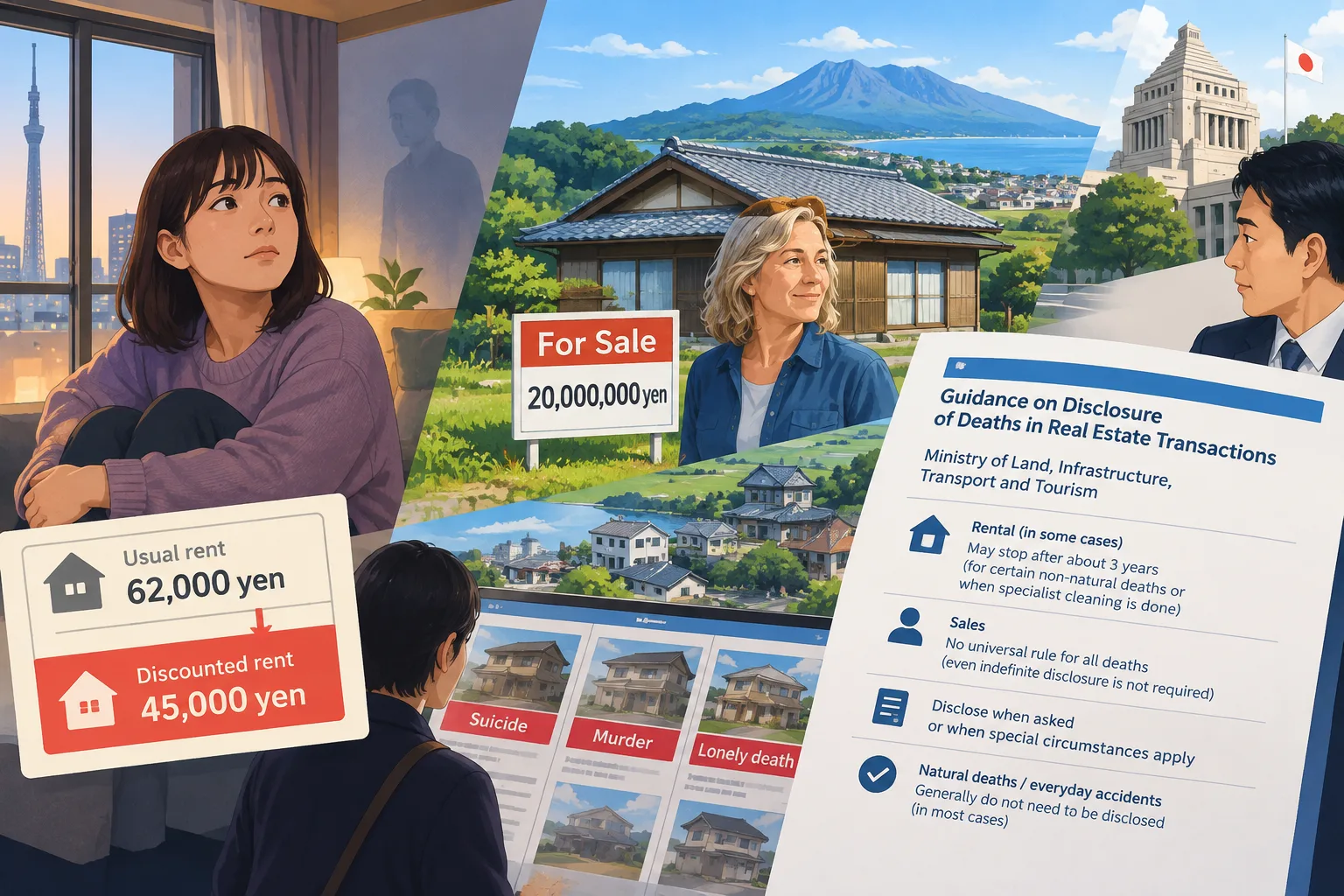
Tokyo entertainer Ryua told the BBC she moved into her flat after being told a previous occupant had died by suicide. She says she pays 45,000 yen a month, almost 30% below the usual rent of 62,000 yen, and describes hearing footsteps and a voice in the apartment. Her account of paranormal activity is her own experience.
In rural Kagoshima, American resident Diane Tincher bought a three-bedroom house for 20 million yen after learning that an elderly woman had died alone there. The BBC reported that similar homes in the area can sell for up to 45 million yen. Tincher said she did not believe in ghosts but was grateful for the affordable home.
Japan’s Ministry of Land, Infrastructure, Transport and Tourism issued guidance for estate agents in October 2021. It sets different disclosure expectations according to the circumstances and type of transaction. In some rental cases involving a death other than natural causes or an everyday accident, or a death followed by specialist cleaning, agents may generally stop disclosing the information after about three years, subject to exceptions. The guidance does not set a universal three-year rule for all deaths or an indefinite disclosure requirement for every sale.
The guidance also says agents may need to disclose information when a prospective buyer or tenant asks, or when special circumstances make it important to their decision. Natural deaths and deaths from everyday accidents generally need not be disclosed, unless, for example, the body was left undiscovered for a long time and specialist cleaning or major renovation followed.
The BBC reports that homes with a history of suicide, murder or a lonely death can be difficult to rent or sell in Japan. Estate agent Erik Oskamp told the broadcaster that some renters are also deterred by homes near cemeteries. The lower prices can therefore appeal to people who do not share those concerns—or who are prepared to accept the property’s history in exchange for a cheaper home.
How do we know?
3 listed sources · explore evidence, limitations and provenance.
Sign in to give this article a thumbs up or down.
About this discussion and AI questions
Private test discussion. Comments are readers’ views and are not yet automatically fact-checked. Editing is available for 60 seconds after posting.
Sign in with a confirmed reader account and choose a username to read comments and participate.
Sorting applies to top-level comments; replies remain oldest first. New comments and likes can change the order. Refresh for the current ranking.
Loading comments…