News Made Clear · Loading…
Category
Regions
Continents
Topics
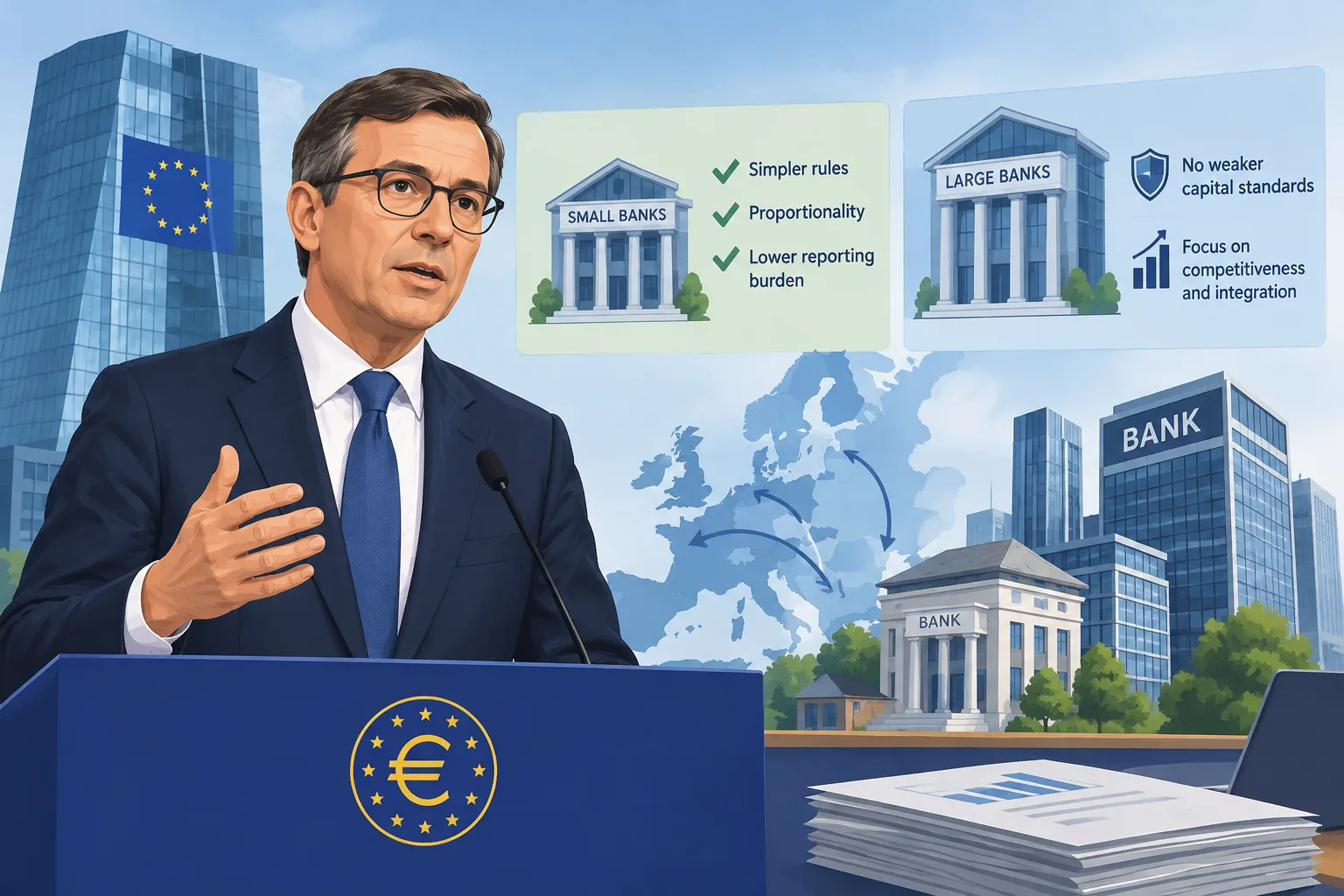
ECB official urges simpler rules for small banks, rejects weaker capital standards
Loading statistics…
ECB Supervisory Board member Pedro Machado says Europe should ease the reporting and supervisory burden on smaller banks, but argues that weakening capital standards is not the answer to the competitiveness gap facing the sector.
Review information is loading.
Pedro Machado, a member of the European Central Bank’s Supervisory Board, has called for simpler, more proportionate rules for smaller banks while arguing that Europe should not weaken capital standards to improve the competitiveness of its largest lenders.
In a speech in Frankfurt on Tuesday, Machado said the bigger obstacle to European banks’ competitiveness was a market still divided along national lines. He pointed to technology’s rising fixed costs as a reason for banks to gain scale through cross-border integration or domestic consolidation, rather than looser regulation.
His remarks set out the ECB’s case for separating targeted simplification from demands to reduce capital requirements. Machado said smaller banks faced a disproportionate burden from compliance costs, while complex rules could also give larger banks more scope to exploit differences in how risks are measured.
Different banks, different demands
Machado cited ECB analysis of responses to a European Commission consultation, which grouped requests for change into five themes: simpler buffers and rules, proportionality, minimum capital requirements, external competitiveness and reporting burdens.
Among the largest banks, nearly a third of the issues raised concerned external competitiveness, particularly comparison with US peers; almost a fifth concerned minimum capital requirements. For small banks, nearly half of the issues concerned proportionality and more than a third reporting burdens, Machado said.
He argued that these are distinct concerns: small lenders want rules and reporting scaled to their size and risks, while many large banks are seeking relief from capital requirements. The analysis covered 100 of 217 respondents who had made a clear request for change, with each respondent weighted equally.
For smaller lenders, Machado outlined proposals to widen the existing category of small and non-complex institutions. Supervisors could raise the threshold for inclusion from €5 billion to as much as €10 billion in assets, and change the test of whether a bank is non-complex. The ECB estimates that up to 85% of less significant institutions could then qualify, around 150 more than today.
The proposals would also allow some smaller banks to go two to three years without a full supervisory review where their risk profile permits. From 2027, a dedicated reporting category could reduce the data points required from these banks from about 13,500 to roughly 700, Machado said. Supervisors would retain discretion to examine risks more closely when needed.
He stressed that lighter procedures should not mean weaker safeguards. Smaller banks face risks including cyber threats and climate change, he said, and proportionality should remain within the EU’s common rulebook and be backed by a credible crisis-management framework.
How do we know?
1 listed sources · explore evidence, limitations and provenance.
Sign in to give this article a thumbs up or down.
About this discussion and AI questions
Private test discussion. Comments are readers’ views and are not yet automatically fact-checked. Editing is available for 60 seconds after posting.
Sign in with a confirmed reader account and choose a username to read comments and participate.
Sorting applies to top-level comments; replies remain oldest first. New comments and likes can change the order. Refresh for the current ranking.
Loading comments…