News Made Clear · Loading…
Category
Regions
Continents
Topics
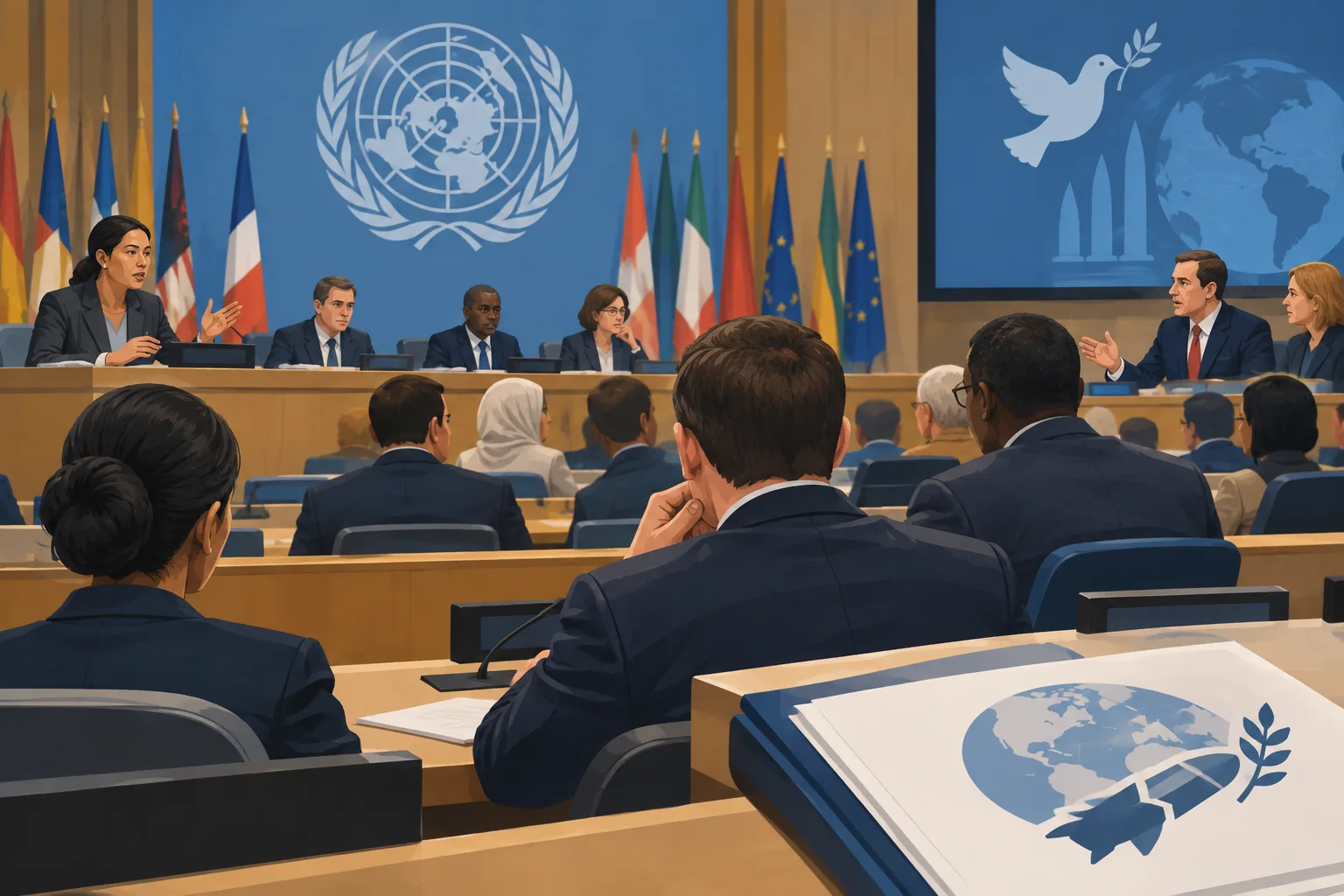
UN disarmament debate exposes divide over political will and procedural reform
Loading statistics…
UN delegates blamed political divisions for years of stalled disarmament work, while disagreeing over whether the rules themselves are also part of the problem. The United States urged the First Committee to make annual resolutions the exception rather than the norm.
Review information is loading.
The UN’s disarmament bodies are failing to make progress because of a lack of political will, rather than flaws in their procedures, several delegates told the General Assembly’s First Committee on Monday. Others argued that institutional rules, including the use of consensus, were helping to block action.
The debate exposed sharp disagreement over how to revive the system and whether it should be reformed. The United States also called for annual resolutions to become the exception, arguing that the committee should focus on fewer, more substantive decisions.
The three main parts of the UN disarmament machinery have struggled to deliver results. The Conference on Disarmament has not produced a new disarmament instrument in three decades and, in 2026, failed to agree on a programme of work or establish subsidiary bodies. The UN Disarmament Commission did not adopt its substantive agenda, complete its planned work or issue recommendations during its 2024–2026 cycle.
Indonesia, speaking for the Non-Aligned Movement, said the broader crisis reflected insufficient political will, particularly on nuclear disarmament. Nepal’s delegate also said the main obstacle was a lack of trust and commitment among member states, rather than institutional or procedural constraints.
Pakistan defended the existing framework, arguing that it had produced landmark agreements when governments had the political will to reach them. Cuba likewise backed the Conference on Disarmament’s consensus-based procedures, while urging states to begin substantive negotiations.
Brazil took the opposing view, saying consensus was increasingly being used to obstruct progress and urging a review of how it is applied to procedural decisions. The European Union, represented as an observer, said the Conference’s job was to negotiate, not deliberate indefinitely, and called for practical improvements to its working methods.
Access for observers was another point of contention. The Conference received 33 participation requests from non-member states in 2026 but invited only 18. Several delegates criticised the blocking of observer participation, with objections attributed to Russia. Russia’s representative, in turn, accused Western states of advancing their own political aims in disarmament forums while ignoring others’ security concerns.
The United States called for shorter meetings and more focused agendas. Its representative questioned the value of the Disarmament Commission, saying it meets for three weeks each year but achieves little, and argued that annual First Committee resolutions should not be routine. France and Germany also proposed shorter speaking times and sessions, and limiting resolutions to those that introduce substantive changes.
Other delegates cautioned that streamlining must not weaken negotiations or exclude developing countries and smaller delegations. Proposals for easing the impasse included agreeing a programme of work for the Conference, setting up subsidiary bodies, negotiating a treaty to cut off production of fissile material, and considering a wider review of the disarmament machinery. Delegates also called for more inclusive participation and predictable funding for UN bodies and treaty implementation.
How do we know?
1 listed sources · explore evidence, limitations and provenance.
Sign in to give this article a thumbs up or down.
About this discussion and AI questions
Private test discussion. Comments are readers’ views and are not yet automatically fact-checked. Editing is available for 60 seconds after posting.
Sign in with a confirmed reader account and choose a username to read comments and participate.
Sorting applies to top-level comments; replies remain oldest first. New comments and likes can change the order. Refresh for the current ranking.
Loading comments…