News Made Clear · Loading…
Category
Regions
Continents
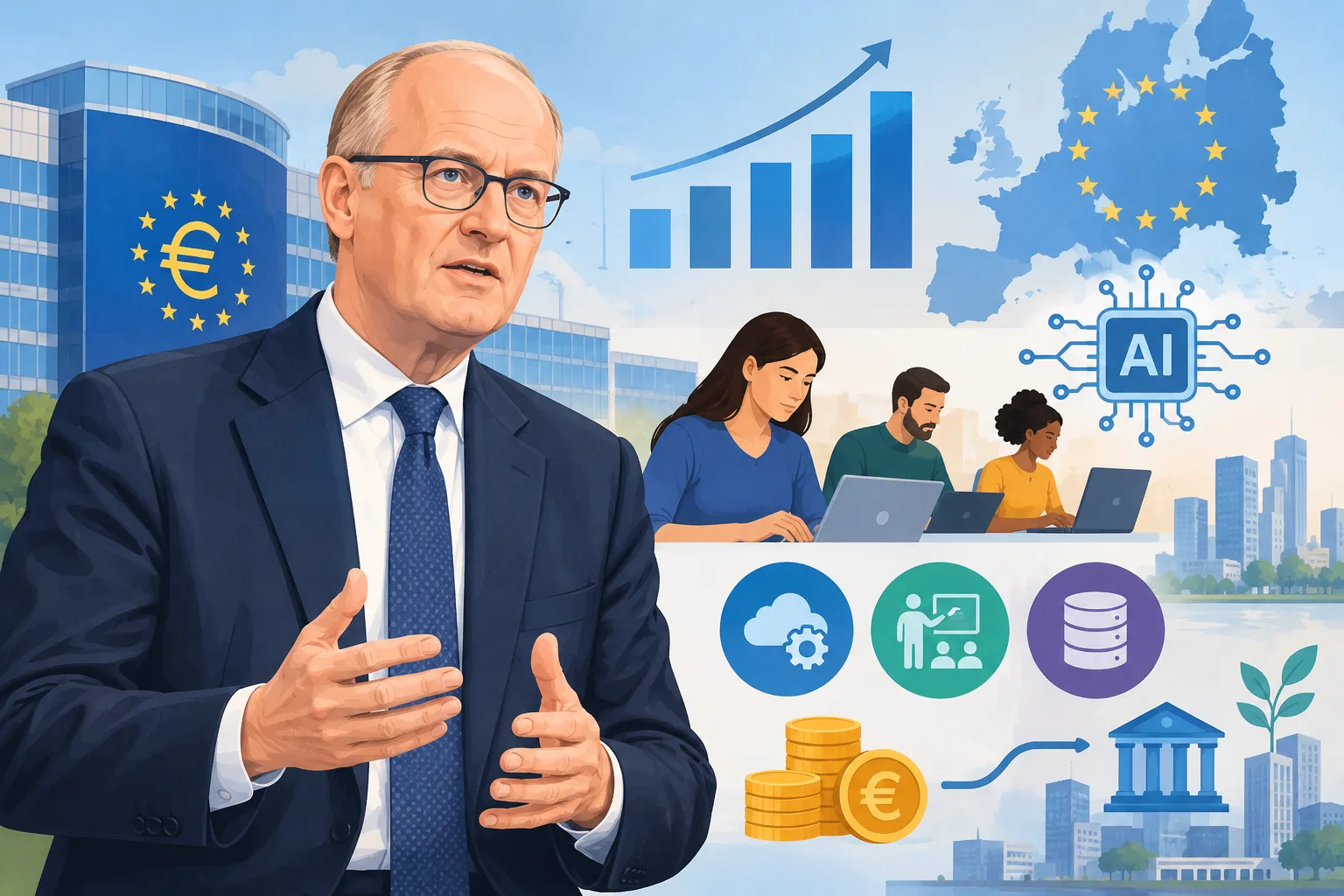
AI spending supports euro area activity, but long-term impact remains uncertain, ECB says
Loading statistics…
AI spending is supporting euro area activity and adoption is spreading among firms and workers, ECB board member Philip Lane said. But the bank says the scale and timing of AI’s wider economic impact remain uncertain.
Review information is loading.
Artificial intelligence is already contributing to euro area economic growth, but its longer-term impact remains uncertain, European Central Bank Executive Board member Philip Lane said in a speech on Friday.
Lane said spending on AI adoption was supporting current economic activity and that European firms were part of the global supply chain. The speech, delivered at a Federal Reserve Bank of San Francisco symposium, draws on ECB surveys and economic data to examine how AI is affecting businesses, workers and financial markets.
Digital investment in the euro area rose by 73% in real terms between 2014 and 2024, reaching 3% of gross domestic product, according to the ECB. The bank estimates that it rose to 3.3% by the first half of 2026, while noting that the latest estimate uses an output-based proxy. US digital investment reached 7.3% of GDP in the same period.
The ECB’s surveys suggest AI use is spreading, though adoption varies. In its Consumer Expectations Survey, 52% of workers said they used AI at work in 2026, double the 26% recorded in 2024. Lane noted that this measure is towards the high end of estimates from other surveys; Eurostat data, for example, show that 32.7% of people aged 16 to 74 in the EU used generative AI tools in 2025.
Among workers using AI, the median respondent said it saved three hours a week. The ECB cautioned that reported savings were uneven: most users described moderate gains, while a small number reported much larger ones. Workers most often cited improving business processes as a reason for using AI, rather than reducing labour costs.
Businesses are also investing in the technology. In the ECB’s latest Survey on the Access to Finance of Enterprises, covering the second quarter of 2026, firms planning AI investment most commonly expected to spend on software and other tools, employee training, and data or infrastructure. The survey found that 49% planned to invest in AI tools, 46% in training and 40% in data and infrastructure; respondents could select more than one option.
Lane said the financial system was responding to AI-related funding needs, while internal funds remained the main source of finance for most firms. ECB estimates suggest AI-related lending accounted for about 0.9 percentage points of annual euro area credit growth in the first quarter of 2026, around a quarter of the total. The bank also found that AI-exposed firms had lower borrowing spreads and higher equity returns, but warned that the results could partly reflect investor optimism that proves unwarranted.
The speech also identifies risks and limits to the evidence. AI-related investment and adoption are unevenly distributed, and the ECB said the timing and scale of any economy-wide transformation remain highly uncertain. Lane said the bank would continue monitoring the technology’s effects on the euro area.
How do we know?
1 listed sources · explore evidence, limitations and provenance.
Sign in to give this article a thumbs up or down.
About this discussion and AI questions
Private test discussion. Comments are readers’ views and are not yet automatically fact-checked. Editing is available for 60 seconds after posting.
Sign in with a confirmed reader account and choose a username to read comments and participate.
Sorting applies to top-level comments; replies remain oldest first. New comments and likes can change the order. Refresh for the current ranking.
Loading comments…