News Made Clear · Loading…
Category
Regions
Continents
Topics
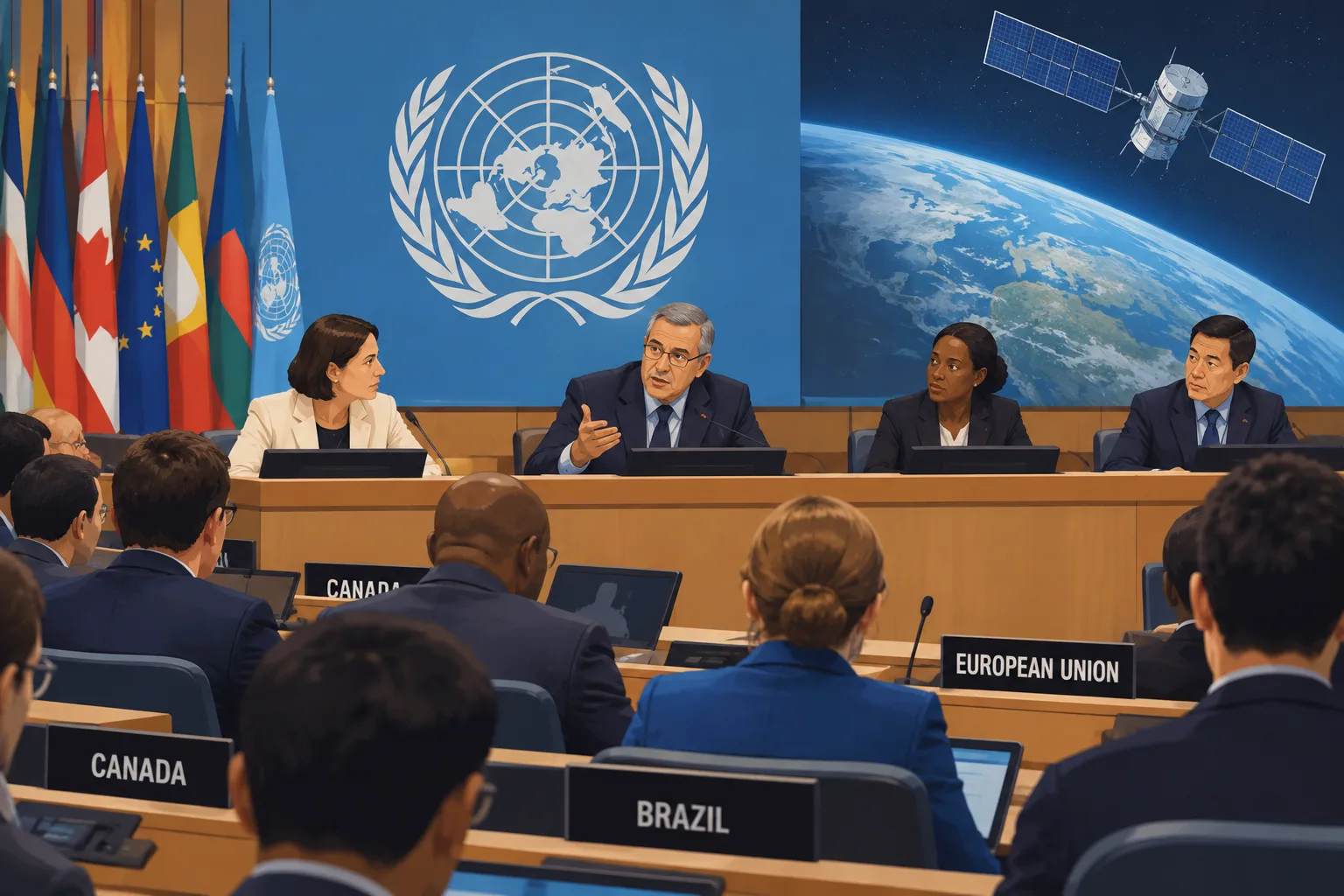
Geopolitical tensions hinder UN space committee’s work, delegates say
Loading statistics…
Delegates told a UN General Assembly committee that geopolitical tensions are complicating cooperation on space, after its specialist committee failed to agree on a substantive report at its latest session.
Review information is loading.
Delegates at a UN General Assembly committee have warned that geopolitical tensions are making it harder to reach agreement on space issues, even as they called for transparency and continued international cooperation.
The debate on the peaceful uses of outer space took place on 27 October in the Fourth Committee, which heard the annual report of the UN Committee on the Peaceful Uses of Outer Space (COPUOS). The UN account said the committee’s latest session had struggled to reach consensus on substantive matters.
Canada’s representative, speaking for Australia and New Zealand, described it as the most challenging session in recent memory. She said negotiations over its report had been exceptionally difficult and that geopolitical tensions were complicating decisions even in technical forums. The committee did not adopt a substantive report at its latest session, according to China’s representative, who blamed one country for putting its own position above that of other members.
The UN account does not identify that country in the report of China’s remarks. The European Union separately criticised a Russian-backed draft resolution on space science, arguing that it duplicated existing work and raised security questions in a forum not suited to address them. The accounts record competing positions among delegates; they do not establish a single explanation for the breakdown in consensus.
Calls for transparency and cooperation
COPUOS chair Mario Cospito said the committee continued work on long-term sustainability, information-sharing between satellite operators and draft principles for space-resource activities. A new action team on lunar activities had begun developing recommendations on information-sharing, exchange and consultation, he said.
Cospito described the Moon as “no longer merely a destination” but a place of emerging activities, and stressed the need for dialogue and transparency. Canada’s representative also pointed to the lunar action team as a positive result despite the difficulties. She said strengthening the committee’s effectiveness should not mean changing its fundamental character.
Delegates also raised questions about access to the benefits of space activity. Brazil’s representative criticised the omission of the term “developing countries” from reports by the committee’s two subcommittees, arguing that removing it would not address unequal access to space technology. Speakers from Pakistan, Cyprus, Senegal and the Philippines highlighted the role of peaceful space activities in development.
The European Union called the 1967 Outer Space Treaty and related agreements the cornerstone of global space governance. Its representative cited the treaty’s restrictions on placing nuclear weapons or other weapons of mass destruction in orbit, on celestial bodies or elsewhere in space. He also raised concerns about close approaches between satellites and what he called the pursuit and harassment of other satellites.
How do we know?
1 listed sources · explore evidence, limitations and provenance.
Sign in to give this article a thumbs up or down.
About this discussion and AI questions
Private test discussion. Comments are readers’ views and are not yet automatically fact-checked. Editing is available for 60 seconds after posting.
Sign in with a confirmed reader account and choose a username to read comments and participate.
Sorting applies to top-level comments; replies remain oldest first. New comments and likes can change the order. Refresh for the current ranking.
Loading comments…