News Made Clear · Loading…
Category
Regions
Continents
Leaked records raise questions about testimony in Abramovich oil case
Loading statistics…
Investigators say leaked records may conflict with Eugene Tenenbaum’s evidence in a 2008 oil-venture case. The judgment confirms what he told the court, while limiting what the reported discrepancy implies about its ruling.
Review information is loading.
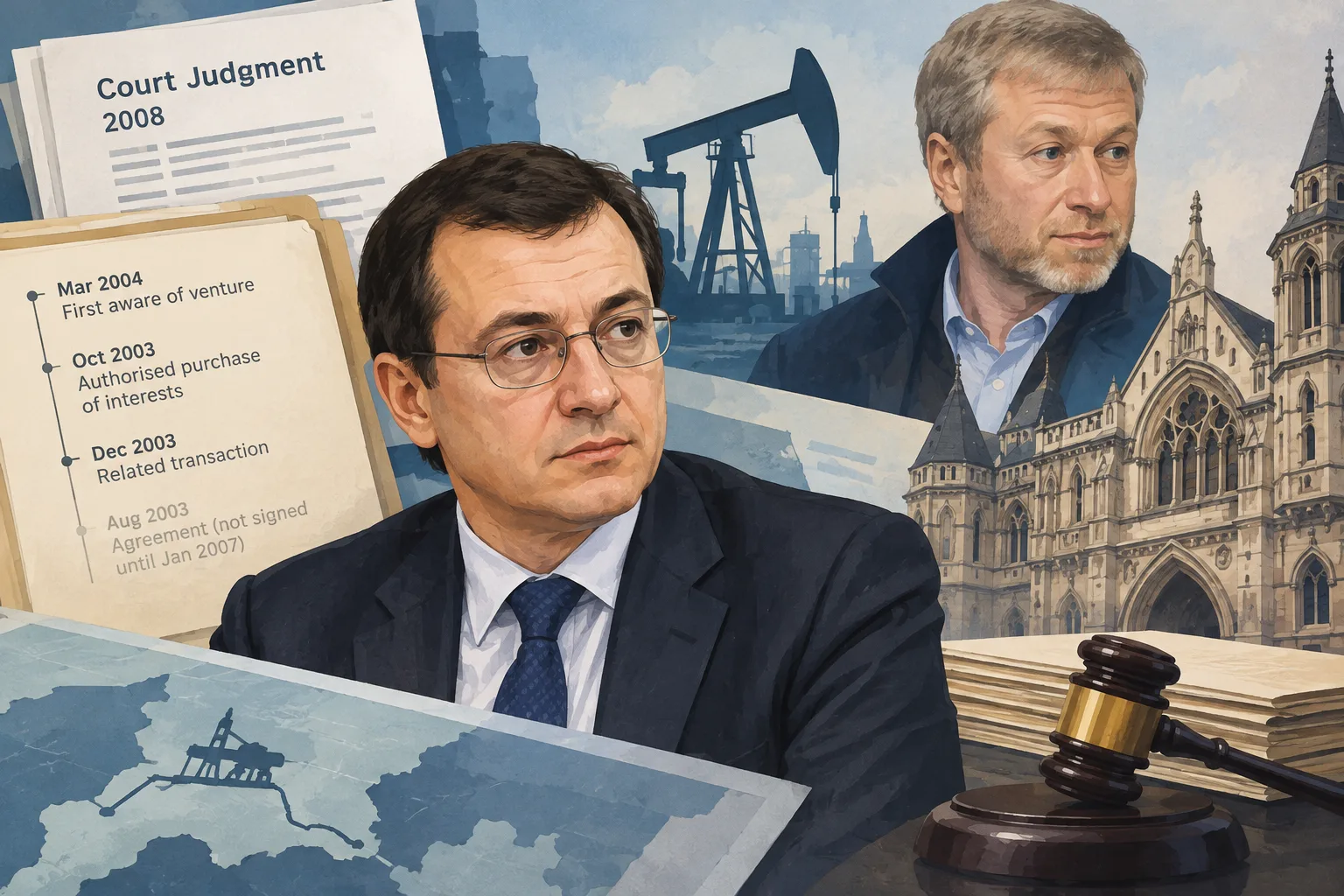
BBC Panorama and the Bureau of Investigative Journalism say leaked records may contradict evidence given by Eugene Tenenbaum, a close associate of Roman Abramovich, in a 2008 High Court case over the Sibneft-Yugra oil venture. The original judgment records what Tenenbaum told the court, but also shows why a possible conflict in his evidence does not, by itself, establish that the case would have ended differently. [1] [2] [3]
The judgment records Mr Tenenbaum as saying he first became aware of Sibneft-Yugra in spring 2004. It also quotes his statement that he had searched his files and emails from 2002 to 2004 and held no records or communications relating to it. The BBC reports that leaked documents show him authorising Abramovich’s purchase of interests in the venture in October 2003, followed by another related transaction two months later. If those authorisations are accurately described, they raise a question about when Tenenbaum first knew of the venture; they do not establish that he deliberately misled the court. [1] [2]
The Bureau also reports that an agreement dated August 2003 was not signed until January 2007. The Guardian reported that Tenenbaum’s lawyers said a transaction could sometimes legitimately be recorded as taking effect earlier. Forensic accountant Rachel Sexton told the Guardian that this was possible in principle, though she did not think it explained the evidence she had seen. The 2008 judgment had itself noted dating questions about documents bearing a date before the companies concerned were incorporated, without finding that they were forged. [2] [3] [4]
The dispute was substantial. The judgment records Yugraneft’s interest in the venture falling from 50% to 0.98% after capital issues in 2002–03. Yugraneft alleged fraud directed by Abramovich and claimed at least $2bn in losses, according to the judgment. BBC News described that amount as approximately £1bn in 2008. That was a claim, not an award of damages.
How do we know?
4 listed sources · explore evidence, limitations and provenance.
Sign in to give this article a thumbs up or down.
About this discussion and AI questions
Private test discussion. Comments are readers’ views and are not yet automatically fact-checked. Editing is available for 60 seconds after posting.
Sign in with a confirmed reader account and choose a username to read comments and participate.
Sorting applies to top-level comments; replies remain oldest first. New comments and likes can change the order. Refresh for the current ranking.
Loading comments…