News Made Clear · Loading…
Category
Regions
Continents
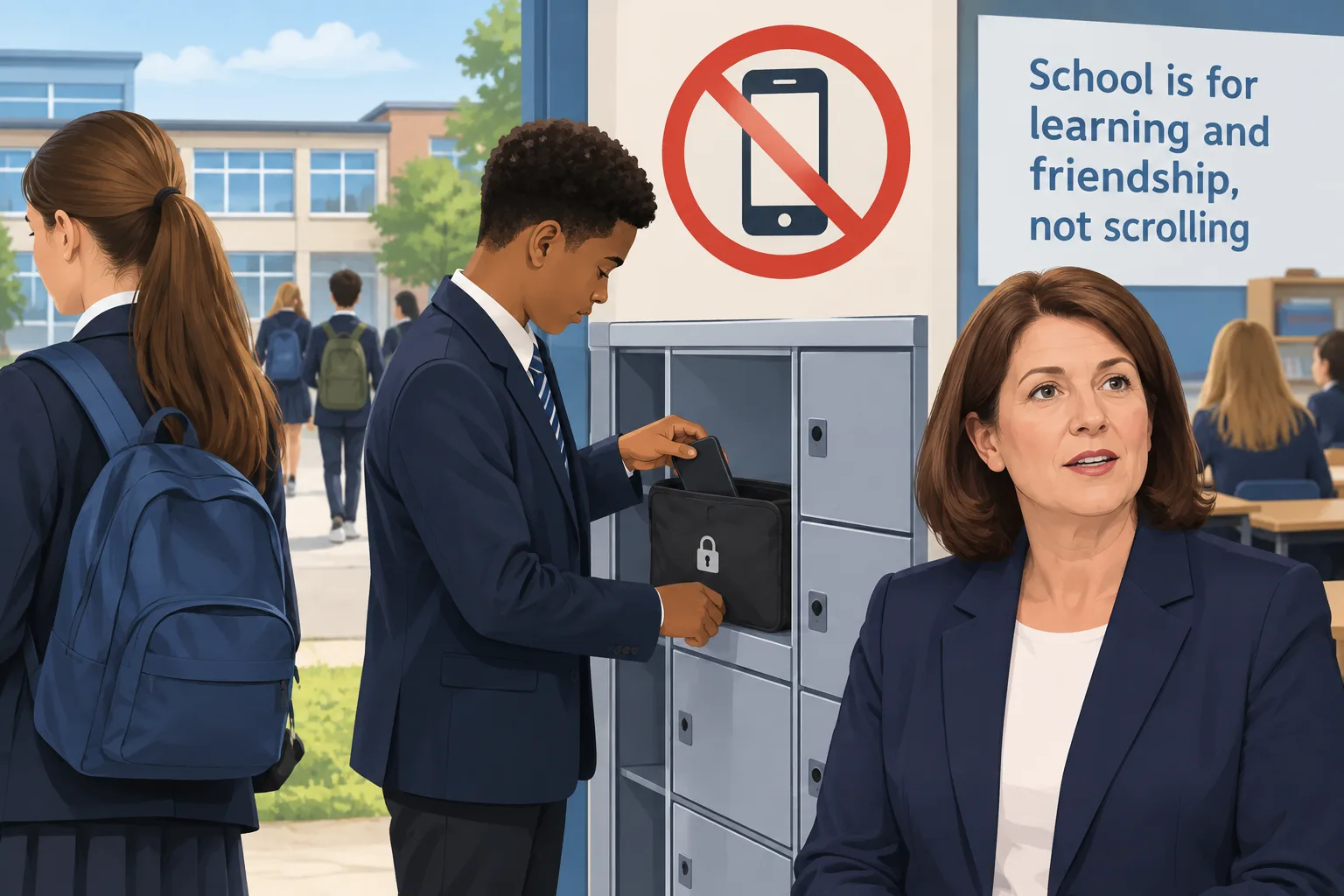
England schools to stop pupils carrying phones under tougher rules
Loading statistics…
England’s schools will be expected to keep pupils’ phones out of bags and pockets during the school day from September 2027. Schools can choose how to enforce the tougher guidance, while school leaders warn that secure storage could require government funding.
Review information is loading.
Schools in England will be expected to stop pupils carrying mobile phones in their bags or pockets during the school day under tougher government guidance due to take effect in September 2027. The change goes beyond rules that allow phones to be kept out of sight and switched off, but leaves schools to decide how to enforce it.
Statutory guidance introduced in June already makes schools and trusts legally responsible for keeping schools phone-free throughout the day. The government says revised guidance will rule out “no see, no hear” policies, under which pupils may keep phones in their bags if they are not seen or heard.
Schools can choose how to comply. Some use lockable pouches or secure lockers; others collect phones at the start of the day or ban them from school sites. The BBC previously reported on [the phone restrictions coming into force in English schools](https://www.bbc.co.uk/news/articles/cy8wjv3x81qo).
Education Secretary Lucy Powell said the government’s message to parents and pupils was that “school is for learning and friendship, not scrolling”. The government says access to phones risks distracting children from learning and one another.
School leaders’ unions welcomed greater clarity but warned that secure storage could be costly. Paul Whiteman, general secretary of the NAHT, said stronger measures would “come at a cost”. Pepe Di’Iasio, head of the Association of School and College Leaders, said it would not be feasible to provide lockable pouches or other secure storage for every pupil without government funding.
The Children’s Commissioner for England, Dame Rachel de Souza, welcomed action to prevent phones disrupting the school day. Campaign group Generation Focus also backed the change. Its co-founder Charlotte Ashton said existing “no see, no hear” policies were not working.
The rules apply to England. Education is devolved, and approaches differ elsewhere in the UK: Scotland is consulting on restrictions, Wales has no national statutory classroom ban, and Northern Ireland has consulted on whether to ban phones by law.
How do we know?
1 listed sources · explore evidence, limitations and provenance.
Sign in to give this article a thumbs up or down.
About this discussion and AI questions
Private test discussion. Comments are readers’ views and are not yet automatically fact-checked. Editing is available for 60 seconds after posting.
Sign in with a confirmed reader account and choose a username to read comments and participate.
Sorting applies to top-level comments; replies remain oldest first. New comments and likes can change the order. Refresh for the current ranking.
Loading comments…