News Made Clear · Loading…
Category
Regions
Continents
Topics
Children’s services vary sharply by area in England, commissioner warns
Loading statistics…
England’s Children’s Commissioner says where children live can shape their access to health, education and youth services, and is urging national standards and an emergency improvement fund.
A new report from England’s Children’s Commissioner says children’s chances of receiving good services vary sharply by where they live, with differences that cannot be explained by deprivation alone. Dame Rachel de Souza is calling for national minimum standards and an emergency fund to improve provision in struggling areas. [1]
Her report, *The Childhood Lottery*, compares more than 100 measures covering health and social care, education, safety and play. It describes services as being in a “state of emergency” and says the gaps amount to a “postcode lottery”.
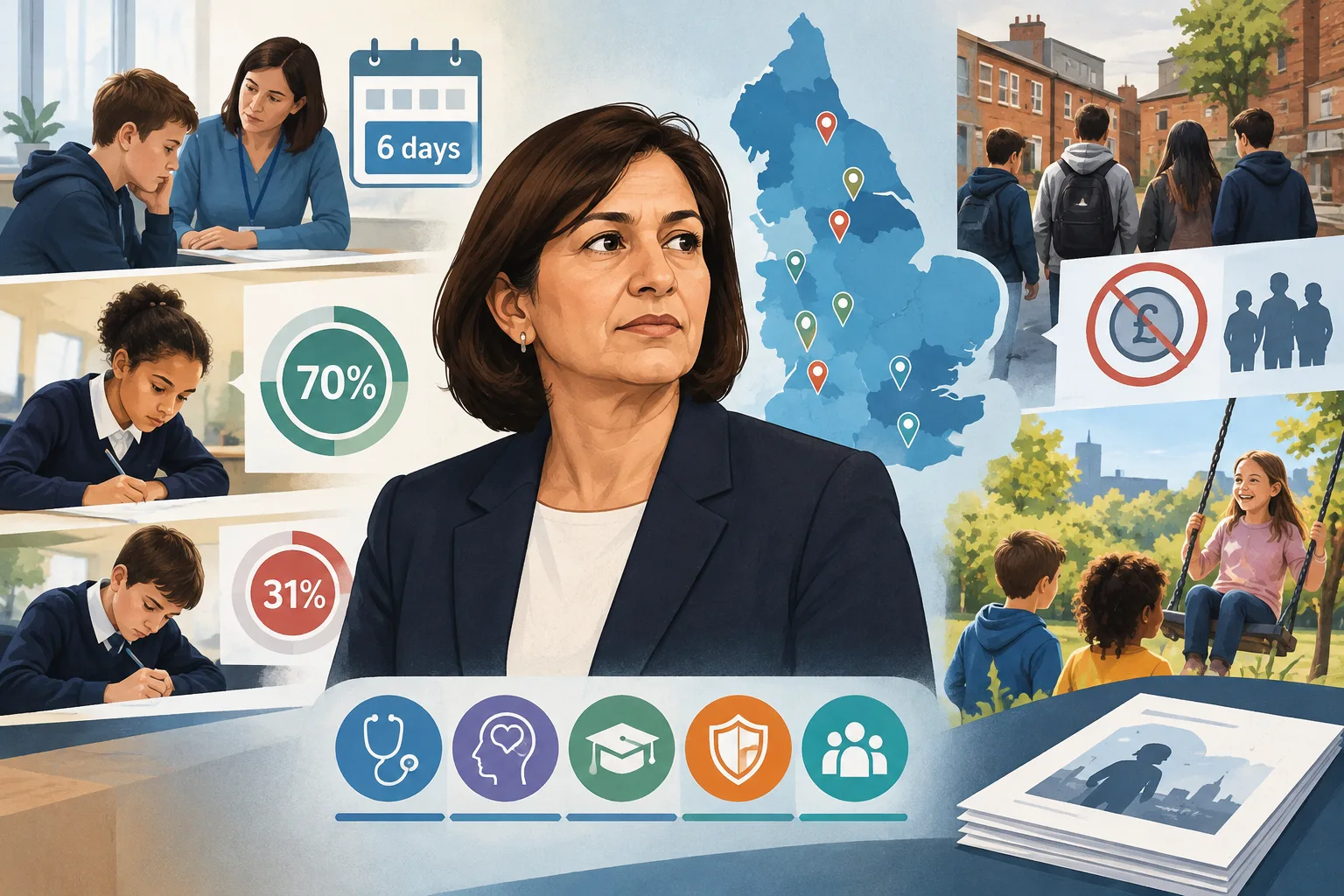
The figures illustrate the scale of the differences. Children waited an average of six days for a mental health assessment in Leicester, compared with 118 days in Hampshire and the Isle of Wight. In Richmond upon Thames, 70% of pupils achieved good grades in English and maths GCSEs, against 31% in Knowsley. The report also says that, in four council areas, spending on youth services per teenager was zero.
The commissioner’s analysis ranked Middlesbrough, Hounslow, Bradford, Nottingham, Halton, Peterborough, Leicester, Liverpool, Sunderland and Medway among the hardest places in England to grow up. Cheshire East, Merton, Surrey, Richmond upon Thames, Hertfordshire, Cheshire West and Chester, Haringey, Leicestershire, Central Bedfordshire and Wokingham were rated among the least challenging.
Deprivation did not always correspond to weaker services: Haringey scored well despite high deprivation, while Cambridge, among England’s least deprived areas, ranked lower. De Souza said she had previously resisted reducing the issue to funding, but that the extent of failure was too great.
She wants larger local authorities and strategic authorities, including areas with mayors, to have a deputy mayor for children responsible for assessing how policies affect young people. Her proposals also include minimum standards for the impact of education, policing, health and youth services on children.
The report says more than one million children were referred to mental health services in 2024-25; 55% did not achieve a good standard in English and maths GCSEs; and 12% said they did not feel safe in their local area. It also reports that one million people aged 16 to 24 across the UK were not in employment, education or training.
How do we know?
1 listed sources · explore evidence, limitations and provenance.
Sign in to give this article a thumbs up or down.
About this discussion and AI questions
Private test discussion. Comments are readers’ views and are not yet automatically fact-checked. Editing is available for 60 seconds after posting.
Sign in with a confirmed reader account and choose a username to read comments and participate.
Sorting applies to top-level comments; replies remain oldest first. New comments and likes can change the order. Refresh for the current ranking.
Loading comments…