News Made Clear · Loading…
Category
Regions
Continents
Medetomidine reports rise in US drug supply, complicating overdose care
Loading statistics…
US drug-lab reports increasingly identify a sedative mixed with fentanyl. It can make overdoses harder to treat, but health officials say naloxone remains essential when opioids may be involved.
Review information is loading.
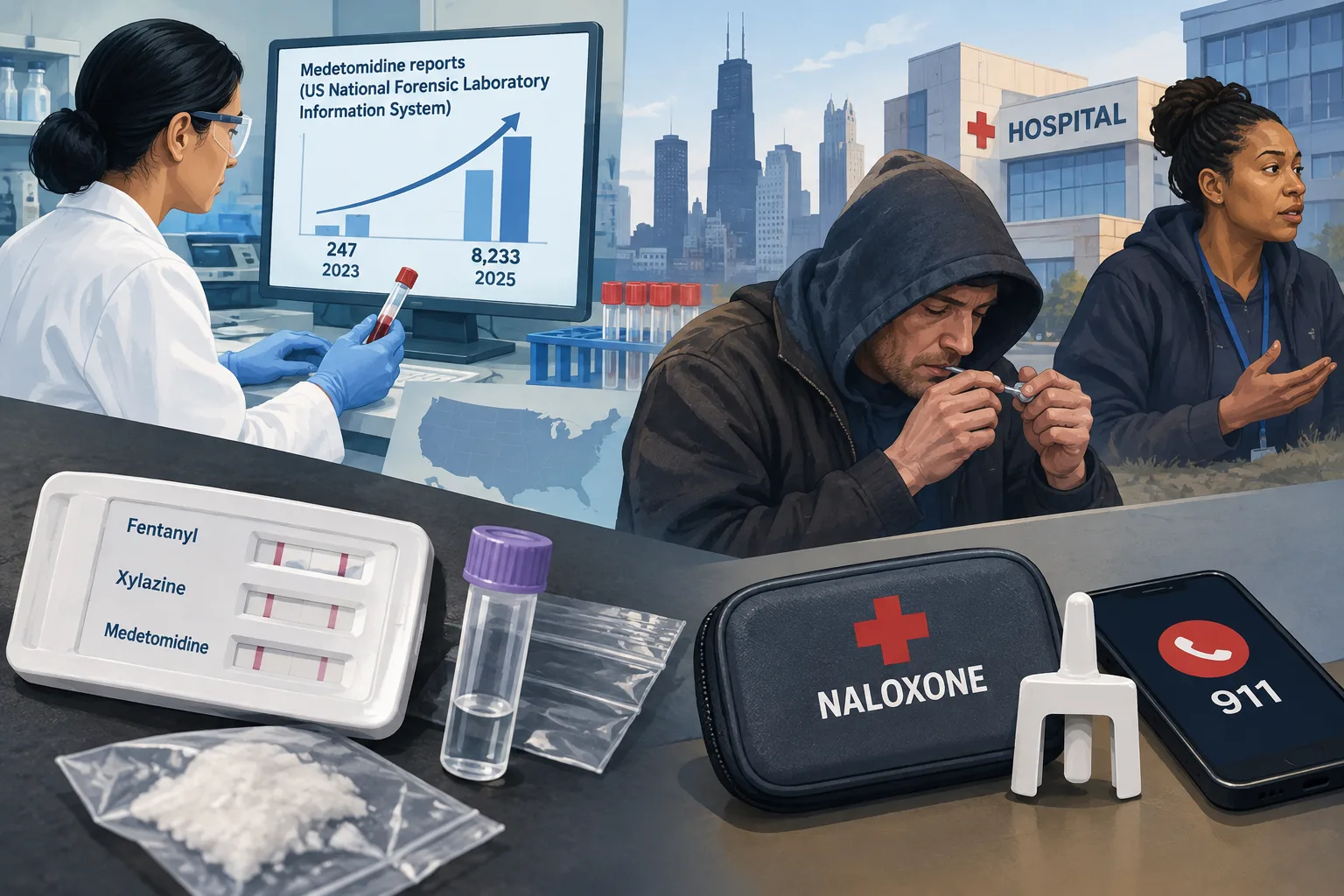
Reports of medetomidine in the US National Forensic Laboratory Information System rose from 247 in 2023 to 8,233 in 2025, according to the Centers for Disease Control and Prevention (CDC). The sedative is often found mixed with illicit fentanyl and can complicate an overdose. Those figures count laboratory reports, not overdoses or the proportion of drugs containing it. Overall US overdose deaths have fallen: the BBC puts the toll at about 70,000 in 2025, down from roughly 110,000 in 2022. [4] [1]
The danger is documented in Chicago. During one week in May 2024, the city’s health department and the CDC identified 12 confirmed and 26 probable overdoses involving medetomidine and opioids among patients at three hospitals on the West Side. Every blood specimen and drug sample in that investigation that tested positive for medetomidine also contained fentanyl. [3]
A BBC report from Ohio and Illinois describes the uncertainty facing people who use street drugs. In Columbus, it watched a man called Mike smoke what it described as fentanyl. The BBC said one drug kit he brought for testing was positive for medetomidine, though that result does not establish what was in the dose he smoked. Near Chicago, recovery worker Karen Bell told the BBC that “so many things are being mixed in right now”, describing wounds and withdrawal symptoms among people she helps. [1]
A published test of a Chicago sample dated 4 June 2026 identified fentanyl and xylazine among its main substances, with medetomidine present at trace levels. But a single sample cannot show how common that mixture is. The CDC likewise cautions that its testing across 20 US sites used convenience samples that cannot provide representative local or regional rates. [2] [4]
The BBC suggested naloxone would probably not have worked on Mike. How he would have responded is unknown. Naloxone does not reverse medetomidine’s effects, the CDC says, but it remains crucial when an opioid overdose is suspected because it can reverse the opioid component. The agency advises giving naloxone and calling 911.
How do we know?
4 listed sources · explore evidence, limitations and provenance.
Sign in to give this article a thumbs up or down.
About this discussion and AI questions
Private test discussion. Comments are readers’ views and are not yet automatically fact-checked. Editing is available for 60 seconds after posting.
Sign in with a confirmed reader account and choose a username to read comments and participate.
Sorting applies to top-level comments; replies remain oldest first. New comments and likes can change the order. Refresh for the current ranking.
Loading comments…