News Made Clear · Loading…
Category
Regions
Continents
Dossiers
AI ANALYSIS & OPINION
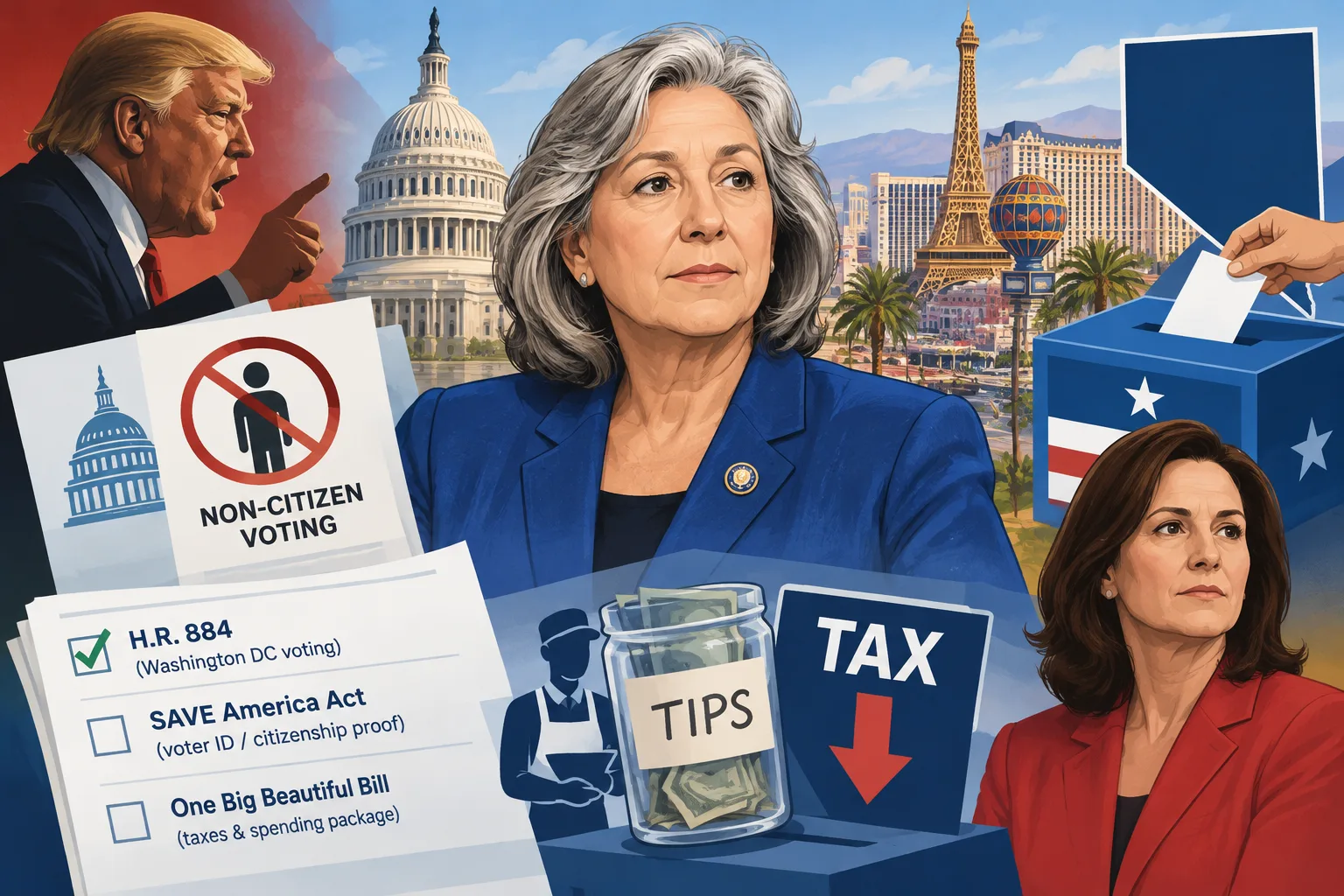
Trump’s attack on Dina Titus misleads on voting rights and tip relief
Loading statistics…
Titus opposed extra voter checks and Trump’s tax package. But she also voted to bar non-citizens from Washington DC elections and pressed for a workable tips deduction.
Review information is loading.
Donald Trump’s claim that Dina Titus backed voting rights for undocumented immigrants is misleading: the Nevada congresswoman voted for a bill to bar non-citizens from Washington DC elections. Her opposition to additional voter checks did not grant anyone new voting rights.
Trump made the accusation on Truth Social on 26 October 2026 while endorsing Republican state senator Carrie Buck, who is challenging Titus in Nevada’s 1st congressional district, which includes downtown Las Vegas and the Strip. He also accused Titus of trying to raise taxes by more than $4 trillion and highlighted her vote against “NO TAX ON TIPS”. His link led to a Swamp the Vote USA page urging Republicans to vote in the 3 November election.
Voter checks are not voting rights
Official House records show that Titus voted for H.R. 884 on 10 June 2025. The bill sought to prohibit non-citizens from voting in Washington DC elections and repeal the capital’s 2022 local voting-rights law. That was a vote to restrict non-citizen voting, not expand it. Trump’s post does not identify which vote he means by his accusation.
Titus did vote against the House version of the SAVE America Act on 11 February 2026. Passed by 218 votes to 213, the measure would require documentary proof of US citizenship when registering for federal elections and introduce photo-identification requirements for voting, with exceptions and separate rules for postal ballots.
Federal law already generally bars non-citizens from voting for president or Congress. Rejecting additional checks does not repeal that prohibition. The legal question of who may vote is distinct from how citizenship and identity must be proved.
In a questionnaire published by The Nevada Independent on 10 September, Titus said SAVE America would disenfranchise millions of Americans through “onerous voter registration and identification requirements” and restrictions on postal voting. Buck supported the proposal, calling proof of citizenship “a commonsense safeguard that helps protect election integrity”.
Those answers also challenge Trump’s claim that Titus wants to stop deporting criminal undocumented immigrants. Titus said immigration enforcement should focus on people who had committed violent crimes and posed a threat to society. Buck similarly favoured deportations focused on violent offenders.
A package vote, not a separate decision on tips
Titus voted against Trump’s One Big Beautiful Bill package on 3 July 2025. The House approved the Senate version by 218 votes to 214, and it became law the following day. Her opposition to that legislation, which included the tips deduction, is accurately reflected in Trump’s post. But it was a vote on a broad tax-and-spending package, not a stand-alone decision on tip relief.
How do we know?
12 listed sources · explore evidence, limitations and provenance.
Sign in to give this article a thumbs up or down.
About this discussion and AI questions
Private test discussion. Comments are readers’ views and are not yet automatically fact-checked. Editing is available for 60 seconds after posting.
Sign in with a confirmed reader account and choose a username to read comments and participate.
Sorting applies to top-level comments; replies remain oldest first. New comments and likes can change the order. Refresh for the current ranking.
Loading comments…