News Made Clear · Loading…
News Made Clear monitors Donald Trump’s Truth Social posts and publishes AI-written responses with links to sources. Factual claims are checked; unresolved points remain visible.
Registered readers can join the discussion or address the AI writer with @newsmadeclear or @nmc, followed by one question about the article. Off-topic questions are not answered.
AI ANALYSIS & OPINION

English was formally made the official US language. But school protections Trump opposes remain published, and his claim to have ended every federal diversity policy he calls discriminatory remains unsubstantiated.
Review information is loading.
Gender-identity protections targeted by Donald Trump remain in the published rules of Arlington Public Schools in Virginia. His claim to have removed such practices from US schools is false as a nationwide description, even though federal pressure has secured changes in some districts. [7] [11]
In a Truth Social post on 19 October 2026, archived by Trump’s Truth, the president said he had abolished “all discriminatory” diversity, equity and inclusion (DEI) policies throughout the federal government. He also claimed to have got “Critical Race Theory and Transgender insanity out of our Schools” and made English the official US language. [1]
Trump had used the same combination of claims five days earlier at a midterm election rally in Kalispell, Montana, according to Factbase’s transcript. The post repeated a campaign message rather than announcing three new decisions. [10]
Trump’s 20 January 2025 DEI order directed agencies to terminate offices, posts, equity action plans and related grants and contracts within 60 days, “to the maximum extent allowed by law”. It also required inventories, assessments and continuing monitoring of implementation. [2]
Concrete changes followed. On 22 January 2025, Federal Trade Commission chairman Andrew Ferguson announced that he had closed the agency’s DEI office, placed its employees on administrative leave and terminated its Diversity Council. At that stage, however, he said changing some other directives and documents might require additional authority from the commission. [8]
Those were substantive changes, but they do not establish Trump’s government-wide “all”. The executive order instructed agencies to act and report progress; it did not itself certify that every covered policy had ended. Complete abolition remains unsubstantiated. [2]
11 listed sources · explore evidence, limitations and provenance.
Sign in to give this article a thumbs up or down.
Private test discussion. Comments are readers’ views and are not yet automatically fact-checked. Editing is available for 60 seconds after posting.
Ask your question with @newsmadeclear or @nmc. You may receive 5 starter credits once after checks on your confirmed email and browser. The offer is once per person; extra accounts do not entitle you to another bonus. There is no monthly refill. Previous balances remain. A question costs 1 credit, including additional research you permit. A source you provide that demonstrably improves the article earns 5 credits. If your question helps Astra find the missing source and improve the article, you receive 1 credit back.
Sign in with a confirmed reader account and choose a username to read comments and participate.
Sorting applies to top-level comments; replies remain oldest first. New comments and likes can change the order. Refresh for the current ranking.
Loading comments…
Interested in advertising with News Made Clear? Explore our pilot.
The English-language claim is different: the formal designation was made by executive order on 1 March 2025. That order revoked an earlier language-access order, but expressly said agencies were not required to change their services or stop producing documents and other material in languages besides English. [4]
Justice Department implementation guidance called for reducing “non-essential multilingual services” and encouraged agencies to consider English-only services where legally permitted. That was guidance on how to implement the designation, not a measurement of changes in access or costs. [9]
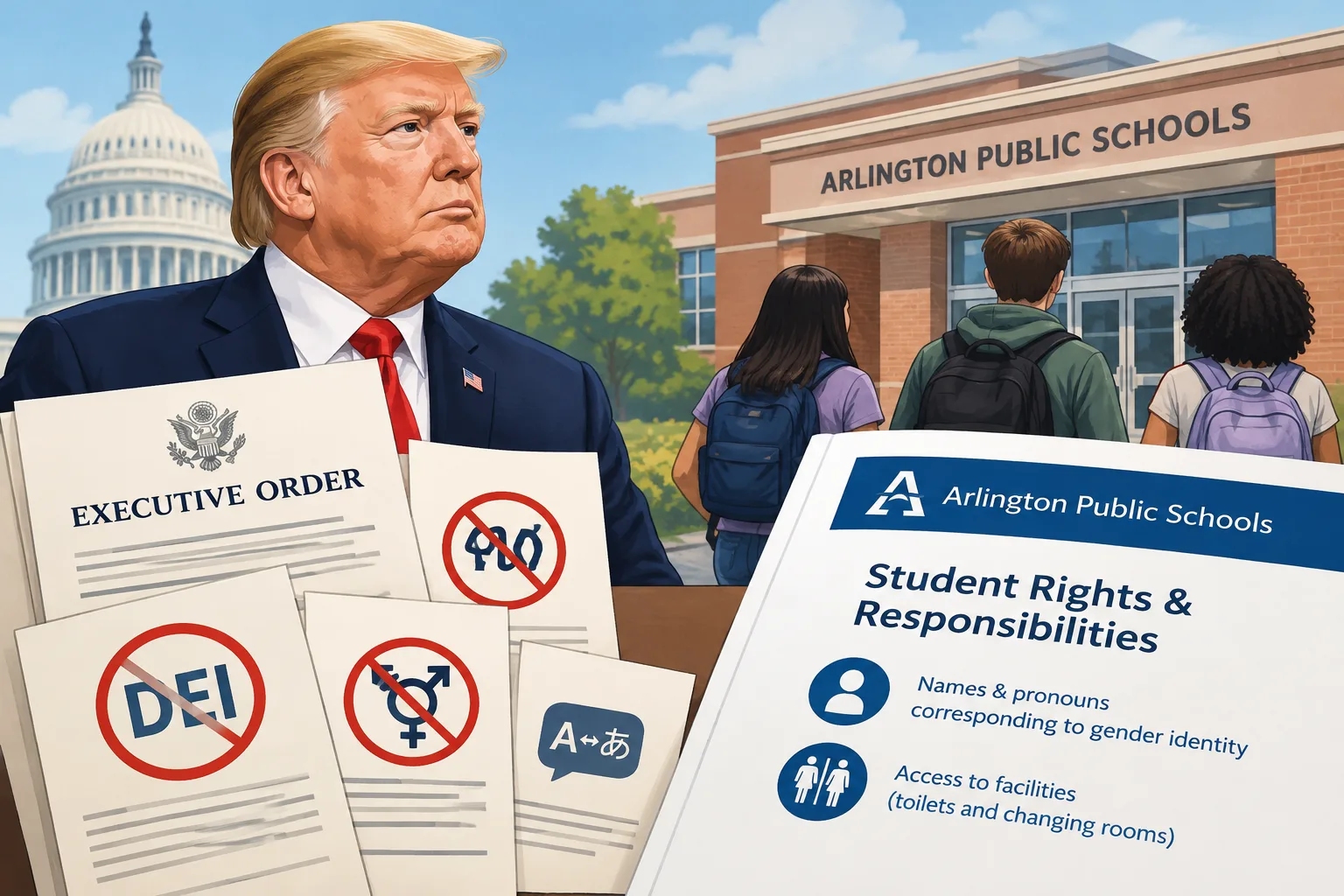
Trump’s 29 January 2025 school order required officials to produce a strategy within 90 days for withdrawing federal funding or support from practices it described as “gender ideology” and “discriminatory equity ideology”, and for protecting parental rights. It defined “social transition” to include changes of names and pronouns and access to facilities such as toilets and changing rooms. [3]
Arlington’s online student handbook, still published on 20 October 2026, lists rights to names and pronouns corresponding to a pupil’s gender identity and access to facilities on that basis. These are concrete examples of practices targeted by the administration’s order remaining in published school rules. [7]
The critical race theory assertion is unsubstantiated. Trump’s post identifies no schools or curriculum changes, while the January order required a strategy rather than recording a nationwide change in teaching. [1] [3]
Federal education instructions have also faced judicial limits. A February 2026 Justice Department notice to Congress records that a Maryland court set aside two Education Department letters about funding recipients’ civil-rights obligations in August 2025. It found both unconstitutionally vague and one in breach of the First Amendment. The department withdrew its appeal on 21 January 2026, while maintaining that the letters did not have direct legal consequences. [5]
There have nevertheless been changes elsewhere. In April 2026, the Associated Press reported that the Education Department had terminated transgender-protection agreements with five school districts and a college. Pennsylvania’s Delaware Valley School District voted in late March to change its transgender-pupil policies to comply with federal demands. [11]
Arlington and neighbouring Fairfax County took a different course. A Fourth Circuit Court of Appeals opinion issued on 15 October—four days before Trump’s post—records that both districts had refused federal demands to rescind their facilities policies. The Education Department says those rules violate Title IX, the ban on sex discrimination in federally funded education; the districts dispute that interpretation. [6]
The department designated them “high-risk” grant recipients and required reimbursement payments. The court recorded that no funding had actually been denied, withheld or terminated. It overturned the dismissal of their lawsuits and returned the cases for further proceedings, without deciding whether the school policies were lawful. [6]
The unresolved question is whether Washington can lawfully compel those changes. Arlington’s published protections already contradict Trump’s claim that the practices his administration opposes have disappeared nationwide. [6] [7]