Starlink as leverage: Russian diesel, private interests and Ukraine’s security
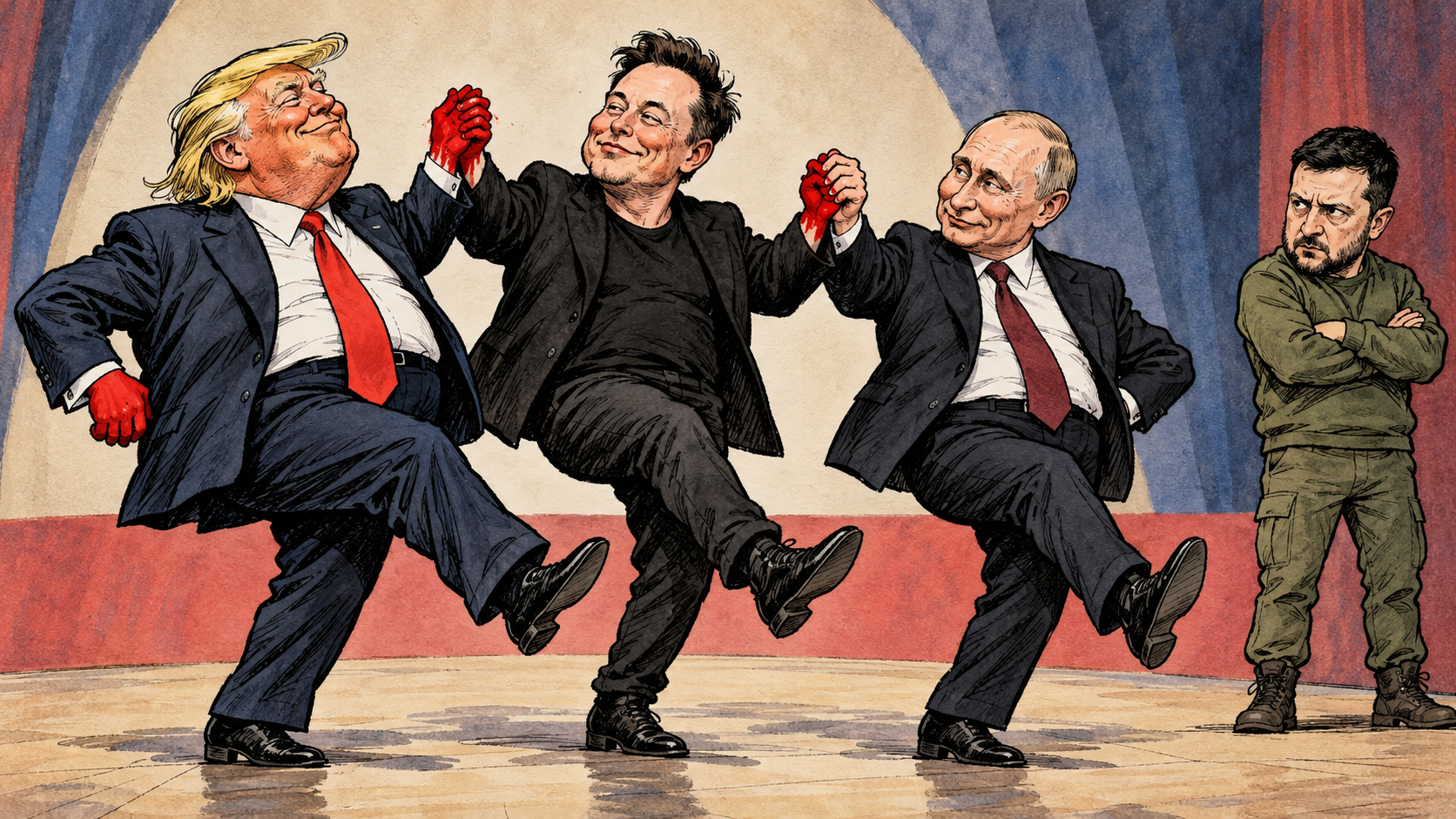
AI-generated political cartoon accompanying this investigation. Satirical illustration, not a news photograph or evidence of an actual meeting.
Loading statistics…
Ukrainian lives must not become bargaining chips. While Trump promises cheaper fuel and opens space for Russian diesel trade, restrictions affect satellite services used in Ukraine’s defence. Who controls the connections, who stands to gain, and who bears the risk? A critical examination of power, money and responsibility.
Restricting the connections Ukraine uses to fight Russian drones means intervening in the security of a country under attack. The consequences are concrete. According to AP, the Starshield restriction forced Ukrainian drones to fly more slowly, making them easier for Russian weapons to target or evade. Behind a technical setting lies a human reality: fewer effective ways to defend against attack. [1]
At the same time, Trump was pressuring Kyiv to stop striking Russian refineries and announcing trade in Russian diesel. Three anonymous officials told Reuters that the order to restrict the satellite service came from inside the White House; they did not identify an individual decision-maker. The Telegraph, citing four sources, reported that Musk proposed the restriction; one source said Trump agreed. Trump denied responsibility. Musk pointed to US government control. [2][3]
Ukraine bears the security risk of decisions it does not control. Trump and Musk must explain their roles, the risks accepted and whose interests took priority. For Zelenskyy, the issue is his country's ability to defend itself. For Ukrainian civilians, it is protection against the next attack. That should come before fuel-price promises and corporate arrangements.
What the restriction actually affected
Presidential adviser Serhii Beskrestnov said connections cut out above approximately 160 kilometres per hour: movement speed, not internet speed. He also said Starshield does not serve the drones attacking Russian refineries. The restriction therefore cannot be described as having demonstrably disabled those particular attacks. [1]
Starshield is SpaceX's offering for government and national-security users, with communications relying partly on Starlink infrastructure. A military contract changes the product and its terms; it does not automatically give Ukraine control over the network. Washington can hold decision-making authority while SpaceX remains operationally indispensable. That combination leaves Ukraine exposed. [4][5]
Reporting about a White House instruction and a Musk proposal points to a deliberate intervention. That is an inference from journalistic sources, not a finding based on a published order. The full decision-making chain and the risks assessed beforehand remain undisclosed. The available evidence also does not establish that this intervention caused particular civilian deaths.
How do we know?
53 listed sources · explore evidence, limitations and provenance.
Oil and gas revenues support Russia's state budget and its war against Ukraine. Restricting those revenues targets a material resource that helps Moscow keep fighting. Economic pressure on Russia's energy sector is therefore directly relevant to Ukraine's defence, even though no single military or economic strategy can be assumed to guarantee peace. [46]
Trump moved in the opposite direction in October. His administration opened space for Russian diesel trade while he urged an end to Ukrainian refinery strikes. The first announced shipment amounted to approximately 300,000 tonnes, or 2.25 million barrels. Trump made later volumes partly dependent on the condition of Russian refineries. His promise of cheaper fuel thus collided with Ukraine's efforts to weaken the aggressor economically. [9][10][38]
On 9 October, the US sanctions office OFAC issued General License 135, authorising specified Russian diesel transactions, including transactions related to imports into the United States, until 7 April 2027. It did not remove every other statutory import restriction. On 16 October, Trump also waived new sanctions and duties under the Graham Act, including duties targeting major buyers of Russian energy. Earlier measures under executive orders were expressly left intact. [7][8][32]
The political consequence is stark: Washington is removing trade barriers and planned pressure from a revenue source for Putin's war machine. That can give Moscow financial breathing room to keep fighting. Trump sells the policy as relief at American fuel pumps. Ukraine, meanwhile, is asked to ease economic pressure on the country attacking it. A president who squeezes a partner while opening commercial space for its aggressor must answer the charge that he is hollowing out that partnership.
Europe has moved to reduce dependence on Russian oil precisely to deprive Moscow of resources for the war. Its embargo on seaborne oil and petroleum products includes exceptions, including for pipeline supplies. [50] European households and businesses have meanwhile faced high energy costs arising from a combination of war, disruption, sanctions and market reactions. [51] Trump's exemptions work against that shared financial pressure. They do not erase Europe's efforts, but they undermine the coherence of the policy.
An announcement is not a delivery
On 15 October, Russian Deputy Prime Minister Alexander Novak told TASS that contracting, loading and chartering still had to take place, and that a first delivery to the United States would require at least two to three weeks. This is the Russian government's account, not an independently verified trade register. It nevertheless underlines why the announced trade must not be presented as revenue already received. [47]
The sources reviewed do not identify the specific diesel buyers, sellers, contract prices or completed payments. OFAC's licence does not name them either. The proposed Lukoil acquisition discussed below is a separate transaction: selling corporate assets is not an established contract to supply diesel to the United States. [8][16][17]
Trump's own words show how the pressure grew
The pressure on Ukraine was already building in September. The public record makes clear that Trump's criticism of refinery attacks did not begin only after his 9 October conversation with Putin. We examined the energy-price argument in our earlier article, “De oorlog die Trump uit de dieselprijs weglaat” (“The war Trump leaves out of the diesel price”). [53]
- On 8 September, Trump and Putin spoke for about an hour, according to Putin's adviser Yuri Ushakov. In that Russian account, Trump wanted a swift end to the war and restored relations. [48]
- On 13 September, Trump called on Ukraine to stop attacks on diesel facilities. The Kremlin welcomed the appeal the following day. Spokesman Dmitry Peskov simultaneously identified the Gulf crisis as the main reason for rising energy prices. [49]
- On 14 September, Trump’s Truth Social post was already insisting that the fuel-price problem was “not Iran”. The attempt to shift attention away from the Middle East therefore preceded his October diesel announcement. [52]
- On 5 October, Trump wrote on Truth Social that refineries, rather than the Strait of Hormuz, were driving American petrol prices. He singled out Ukrainian attacks on Russian refineries. [37]
- On 9 October, immediately after speaking to Putin, Trump announced Russian diesel supplies and rapid price reductions. Ushakov said the call had lasted approximately 90 minutes. [38][45]
- On 11 October, Trump declared that both parties had agreed to an immediate energy ceasefire. Kyiv welcomed the prospect but was still awaiting details and Russian reciprocity; a White House official told Axios that Russia was still considering it. [40][41][44]
- On 12 October, Trump said aloud: “They agreed because I said they agreed.” The official Rapid Response channel and the Roll Call transcript record the statement. [42][43]
Presenting an unfinished arrangement as an immediately binding agreement by both sides is misleading. It puts political pressure on Ukraine to behave as though the promised protection already exists. None of these verified statements, however, contains an instruction to restrict Starshield.
The economics of Trump's fuel-price promise were also less convincing than his announcement. On 14 October, the International Energy Agency pointed to insufficient working refining capacity and continuing disruption from the Middle East. It expected relaxed Russian diesel export restrictions to make little difference to the global market balance. Ukrainian attacks had an effect, but Trump's claim that Hormuz was no longer the problem left out a major cause. [39]
Who holds power, who receives money, who stands to benefit?
The companies and investors below are ranked by their direct power over communications, documented economic interests and concrete roles in the oil negotiations. The order below follows that evidence: first the power to restrict a vital service, then the interests and money around the deals.
1. SpaceX: the commercial power of being indispensable
SpaceX comes first because it supplies the infrastructure on which Ukraine depends. Government contracts generate revenue, while dependence gives the supplier bargaining power over prices and permitted uses. Reuters reported in May on a dispute involving US LUCAS drones: SpaceX reportedly sought a service costing approximately $25,000 a month instead of about $5,000 per terminal for the use in question. The Pentagon accepted the higher price, according to the report; Musk and a Pentagon spokesman disputed it. This concerned a separate American programme. [4][6]
The difficulty of switching providers is documented more directly. A Space Force assessment for another Starshield aviation programme estimated a transition of 2.5 to three years, with replacement hardware alone costing approximately $72 million. Those estimates concern that US programme, but illustrate how hard it becomes for a public customer to walk away once a commercial network is embedded in military operations. [36]
Trump has also disclosed SpaceX investments of his own. His public transaction report records an 18 August 2026 purchase of bonds worth between $1,000,001 and $5 million; Reuters reported a separate share purchase in June. The White House says independent institutions manage the portfolio without investment instructions from Trump or his family. The disclosures establish purchases; subsequent changes in holdings have not been fully examined here. The question remains: how are public decisions about a critical supplier kept separate from the president's disclosed private financial interests? [27][28][29]
2. Russian energy exporters and the state: room for new revenue
The most direct potential beneficiaries of the diesel measures are Russian sellers and the state that draws revenue from the energy sector. The licence and waivers expand their commercial room or prevent additional restrictions. They do not establish how much extra revenue has actually been earned. Without public contracts, naming a particular company as the winner of the US diesel announcement would be premature. [8][32][46][47]
That distinction does not weaken the political criticism. Opening a revenue channel for a state waging war can strengthen its ability to fund that war. Washington must explain not only what American consumers might gain, but what concrete Russian concession towards peace is being secured in return.
3. Lukoil and prospective buyers: oil assets, political access and possible public backing
Lukoil is seeking to sell foreign assets. It announced a conditional, non-exclusive agreement with Carlyle in January; by 9 October, Carlyle was no longer actively pursuing an acquisition. In September, the Financial Times described a different proposed group around Todd Boehly, with International Holding Company (IHC) and Allied Investment Partners (AIP). Reuters, citing the New York Times, reported that Putin raised a possible Lukoil transaction with Steve Witkoff and Jared Kushner on 5 September. The sale was therefore already in a political negotiating channel before the diesel announcement. [11][12][16][17]
The commercial stakes are clear. Lukoil wants to turn assets into sale proceeds; prospective buyers could acquire an extensive oil portfolio and its future earnings. The final owners, price and sanctions conditions remain unsettled. The conditions under which sale proceeds could be released also matter.
Boehly belongs in this account because of his role in the proposed buying group and his documented financial support for Trump's political circle. FEC filings record two personal donations of $1 million each to MAGA Inc. and a separate $1 million inauguration donation by Eldridge Business Services LLC. These are concrete payments to political organisations, not proof that an oil deal was bought. [17][31][34][35]
IHC and AIP belong alongside him as reported bidding partners, not completed purchasers. IHC is chaired by Tahnoon bin Zayed Al Nahyan; AIP belongs to Al Hail Holding, according to the group's own information. The distinction matters: different Abu Dhabi companies must not be treated as a single pool of money. [11][18][26]
Moutaz and Ramez Al-Khayyat, also named as potential investors, have a specific family-business connection relevant to this story. NPR described their involvement through Albania Land Development in a resort project with Kushner and Ivanka Trump. Registry copies support their position behind the developer. A project spokesman said the partners were investing personally and Affinity Partners had no role. This is an overlap between the business environment of possible oil buyers and that of American negotiators. [17][19][24][25]
The US International Development Finance Corporation, DFC, has also been named as a possible participant. If public capital or guarantees help make a transaction possible, the selection process, division of risk and ultimate beneficiaries must be disclosed. DFC is a public institution. Its resources are not Trump's private property. [17][20]
4. World Liberty Financial and Aryam: private financial interests around the negotiating table
World Liberty Financial is relevant because Trump family members hold economic rights in the crypto business and its documents identify Witkoff as a co-founder emeritus. Its own disclosures describe rights to token proceeds and income associated with USD1 reserves. These are concrete economic rights on paper. [21][22][30]
The Wall Street Journal reported that Tahnoon-backed Aryam Investment 1 acquired 49 per cent of WLF for $500 million. According to the newspaper, $187 million from the first payment went to Trump entities, while at least $31 million was earmarked for Witkoff-family entities. WLF and the White House denied wrongdoing and policy influence. These are reported payments from a crypto transaction, not established diesel or Lukoil proceeds. Aryam is also a different entity from IHC. [23][33]
Those concrete private relationships warrant scrutiny of the public negotiations. The reporting reviewed does not establish that Kushner or Witkoff would personally profit from the discussed Lukoil transaction; Witkoff's spokeswoman denied a financial interest. The pressing question is how conflicts are prevented when diplomatic decision-makers and potential investors also operate in a business environment involving family interests. [13]
Ukraine bears the risk
These dossiers show where public power and private economic interests meet: a commercial supplier operates indispensable technology; Washington can influence its conditions of use; Russian energy trade receives room to operate; and possible oil investors have access to American negotiators and their business networks. The documented relationships demand scrutiny, without inventing missing payments.
The strongest criticism concerns the choices already visible. Trump pressures Ukraine over strikes on Russian energy infrastructure while making room for Russian trade. At the same time, a satellite service used in Ukraine's defence is restricted. The precise personal instruction remains disputed. Neither the consequences nor the obligation to account for them disappears with that dispute. [1][2][3][8][32][38]
A complete account also recognises that SpaceX has helped Ukraine. In February, Kyiv reported cooperation to block Starlink terminals used by Russian forces; Reuters could not independently establish the scale. That does not make today's concentration of power harmless. It shows how much can turn on the decisions of a single supplier. [14]
Trump and his administration must explain who authorised the restrictions, what risks were assessed and how Ukraine's defence was weighed in that decision. Musk and SpaceX must explain their operational and contractual roles. Four Democratic members of Congress, including Jason Crow, demanded answers on 16 October about authorisation, possible Russian contacts and assessed risks. [15]
The diesel and oil negotiations require equally concrete answers. Who gets the contracts? Who receives the money? What sanctions conditions apply? What risk does the public carry, and what verifiable concessions does Russia make? When decisions may affect the private interests of the president, relatives or negotiators, appeals to good intentions are not enough. The separation between public authority and private interest must be open to scrutiny.
Ukrainian lives must not become bargaining chips. That is the standard against which these choices should be judged. Anyone who controls the means by which an attacked country defends itself bears responsibility for the risks of restricting them. Protection against Russian attacks must not depend on political pressure, commercial interests or personal favours.