News Made Clear · Loading…
Category
Regions
Continents
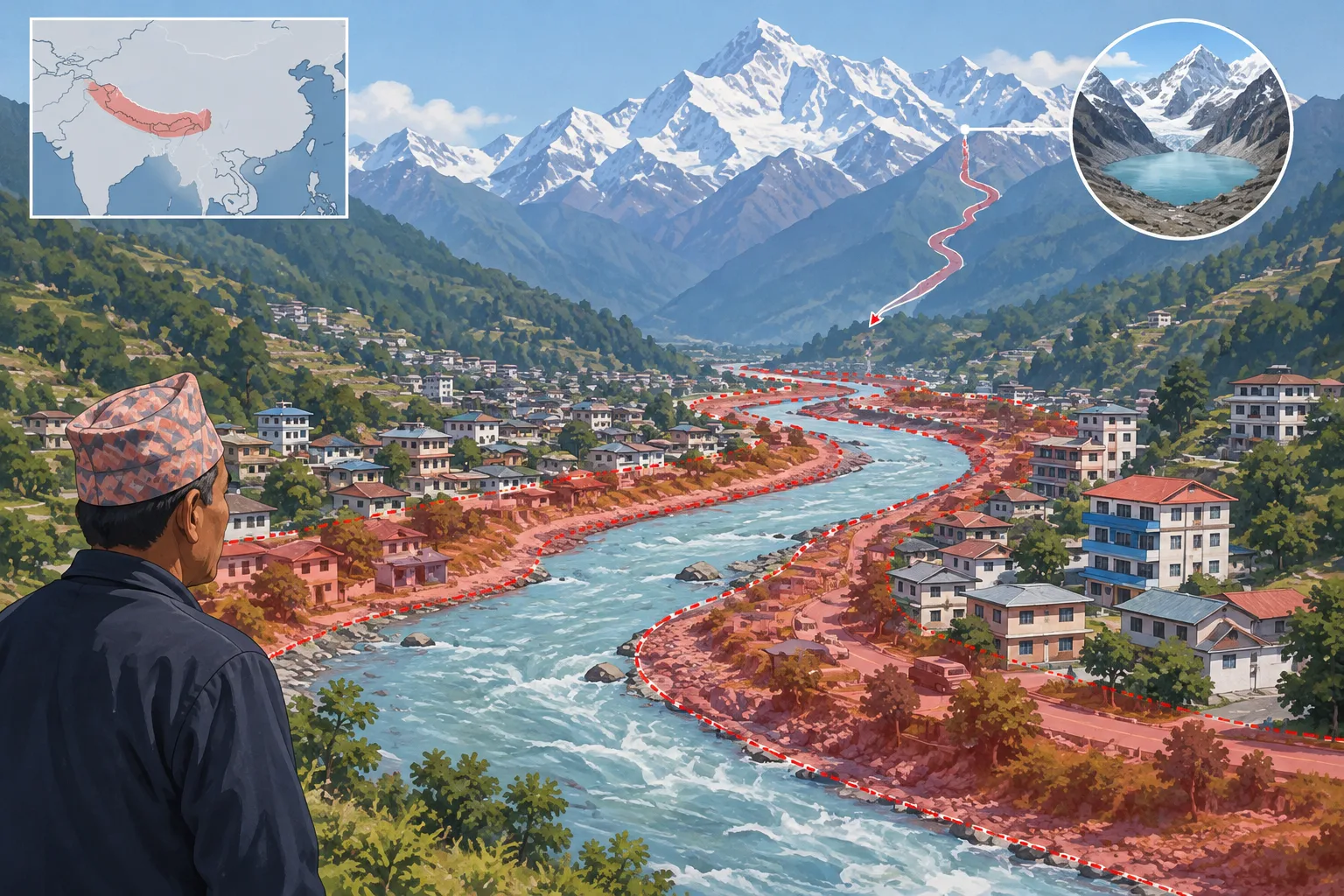
Study estimates nearly 294,000 people exposed to potential Himalayan flooding
Loading statistics…
A study estimates that about 293,800 people in Himalayan river catchments were living within a proxy zone for potential flood exposure in 2026, while building area in the zone grew 46% from 2016 to 2023.
Review information is loading.
A study estimates that nearly 294,000 people in Himalayan river catchments across Nepal and neighbouring parts of India and China were living in areas potentially exposed to flooding in 2026, as building development in some of those areas expanded sharply.
The estimate covers people living within 50 vertical metres of river channels — a measure the researchers used as a proxy for possible flood exposure, not a prediction that those people will be hit by a flood. The study, published in *Scientific Reports*, found that building area within this band grew by 46% between 2016 and 2023. Building area inside modelled flood zones for high-risk glacial lakes increased by 77%.
The research examined catchments in Nepal and transboundary areas of India and China, focusing on territory up to 50km downstream of glacial lakes. The 293,800 estimate represents 18% of the population in those study catchments. For glacial-lake flow paths specifically, the researchers estimated that 144,400 people were within the same 50-metre vertical band.
The BBC reports that the study’s mapped areas include northern Nepal, parts of south-eastern Tibet and a section of India’s Uttarakhand state. Its report describes tourism facilities, housing and infrastructure as part of the development taking place in the region. The researchers found no clear increase in building exposure in the Indian catchments, unlike in Nepal and China.
The figures indicate growing exposure, not the number of people likely to be killed or displaced. The 50-metre measure does not model flood depth, speed or return periods, and the population figures rely on projections that the study says carry substantial uncertainty. The researchers also note that building-footprint datasets differ in accuracy and completeness.
In Pokhara, Nepal, mayor Dhana Raj Acharya told the BBC that many old buildings are about five metres from the Seti Gandaki River, despite rules requiring new buildings to be further away. “Where we move them, and how we do that, is the real challenge,” he said.
The study found that building area within 0–50 metres of river-channel height rose from 12.38 sq km in 2016 to 18.04 sq km in 2023. Within modelled glacial-lake flood extents, it increased from 0.72 sq km to 1.28 sq km. The paper says those modelled zones represent scenarios for lakes assessed as having high outburst potential, rather than forecasts of when a lake will burst.
The findings come amid ongoing concern about development along Himalayan rivers. In a separate warning about flood risk in England, Aviva’s chief executive said new homes in flood-prone areas could become difficult to insure
How do we know?
3 listed sources · explore evidence, limitations and provenance.
Sign in to give this article a thumbs up or down.
About this discussion and AI questions
Private test discussion. Comments are readers’ views and are not yet automatically fact-checked. Editing is available for 60 seconds after posting.
Sign in with a confirmed reader account and choose a username to read comments and participate.
Sorting applies to top-level comments; replies remain oldest first. New comments and likes can change the order. Refresh for the current ranking.
Loading comments…