News Made Clear · Loading…
Category
Regions
Continents
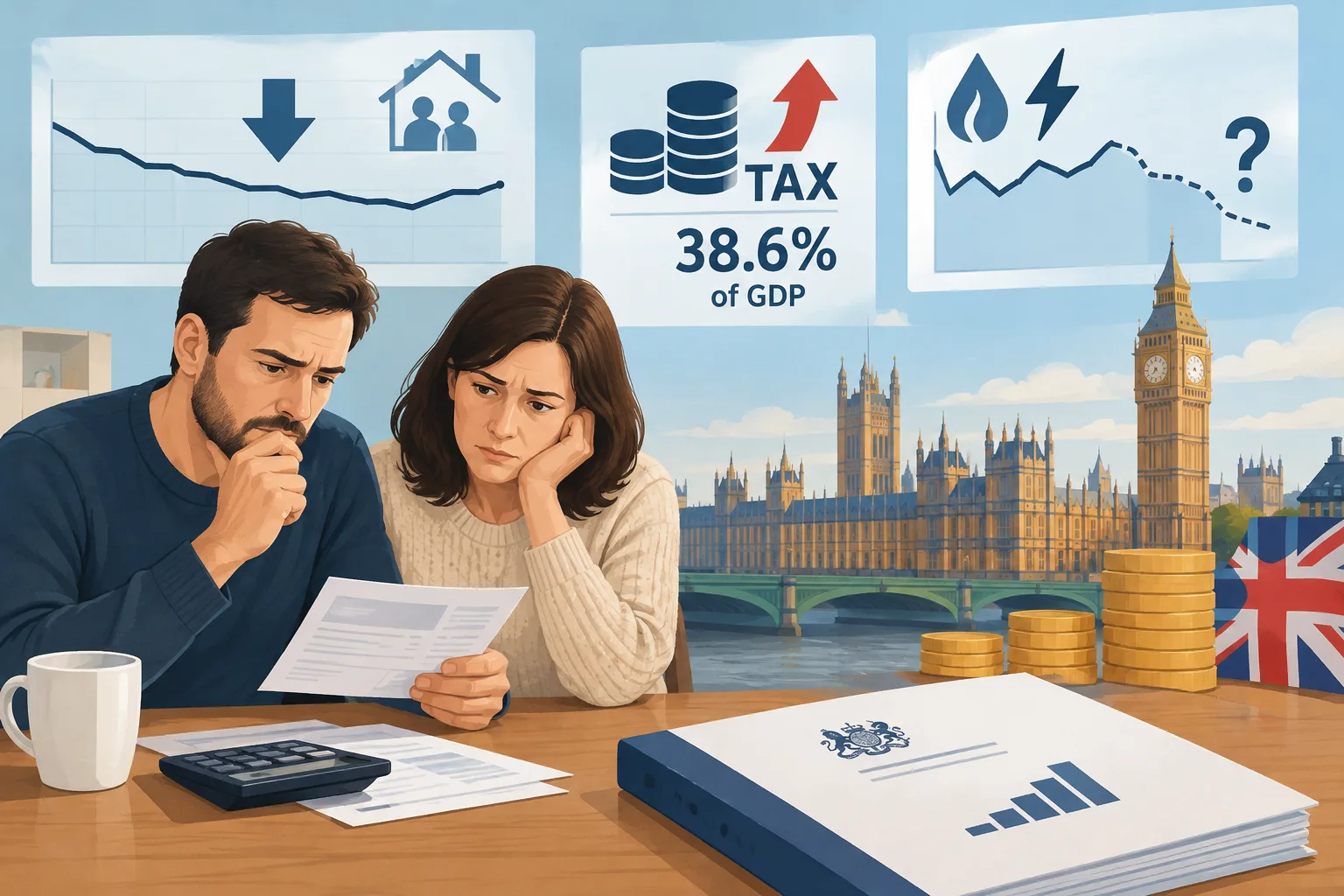
OBR forecasts weak household income growth and record tax take
Loading statistics…
The UK’s fiscal watchdog expects real disposable income per person to fall slightly in the near term and remain only 1% above its pre-pandemic level by 2029–30. It also forecasts a record-high tax take, while warning that the outlook depends on uncertain energy prices.
Review information is loading.
The Office for Budget Responsibility forecasts that UK households’ disposable income per person will fall slightly in the near term and be only 1% above its pre-pandemic level by 2029–30, as higher prices and taxes outweigh income gains. The watchdog also expects the tax take to reach a record 38.6% of GDP by 2031–32.
The projections, published alongside the October Budget, underscore the pressure on living standards and the limits on the Government’s room to respond. The OBR says the income outlook depends on energy prices falling in line with market expectations, and warns that the Middle East conflict makes that path uncertain.
The income measure is real household disposable income per person: a useful but incomplete indicator of living standards. It is forecast to dip in the near term as prices and taxes on income and wealth offset growth in labour income, other income and benefits. The OBR expects a partial recovery as energy prices ease, but says the measure will remain more than ¾% below its March forecast profile in 2030–31.
The 1% comparison is with the pre-pandemic level, not the start of the current parliament. The OBR says that by 2029–30, ten-year average growth in real household disposable income per person is forecast to be below 0.1% a year.
The tax-to-GDP ratio is forecast to exceed its previous high of 37.2% in 2027–28 and rise to 38.6% in 2031–32. The OBR attributes much of the increase to personal taxes, including the effect of frozen income tax thresholds, alongside capital taxes and corporation tax. The figures are forecasts, not outturns.
The OBR’s central economic forecast assumes energy prices fall from their recent rises. It says a more severe and persistent energy-price shock could mean higher inflation, weaker near-term growth and additional borrowing; a faster fall in prices could improve the outlook. Its central estimate puts the Government’s current-budget surplus margin against its 2029–30 fiscal target at £15bn, with a 56% probability of meeting the target.
The watchdog also forecasts that public sector net debt will peak at about 97% of GDP in 2028–29 before edging down to 96% in 2031–32. It says the forecast is subject to substantial uncertainty, including from interest rates, productivity, the labour market and future energy prices.
How do we know?
3 listed sources · explore evidence, limitations and provenance.
Sign in to give this article a thumbs up or down.
About this discussion and AI questions
Private test discussion. Comments are readers’ views and are not yet automatically fact-checked. Editing is available for 60 seconds after posting.
Sign in with a confirmed reader account and choose a username to read comments and participate.
Sorting applies to top-level comments; replies remain oldest first. New comments and likes can change the order. Refresh for the current ranking.
Loading comments…