News Made Clear · Loading…
Category
Regions
Continents
Topics
Severe drought declared in parts of southern England as reservoirs run low
Loading statistics…
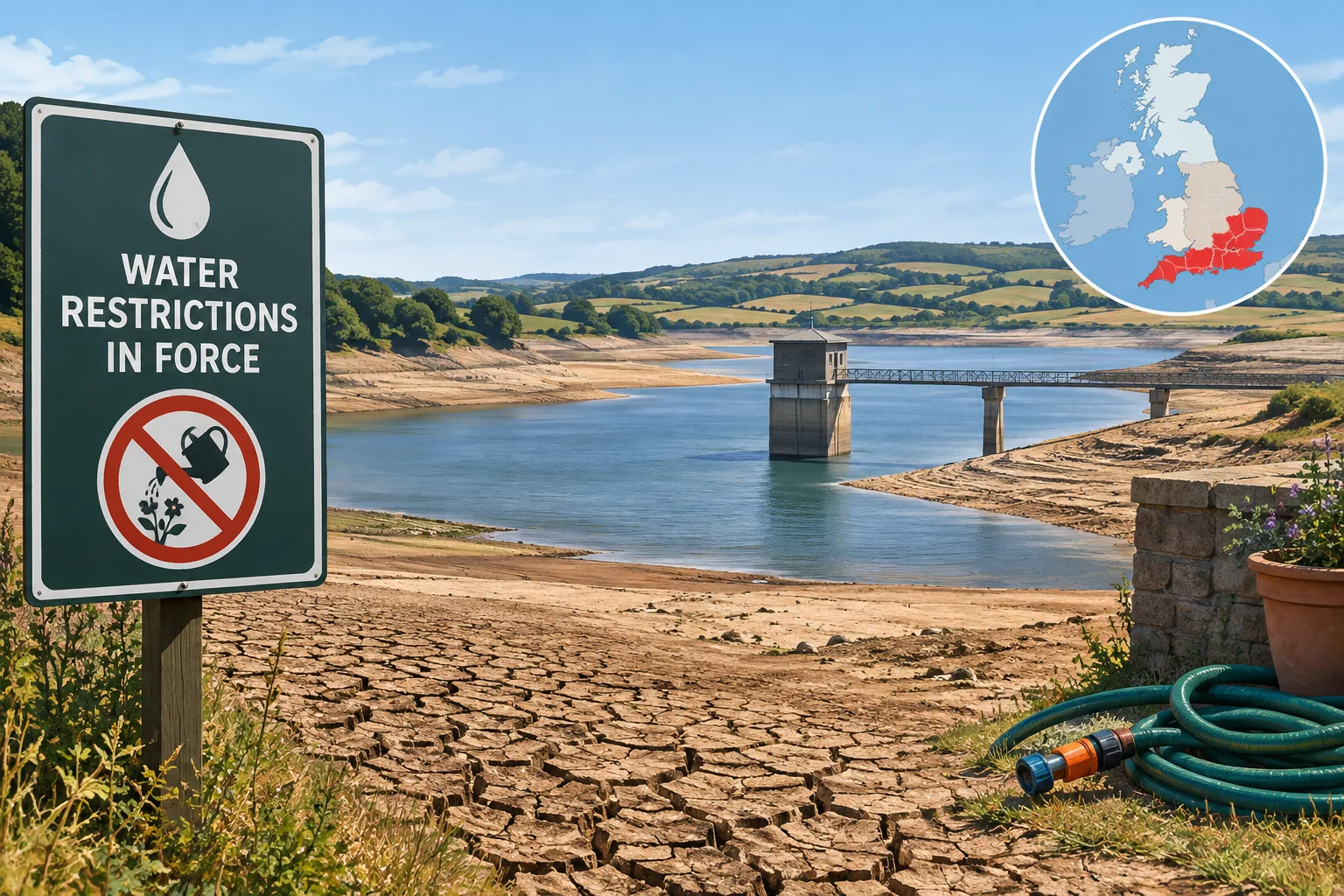
Parts of six southern English counties are in severe drought for the first time since the category was created. Reservoirs are well below seasonal levels, and hosepipe bans cover about 30 million people across England and Wales.
Parts of southern England have been declared to be in severe drought for the first time since the category was introduced, as low rainfall leaves reservoirs and rivers under pressure and hosepipe bans affect about 30 million people across England and Wales.[1]
The Environment Agency has designated parts of Cornwall, Devon, Dorset, Somerset, East Sussex and West Sussex as being in severe drought. The classification triggers increased monitoring of reservoir levels, river flows and water quality, as well as extra checks on businesses taking water from natural sources.
Most of England and all of Wales are already officially in drought. Parts of north-east and north-west England are instead classed as experiencing “prolonged dry weather”. Northern Ireland has no official drought, while Scotland monitors water scarcity rather than declaring droughts. Some south-eastern parts of Scotland remain in the most extreme categories of scarcity, according to the Scottish Environment Protection Agency.
The severe-drought category was introduced after the 2012 drought. The UK government says the droughts of 1976 and 1995 would also have met the threshold had it existed then.
Reservoirs well below seasonal levels
The Environment Agency says England’s reservoirs would normally be about three-quarters full at this point in the year. They are just over half full on average; stocks stood at 54% on 6 October, against a seasonal average of 75%. Ardingly Reservoir in West Sussex and Wimbleball Reservoir in Somerset are among those at exceptionally low levels.
The south-east and south-west of England had their driest April-to-September period in more than a century, according to the agency. Most monitored river flows in England were below normal or lower in July, while groundwater levels were below normal or worse at about half of monitored sites across the UK in September.
Eleven UK water companies have announced hosepipe bans this year: ten in England and one in Wales. The restrictions prohibit uses including watering gardens, washing vehicles and filling swimming pools. One ban, covering customers in Bedfordshire, Berkshire, Buckinghamshire, Hertfordshire, Surrey and parts of London and Essex, began on 17 July.
Scotland’s water supplies have improved in some areas after recent rain, while most Welsh reservoir levels and those in Northern Ireland are reported to be close to normal for the time of year.[1]
The Met Office expects UK summers to be drier on average as the climate warms, but says there has been no clear trend so far. Higher temperatures can also increase evaporation from soil. Water use and infrastructure matter too: a review of England and Wales’ water sector criticised companies for historic underinvestment, while the government and water companies plan nine new reservoirs in England by 2050.
How do we know?
1 listed sources · explore evidence, limitations and provenance.
Sign in to give this article a thumbs up or down.
About this discussion and AI questions
Private test discussion. Comments are readers’ views and are not yet automatically fact-checked. Editing is available for 60 seconds after posting.
Sign in with a confirmed reader account and choose a username to read comments and participate.
Sorting applies to top-level comments; replies remain oldest first. New comments and likes can change the order. Refresh for the current ranking.
Loading comments…