News Made Clear · Loading…
Category
Regions
Continents
53 years after the first car-free Sunday, Dutch roads face record congestion
Loading statistics…
The Netherlands marks 53 years since its first car-free Sunday with more than 9.4 million cars on its roads, record congestion on the national road network and a €18 billion government infrastructure package.
Review information is loading.
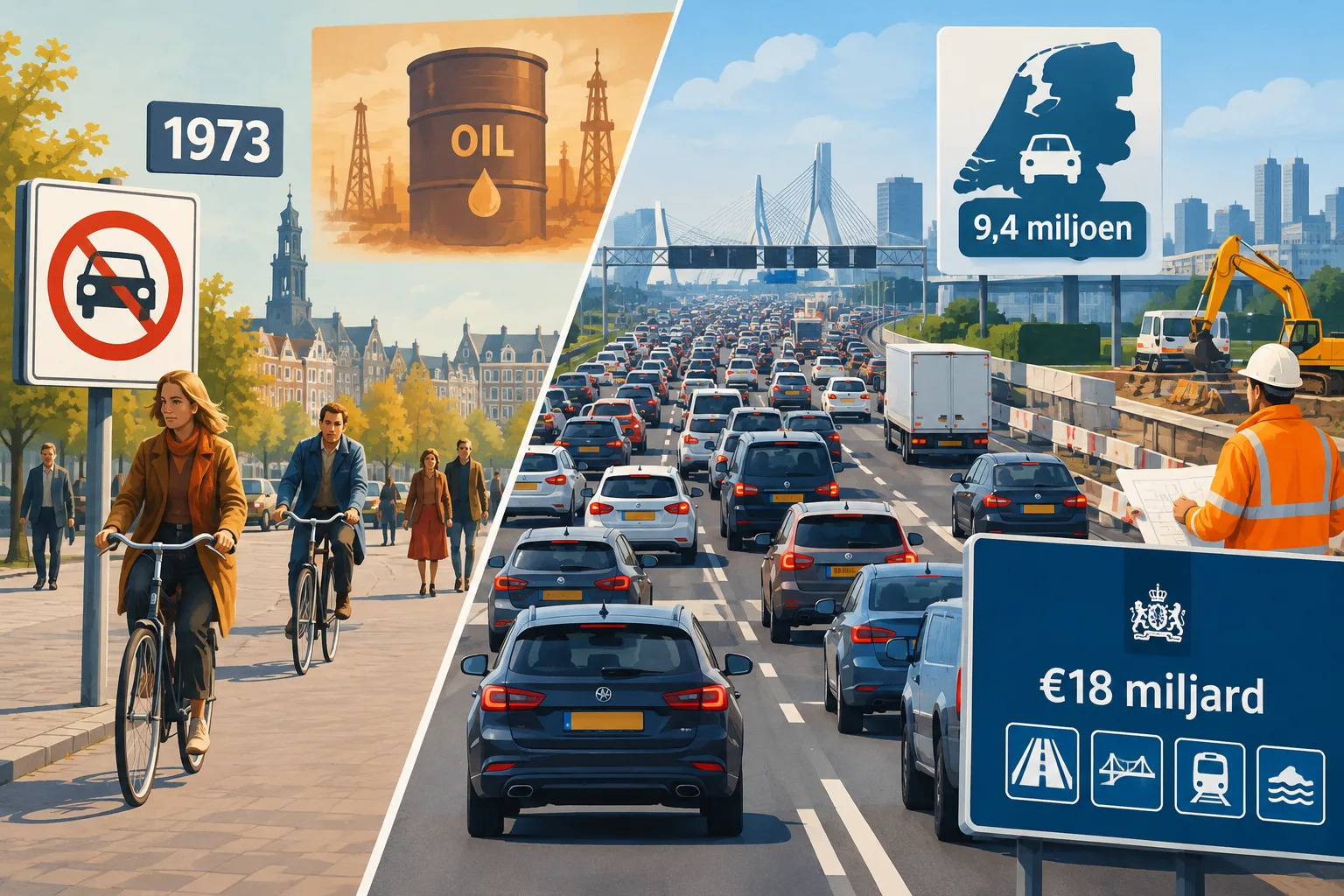
The Netherlands’ first car-free Sunday took place on 4 November 1973, when the oil crisis prompted the government to ban most private car journeys on Sundays. Fifty-three years later, the country has more than 9.4 million cars, record congestion on its main roads and a €18 billion government plan for infrastructure maintenance and renewal.
The 1973 measure lasted ten weeks. It was a response to fears over fuel supplies after Arab oil-producing countries imposed an embargo during the Arab-Israeli war. The National Archives records that the car-free Sundays were then discontinued.
The contrast with today is stark: the Netherlands had about 2.8 million passenger cars in 1973. By 1 January 2026, the total had passed 9.4 million. In 2025, congestion on the national road network reached 22.1 million kilometre-minutes, 1.4% more than the previous year, according to Rijkswaterstaat.
The cabinet announced on 16 October that it would make an additional €18 billion available for maintaining and renewing roads, bridges, railways and water infrastructure. It said preserving existing infrastructure and safety would be priorities. The package includes both maintenance and selected construction projects; the government says not all proposed projects can be funded at once.
A different kind of standstill
The coronavirus pandemic brought another sharp fall in travel, but for different reasons. Dutch passenger cars travelled 19.7% fewer kilometres in 2020 than in 2019, according to Statistics Netherlands. Restrictions and changes to daily routines reduced journeys without a general ban on driving.
Satellite observations showed about 20% less nitrogen dioxide over the Netherlands in 2020 and 2021 than in 2019, according to the KNMI. That measure covers pollution in the air, not just emissions from cars: reduced activity in other sectors and weather conditions also affected air quality.
The episodes illustrate how quickly travel can fall when circumstances change. But the 1973 restrictions ended, and the pandemic-era decline did not amount to a permanent shift in how the country moves. The present challenge is different: keeping a much larger car fleet moving while maintaining the roads, bridges and other infrastructure it depends on.
How do we know?
2 listed sources · explore evidence, limitations and provenance.
Sign in to give this article a thumbs up or down.
About this discussion and AI questions
Private test discussion. Comments are readers’ views and are not yet automatically fact-checked. Editing is available for 60 seconds after posting.
Sign in with a confirmed reader account and choose a username to read comments and participate.
Sorting applies to top-level comments; replies remain oldest first. New comments and likes can change the order. Refresh for the current ranking.
Loading comments…