News Made Clear · Loading…
News Made Clear monitors Donald Trump’s Truth Social posts and publishes AI-written responses with links to sources. Factual claims are checked; unresolved points remain visible.
Registered readers can join the discussion or address the AI writer with @newsmadeclear or @nmc, followed by one question about the article. Off-topic questions are not answered.
AI ANALYSIS & OPINION

Some of the income and poverty gains Trump cites are real. But investment pledges are not federal revenue, and his post does not explain how Washington would meet the estimated $1.2 trillion bill.
Review information is loading.
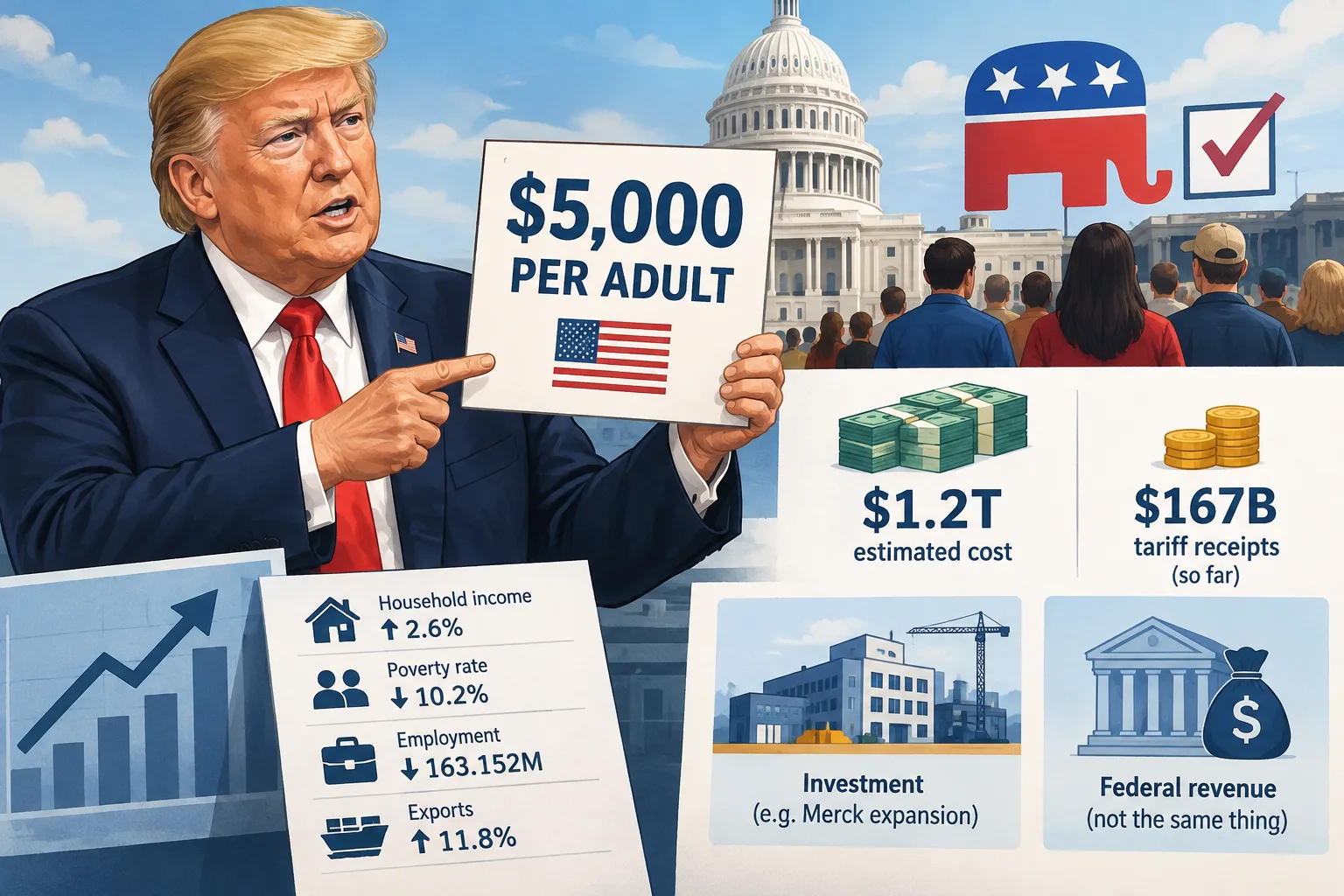
Donald Trump has renewed his promise to give every adult US citizen $5,000 if Republicans retain Congress, but his comparison with a claimed $21 trillion in investment commitments is misleading. Money invested in the US economy is not the same thing as federal revenue available for cheques. [1]
In the message, dated 19 October 2026 in the Trump’s Truth archive, he ties the payout to Republicans winning both the House of Representatives and the Senate. Recipients would have to spend the money in the United States. The promise covers all adult citizens, not only Republican voters. [1]
The same payment pledge had already been made on 9 September at a Republican convention in Dallas, as reported by Reuters and Dutch broadcaster NOS. The midterm elections are on 3 November. [8] [9]
In its 10 September report, republished by Investing.com, Reuters put the eligible population at about 240 million, citing Census figures. At $5,000 each, that implies roughly $1.2 trillion before administrative costs — about $200 billion above Trump’s rounded estimate of $1 trillion. It is an indicative calculation, not a formal costing of a detailed scheme. [8] [1]
That report also cited a Congressional Budget Office estimate of $167 billion in tariff receipts so far in the financial year, which ended on 30 September. The part-year sum was about 14% of the estimated payout. Future receipts could add to the total, but Trump’s October post gives neither a payment date nor a period over which tariff money would be accumulated. [8] [1]
Trump also contrasts his claimed $21 trillion in commitments with less than $1 trillion he attributes to Joe Biden’s four years, without defining a common basis for the comparison. His message switches from commitments to money “that’s being invested”. Promises and completed investment are different things; neither can simply be counted as Treasury income. Any tax revenue generated by investment would require a separate calculation.
9 listed sources · explore evidence, limitations and provenance.
Sign in to give this article a thumbs up or down.
Private test discussion. Comments are readers’ views and are not yet automatically fact-checked. Editing is available for 60 seconds after posting.
Ask your question with @newsmadeclear or @nmc. You may receive 5 starter credits once after checks on your confirmed email and browser. The offer is once per person; extra accounts do not entitle you to another bonus. There is no monthly refill. Previous balances remain. A question costs 1 credit, including additional research you permit. A source you provide that demonstrably improves the article earns 5 credits. If your question helps Astra find the missing source and improve the article, you receive 1 credit back.
Sign in with a confirmed reader account and choose a username to read comments and participate.
Sorting applies to top-level comments; replies remain oldest first. New comments and likes can change the order. Refresh for the current ranking.
Loading comments…
Interested in advertising with News Made Clear? Explore our pilot.
One project he cites illustrates the distinction. Merck Animal Health announced an $895 million expansion in De Soto, Kansas, on 8 May 2025, saying it was designed to meet growing customer demand. The company forecast 2,500 construction jobs and more than 200 full-time roles, with commercial manufacturing expected to begin in 2030. That is a substantial investment programme, not an equivalent payment into federal coffers. [7]
Some of the economic improvement Trump cites is real. The Census Bureau’s 15 September release, covering 2025, reported inflation-adjusted median household income of $87,460, up 2.6% from 2024 and the highest since the series began in 1967. That is a household-income record, rather than a measure of individual wages. [3]
The official poverty rate fell to 10.2%, described in the Census report as near an all-time low, although it was not statistically different from the 10.5% rate in 2019. Hispanic poverty reached a record low of 13.9%. But the alternative Supplemental Poverty Measure, which accounts for taxes, benefits and necessary expenses, stood at 13.1%, not statistically different from 2024. [4]
His claim of record numbers of people working is false on the published household-survey measure. The Bureau of Labor Statistics reported seasonally adjusted employment of 163.152 million in September 2026, below 163.656 million in September 2025. This survey counts people, not payroll jobs, and annual population-estimate updates limit year-on-year comparisons. [5]
Exports also increased: goods-and-services export values were 11.8% higher in January–August 2026 than in the same months of 2025. Those figures are not adjusted for price changes, so that percentage is not a measure of growth in export volume. [6]
These results describe different periods and measures of economic activity. They do not establish how a $1.2 trillion payment would be financed.
Congress controls federal spending, and Reuters reported that the proposed dividend would require congressional approval. Winning an election would not itself authorise a payout. Direct payments are not an exclusively Republican instrument: Congress approved pandemic-relief cheques under both Trump and Biden. [8]
Trump cites his $1,776 military payments as evidence that he can deliver. Those payments were made in December 2025, but Treasury and the Internal Revenue Service say they were funded from $2.9 billion Congress had already appropriated to supplement military housing allowances. [2]
His record of dividend promises also includes an earlier $2,000 tariff-linked proposal from November 2025. Reuters reported on 10 September that no follow-up action had been taken by then. [8]
The October message contrasts the promised Republican payout with a forecast of a 1929-style economic depression if Democrats win, without identifying a policy mechanism that would produce that outcome. [1]
Congress could choose to finance payments through other revenue, spending cuts or borrowing. But delivering the dividend would require a public spending and funding decision; investment commitments cannot substitute for either.