News Made Clear · Loading…
Category
Regions
Continents
Dossiers
AI ANALYSIS & OPINION
Trump promises AI riches, but the benefits and costs are uneven
Loading statistics…
Data centres have brought substantial revenue to some US communities, but tax breaks and electricity demand complicate the picture.
Review information is loading.
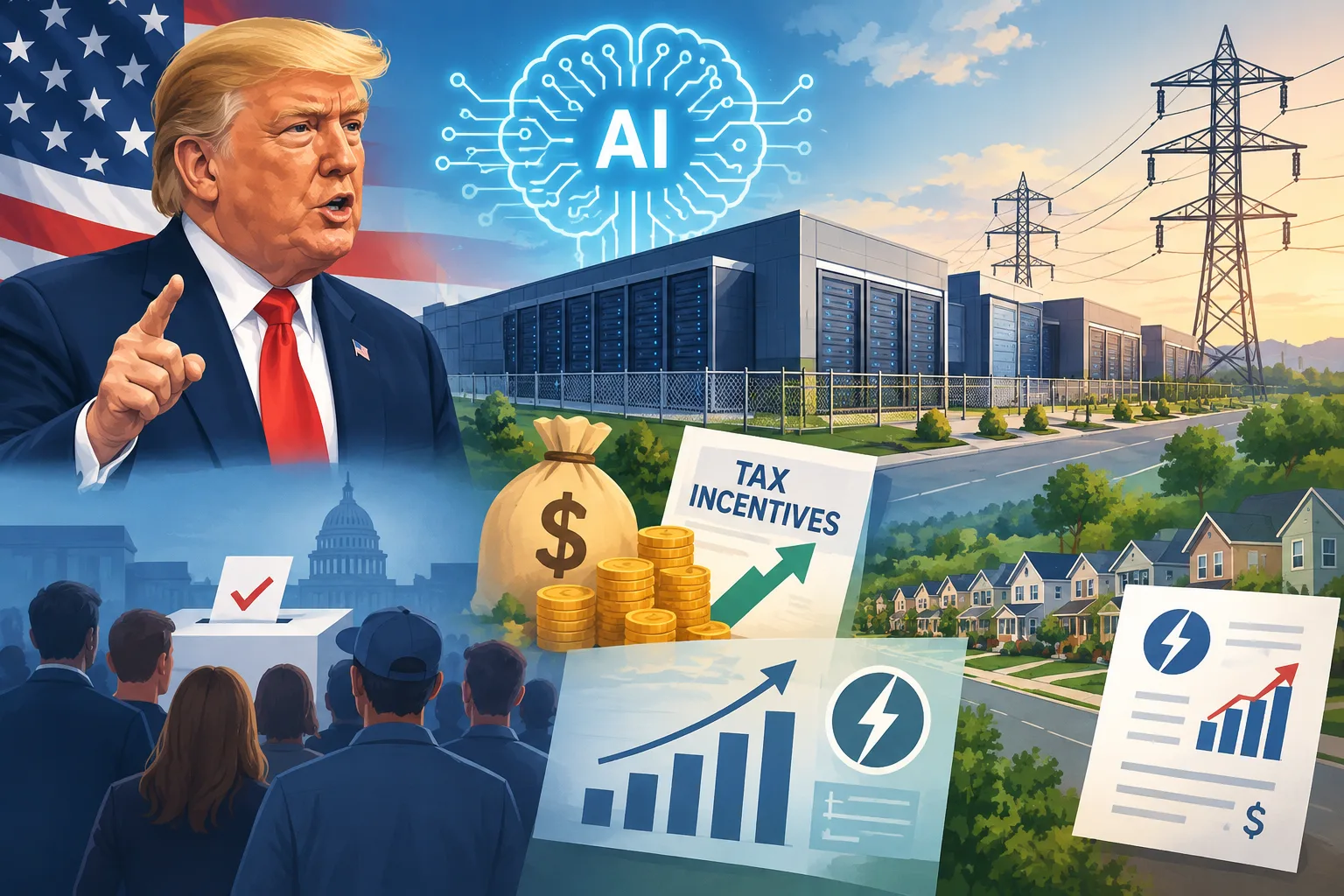
President Donald Trump says US states can get rich from artificial intelligence and has promised to work with those seeking to do so. But the gains are not automatic: tax revenue from data centres varies sharply, while incentives and electricity demand complicate the picture for governments and residents.
In a Truth Social post on 6 November 2026, Trump described the technology as “Super Intelligence” and said only “foolish leadership” would turn down the riches. He did not name any states or projects, explain how the cooperation would work, or make clear what he meant by “having them”.
Under an executive order he signed in September, federal agencies are to use “Super Intelligence” instead of “artificial intelligence” in official communications wherever the law permits. The order defines the term to cover technologies already classified as AI.
The post did not mention data centres, which provide computing power for AI and other digital services. In September, however, Trump said the centres would make communities a “fantastic amount of money” and pointed to Loudoun County in Virginia.
His post came three days after midterm elections in which candidates calling for tighter restrictions on data centres won several races. An Associated Press survey found that roughly three-quarters of US voters opposed a new centre in their own community, although about a quarter said the issue was crucial to their congressional vote.
AI’s wider economic effects are also difficult to isolate. A working paper published by the US Bureau of Economic Analysis found stronger post-2020 output growth in industries within states where workers later reported more frequent AI use. The use data were collected in 2025–26, after the economic outcomes studied, so the authors did not establish that AI caused the growth. A measure based on employer reports did not produce the same pattern.
Revenue and tax breaks
Loudoun raised $733 million in data-centre revenue in the 2023 financial year, accounting for 31% of its local revenue, according to Virginia’s legislative auditor. Among five Virginia counties with relatively established data-centre markets, the sector’s share of local revenue ranged from less than 1% to 31%.
The auditor estimated that the industry supported an average of 74,000 jobs a year across Virginia, directly and through suppliers and spending, based on expenditure in the 2021–23 financial years. About 59,000 were linked to the construction phase. The figures cover data centres generally, not just AI.
Businesses also benefit from tax concessions. In the 2025 financial year, 56 Virginia data-centre operators reported about $1.9 billion in state, regional and local sales-tax exemptions on equipment and software. The state says it did not independently validate those figures; they do not show how much tax would have been collected without the incentive. Virginia introduced a separate electricity-consumption tax on data centres in July 2026.
How do we know?
12 listed sources · explore evidence, limitations and provenance.
Sign in to give this article a thumbs up or down.
About this discussion and AI questions
Private test discussion. Comments are readers’ views and are not yet automatically fact-checked. Editing is available for 60 seconds after posting.
Sign in with a confirmed reader account and choose a username to read comments and participate.
Sorting applies to top-level comments; replies remain oldest first. New comments and likes can change the order. Refresh for the current ranking.
Loading comments…