News Made Clear · Loading…
Category
Regions
Topics
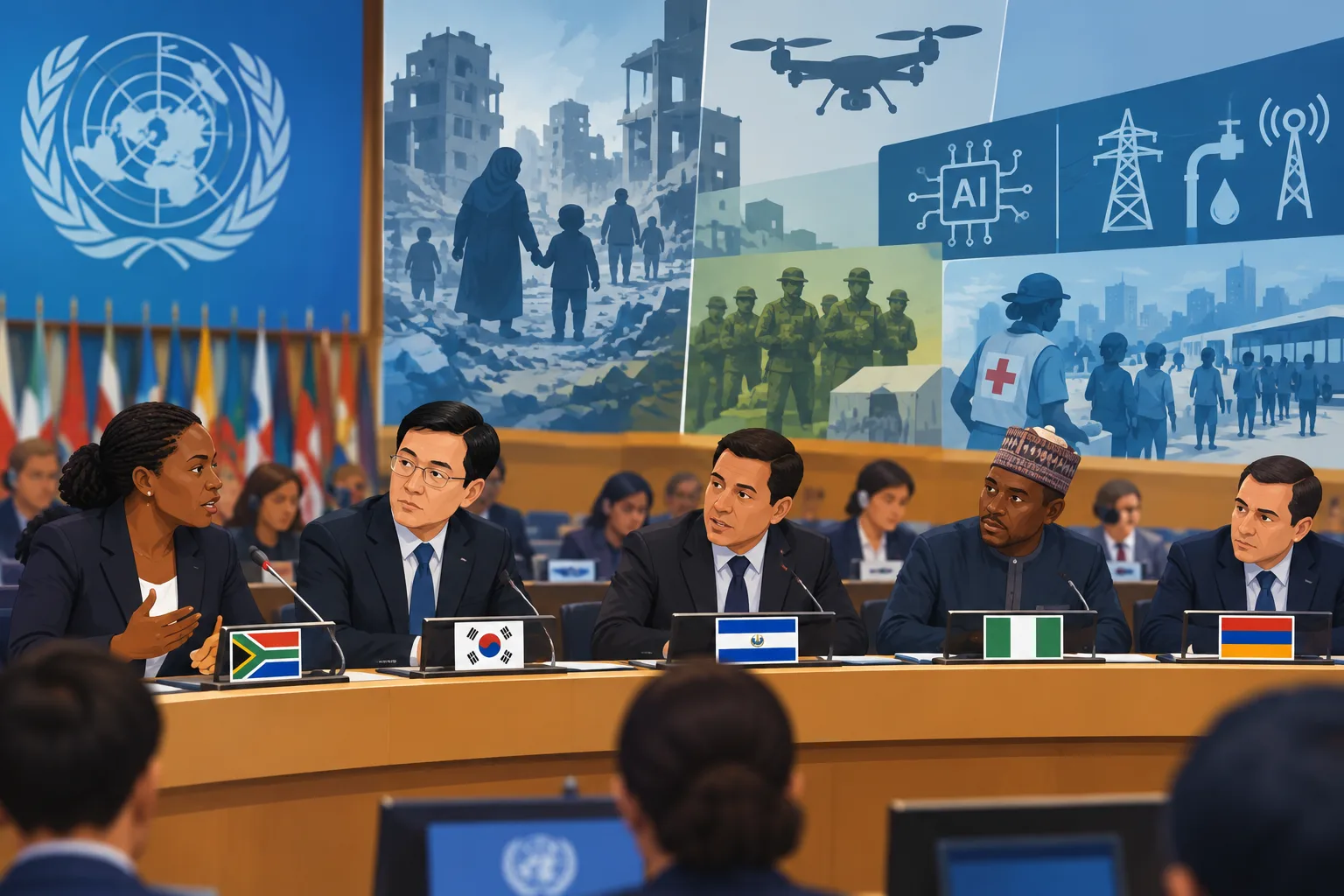
UN delegates urge stronger action to uphold humanitarian law as warfare evolves
Loading statistics…
Delegates at the UN General Assembly’s Sixth Committee called for stronger national action to uphold humanitarian law as warfare and military technologies evolve, with speakers highlighting civilian protection, training and accountability.
At a United Nations committee meeting, delegates from several countries urged governments to strengthen compliance with international humanitarian law, citing evolving warfare and the risks posed by new technologies. They also described national measures including military training, legislation and civilian-protection planning.
The discussion took place on 16 October in the General Assembly’s Sixth Committee, which was considering the status of protocols additional to the Geneva Conventions. The UN’s meeting report said speakers called for both renewed political commitment and practical steps to apply the rules of war [1].
South Africa’s representative said conflicts were becoming more complex and increasingly fought in urban areas, putting civilians at greater risk. She urged regulation of weapons and technologies to prevent them from amplifying the devastation of war.
The Republic of Korea’s representative highlighted the need for national legislative, administrative and political measures, particularly as artificial intelligence and other emerging technologies develop. El Salvador’s representative called for greater understanding of how existing humanitarian-law protections apply to new situations.
Delegates also stressed the importance of implementation at home. Nigeria’s representative said the country incorporated humanitarian law into training and operational rules for its armed forces and security agencies, and that people detained during counterinsurgency operations were treated in accordance with the law. Armenia’s representative described a 2025–26 action plan with the International Committee of the Red Cross that included courses for military personnel.
Other speakers focused on protecting civilian infrastructure. Egypt’s representative warned against using the concept of “dual-use” objects to widen the category of military targets to include essential facilities such as electricity networks, water and sanitation systems, and telecommunications. Poland’s representative outlined government, public and private-sector work on warnings, evacuations, shelters and emergency services.
Ireland’s representative said respect for international humanitarian law had continued to deteriorate and that civilians were bearing the brunt of warfare. Mexico’s representative called for states to renew their commitments and actions to comply with the Geneva Conventions and customary international law.
How do we know?
1 listed sources · explore evidence, limitations and provenance.
Sign in to give this article a thumbs up or down.
About this discussion and AI questions
Private test discussion. Comments are readers’ views and are not yet automatically fact-checked. Editing is available for 60 seconds after posting.
Sign in with a confirmed reader account and choose a username to read comments and participate.
Sorting applies to top-level comments; replies remain oldest first. New comments and likes can change the order. Refresh for the current ranking.
Loading comments…