Eurovision’s first Asian contest reaches its Bangkok final
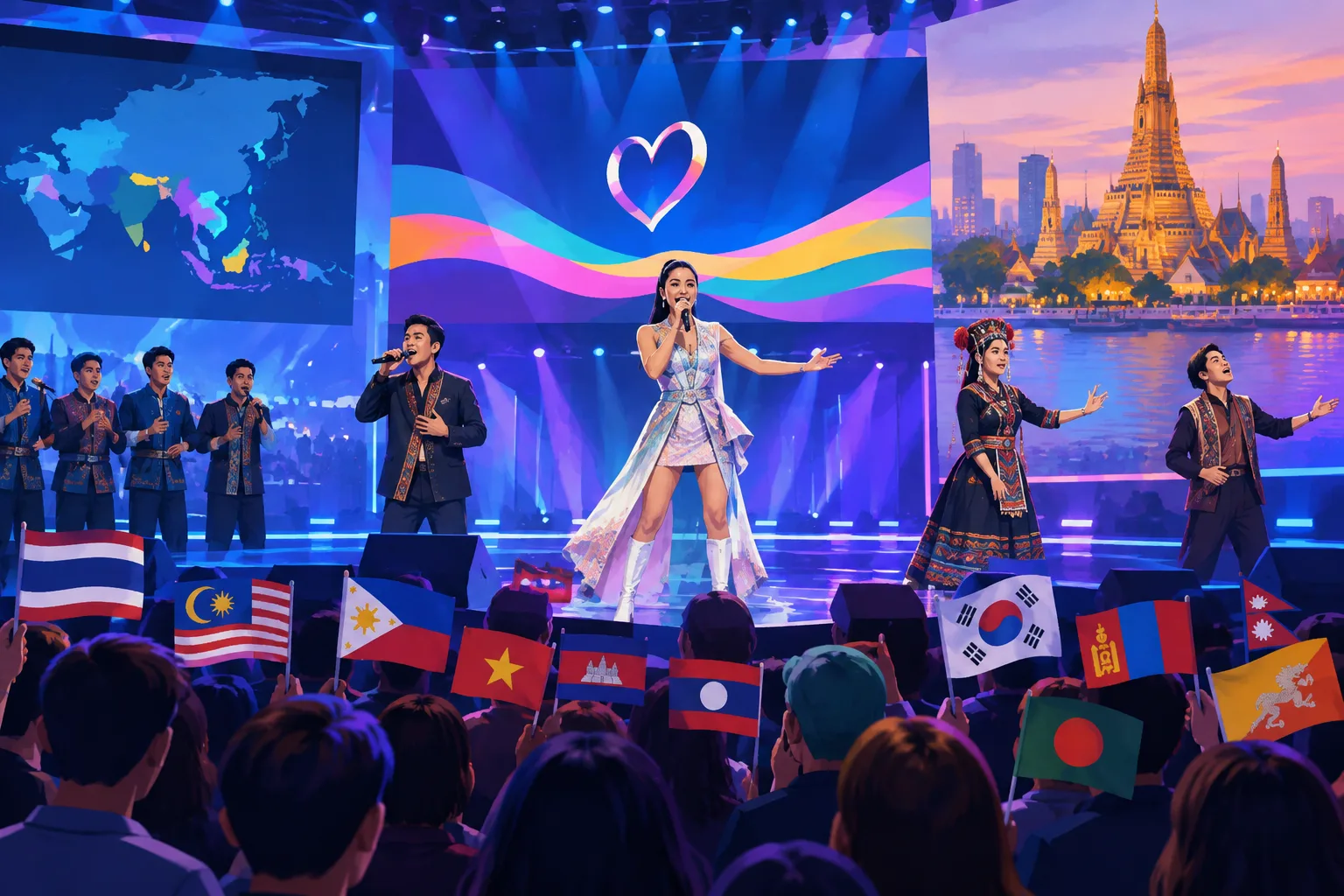
Eurovision Song Contest Asia will stage its first final in Bangkok on Saturday, with 11 countries competing in a debut that will test whether the long-running European format can find an audience in the region.
Review information is loading.
Eurovision Song Contest Asia will hold its first grand final in Bangkok on Saturday, bringing the format to the region for the first time after two decades of proposals and false starts. Eleven countries are competing, with the European Broadcasting Union hoping the event can establish a new audience for the contest in Asia.
Thailand is joined by Malaysia, the Philippines, Vietnam, Cambodia, Laos, South Korea, Mongolia, Bangladesh, Nepal and Bhutan. India, China, Japan and Indonesia are not taking part; the BBC reports that organisers are negotiating with them about possible participation next year, if the contest returns.
The event, which begins at 20:30 local time, comes as Eurovision marks its 70th year. The European contest began in 1956 as a project to encourage cultural exchange after the Second World War. It has since become part of Europe’s shared popular culture, but has no comparable history in Asia, where the format is arriving in an era when traditional television is struggling to attract audiences.
The contest uses a 50-50 split between public votes and national juries from the 11 participating countries, plus a “rest of the world” vote. Registered viewers receive eight votes, which they must give to at least three countries and cannot cast for their own. The voting system is a departure from some regional singing competitions, where Thai singer and Eurovision fan Sarun “Note” Kungbunpot says audiences tend to focus on performers and their popularity rather than the song.
Organisers have also faced setbacks. The BBC reports that a million-dollar budget cut three weeks before the final meant many technicians experienced in staging Eurovision were not brought to Thailand, while several staff resigned. Fans have criticised the audio and lighting in rehearsal videos.
The performers range from established acts to contestants hoping to reach a much wider audience. Bhutan’s 24-year-old singer Thukten Nyendra, who says he had never left his country or flown before travelling to Bangkok, told the BBC: “Nobody knows me. But Eurovision has given me a huge platform.”
Other entries include a cappella and beatboxing group Beatmosphere from Bangladesh, and Vietnamese singer Tóc Tiên, whose performance features elaborate choreography and costume changes. Laos’s Thinla has switched from a sequinned dress to traditional hill-tribe costume for her song, while the Philippines’ 19-year-old Carmelle Collado is the youngest contestant.
The first edition will also test whether the contest’s European identity can travel easily. Eurovision has long been associated with LGBTQ+ artists, but the BBC notes that no visible LGBTQ+ elements feature in this year’s show, which includes Malaysia and Bangladesh, where same-sex activity is illegal.
The organisers hope the Bangkok final will be the start of a wider expansion into a region that accounts for half the world’s population. Whether the contest returns next year remains uncertain.
Sign in to give this article a thumbs up or down.
About this discussion and AI questions
Private test discussion. Comments are readers’ views and are not yet automatically fact-checked. Editing is available for 60 seconds after posting.
Sign in with a confirmed reader account and choose a username to read comments and participate.
Sorting applies to top-level comments; replies remain oldest first. New comments and likes can change the order. Refresh for the current ranking.
Loading comments…