News Made Clear · Loading…
Category
Regions
UN report sets out steep emissions cuts to limit 1.5°C overshoot
Loading statistics…
A new UN report says global warming is set to exceed 1.5°C, but rapid emissions cuts could limit the rise and return temperatures to that level by 2100.
Review information is loading.
The world is on course to exceed the 1.5°C warming threshold, but sharp cuts to greenhouse gas emissions could limit the overshoot and bring temperatures back to that level by 2100, a new UN report says.
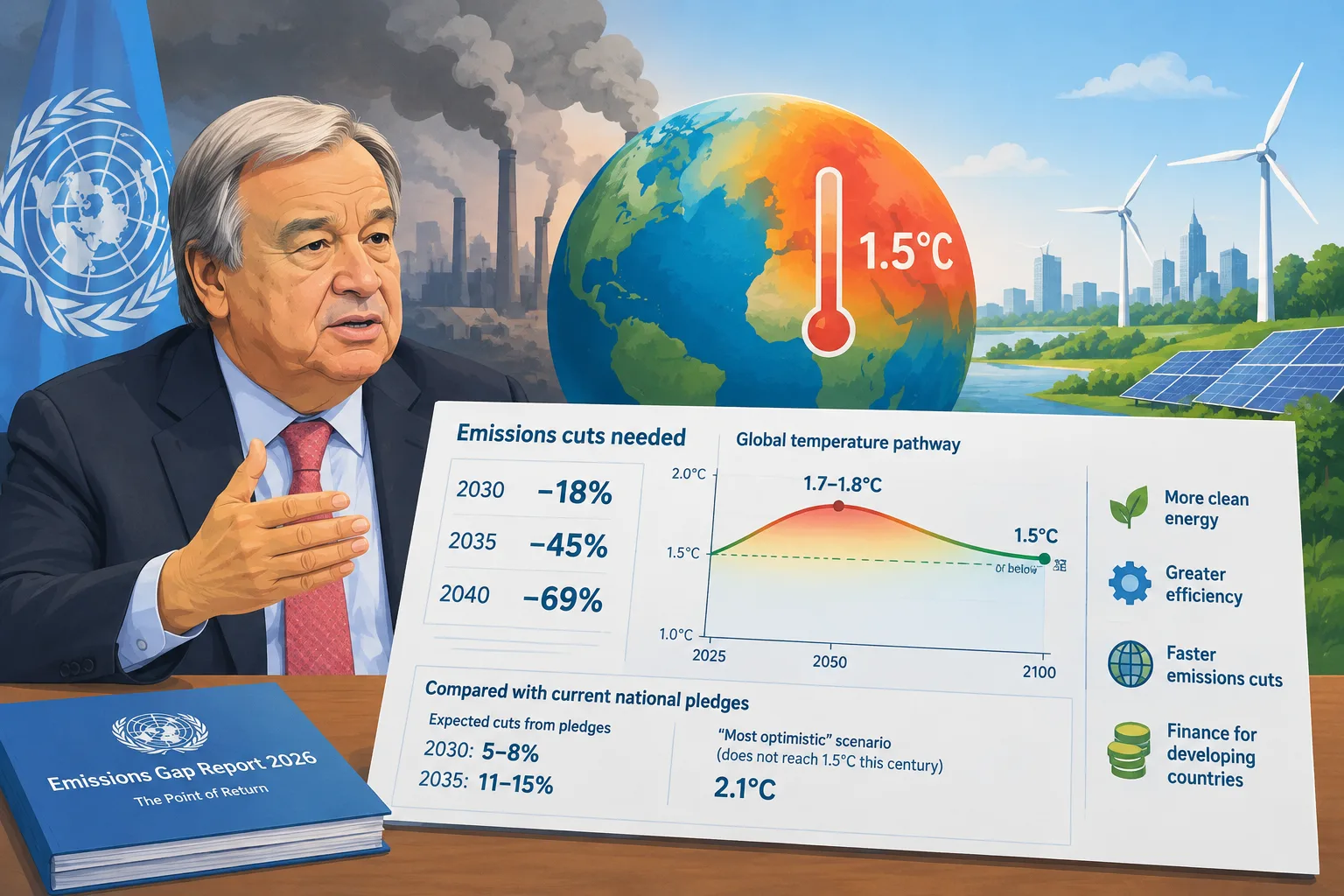
The UN Environment Programme’s *Emissions Gap Report 2026: The Point of Return* sets out a pathway that would require global emissions to fall by 18% by 2030, 45% by 2035 and 69% by 2040, compared with 2025. It also relies on increasing the removal of carbon dioxide from the atmosphere through the century. [1]
Under that “lowest possible” overshoot scenario, warming peaks at about 1.7–1.8°C around mid-century before returning to 1.5°C or below by 2100. The report puts the chance of reaching that return at about 50%. [1]
The scale of the proposed reductions is far greater than the cuts expected from existing national climate plans. Full implementation of those pledges would reduce emissions by 5–8% by 2030 and 11–15% by 2035, relative to 2025, UNEP says. [1]
Current policies could lead to 2.8°C of warming this century, while full delivery of national pledges, with similar efforts continuing, would limit it to 2.6°C. Even the report’s most optimistic scenario, which also assumes additional net-zero targets are met, reaches 2.1°C this century. [1]
UN Secretary-General António Guterres said the world could still make the overshoot “as small and as short as possible”, and called on governments to move faster on clean energy, efficiency and emissions cuts. He also urged developed countries to provide finance to help developing countries manage the transition and climate impacts. [2]
UNEP says renewable energy has expanded since the Paris Agreement and climate policies have reduced emissions in many places. But it warns that progress remains uneven and that current trends are not yet cutting emissions at the pace needed to limit the overshoot. [1]
How do we know?
3 listed sources · explore evidence, limitations and provenance.
Sign in to give this article a thumbs up or down.
About this discussion and AI questions
Private test discussion. Comments are readers’ views and are not yet automatically fact-checked. Editing is available for 60 seconds after posting.
Sign in with a confirmed reader account and choose a username to read comments and participate.
Sorting applies to top-level comments; replies remain oldest first. New comments and likes can change the order. Refresh for the current ranking.
Loading comments…