News Made Clear · Loading…
Category
Regions
Continents
Topics
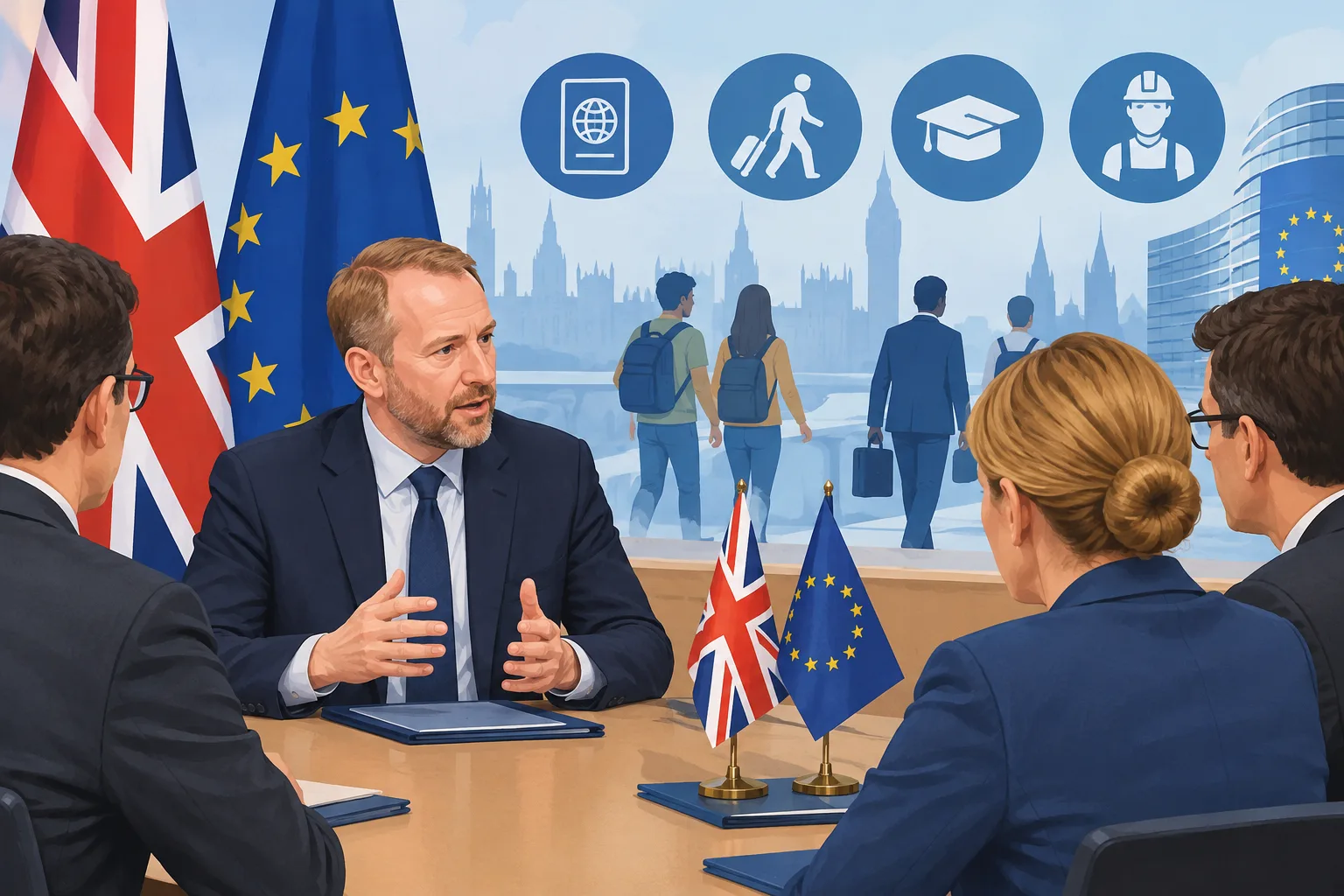
UK and EU officials to discuss future relationship options, including free movement
Loading statistics…
UK and EU officials are expected to discuss future relationship options, including freedom of movement, before a November summit. The government says its immediate focus is on practical agreements, and Labour’s manifesto rules out a return during this parliamentary term.
Review information is loading.
British and European officials are expected to discuss a range of possible future UK-EU arrangements, including freedom of movement, ahead of a summit on 20 November. The talks are about future options, not an agreed plan to restore the right to live and work freely across the bloc.
Business Secretary Jonathan Reynolds told the BBC that officials would discuss what the UK’s relationship with the EU might look like, but said no assumptions had been made about its future shape. He said the immediate focus for the summit was practical deals on areas including food and drink, electricity and emissions trading.
Downing Street has said the government is focused on reaching new agreements on areas such as food and youth mobility. The prime minister has also said major changes to the relationship would need a mandate at a general election, due by 2029. Labour’s 2024 manifesto rules out a return to freedom of movement, the EU single market or customs union during the current parliamentary term.
The debate follows Prime Minister Andy Burnham’s call for an “honest discussion” about the possibility of restoring free movement. Burnham said on Monday that he could not introduce it without a referendum, though Downing Street later said no decision had been made and that he was not proposing a specific option.
Labour MP Melanie Onn, whose constituency voted to leave the EU, said the discussion risked damaging trust. Reform UK leader Nigel Farage also argued that Burnham had no mandate to negotiate such changes and called for the public to decide at an election.
Free movement allows EU citizens to travel, live, study and work in any member country. It is a condition of membership of the EU single market, which also enables the free movement of goods and services and involves shared rules and standards.
How do we know?
1 listed sources · explore evidence, limitations and provenance.
Sign in to give this article a thumbs up or down.
About this discussion and AI questions
Private test discussion. Comments are readers’ views and are not yet automatically fact-checked. Editing is available for 60 seconds after posting.
Sign in with a confirmed reader account and choose a username to read comments and participate.
Sorting applies to top-level comments; replies remain oldest first. New comments and likes can change the order. Refresh for the current ranking.
Loading comments…