Antarctic ozone hole among largest in 48 years, but depletion depth near average
Antarctica’s ozone hole reached 27.3 million square kilometres in September, one of its largest extents in 48 years. Its depth remained close to average, and the European Space Agency says the ozone layer’s long-term recovery remains on track.
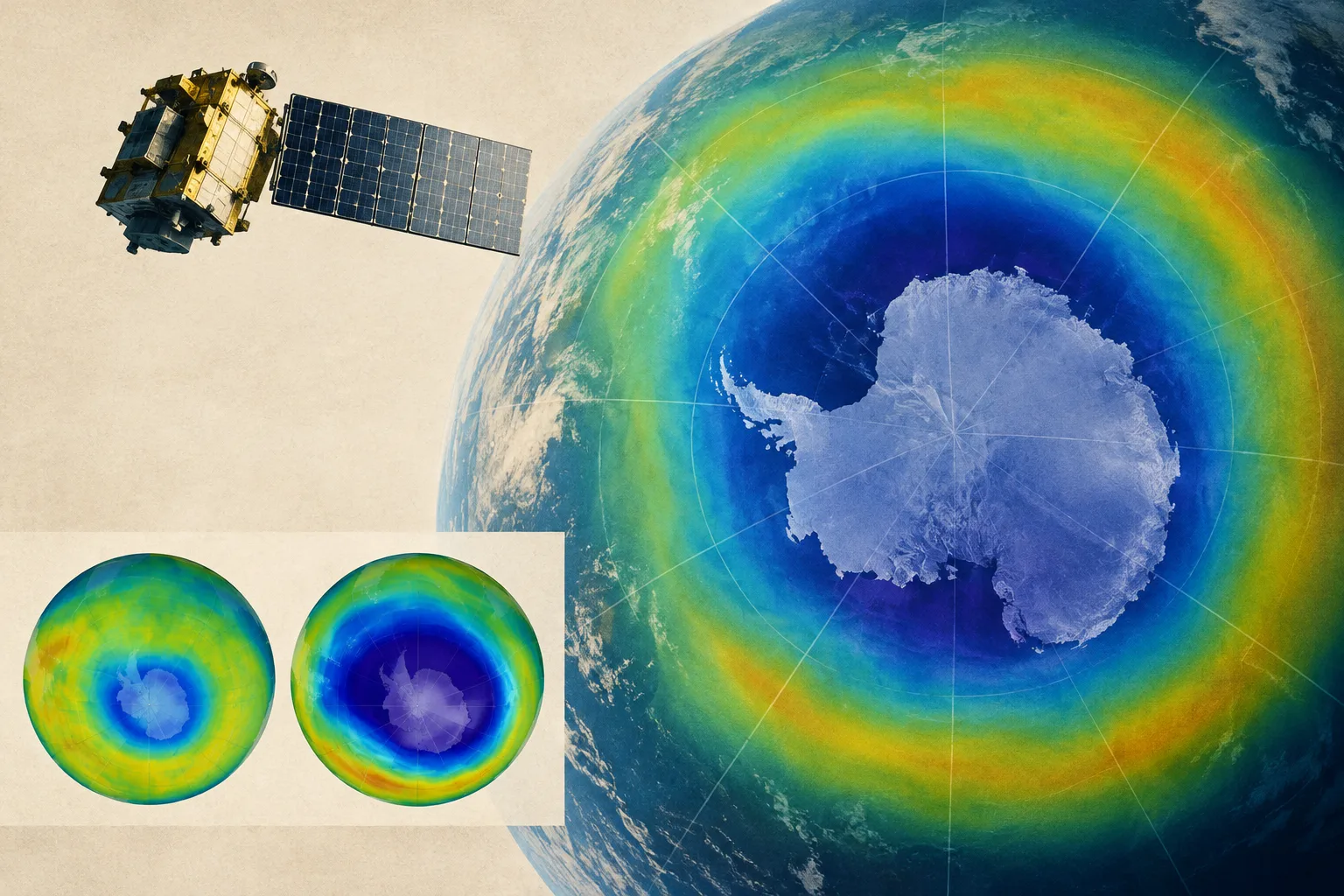
The ozone hole over Antarctica grew to 27.3 million square kilometres in September, making it one of the largest in 48 years. But the European Space Agency says its unusually wide spread did not mean ozone depletion was unusually deep: the hole’s depth remained close to average.
The area was measured on 20 September 2026, about 6.5 million square kilometres — or 31% — above the average for that time of year over the past two decades, according to the ESA. The agency says this year’s hole was driven by an unusually strong, persistent polar vortex, which kept Antarctic stratospheric temperatures favourable for ozone depletion for longer.
The extent of the hole is only one measure of its development. Its depth — the degree of ozone depletion — was close to average, despite the greater area, the ESA says.
The hole forms seasonally, usually beginning in August and reaching its largest extent between mid-September and mid-October. It typically closes by the end of December as the stratosphere warms, ozone depletion slows and the polar vortex breaks down.
The contrast with 2025 is marked: last year’s seasonal ozone hole was the fifth smallest since 1992, while this year’s ranks among the largest in nearly five decades. The ESA says such year-to-year changes are natural and that the ozone layer’s long-term recovery remains on track.
The agency uses observations including those from the Copernicus Sentinel-5P satellite to monitor ozone and the atmospheric conditions that affect it. Consistent records help scientists distinguish natural fluctuations from longer-term trends and assess recovery after the global phase-out of ozone-depleting substances under the Montreal Protocol.
Sign in to give this article a thumbs up or down.
From the discussion
Private test discussion. Comments are readers’ views and are not yet automatically fact-checked. Editing is available for 60 seconds after posting.
Sign in with a confirmed reader account and choose a username to read comments and participate.
Sorting applies to top-level comments; replies remain oldest first. New comments and likes can change the order. Refresh for the current ranking.
Loading comments…