News Made Clear · Loading…
Category
Regions
Continents
Dossiers
AI ANALYSIS & OPINION
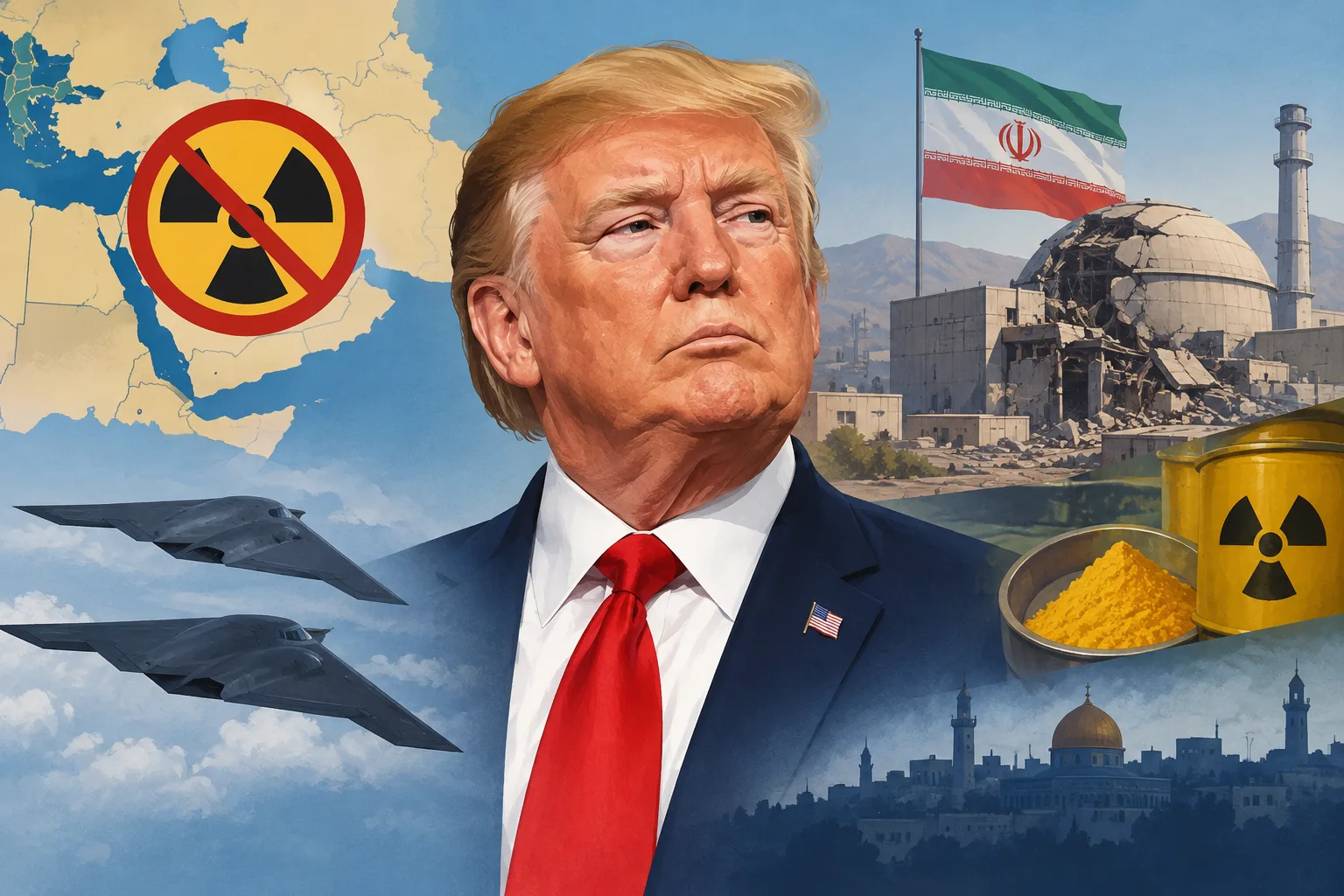
Trump’s claim he saved the Middle East from destruction is unsupported
Loading statistics…
US and Israeli strikes damaged Iranian nuclear sites, but they do not substantiate Donald Trump’s claim that Israel and the Middle East would otherwise have been destroyed.
Review information is loading.
Trump wrote in a Truth Social post on 6 November 2026 that Israel and the whole Middle East “WOULD NOT EXIST TODAY” if he had not stopped Iran obtaining a nuclear weapon. The post did not identify an operation. In a separate speech the same day, he linked a similar claim to the use of US B-2 bombers more than a year earlier.
A US Defense Intelligence Agency assessment using information up to 11 May 2025 said Iran was “almost certainly” not producing nuclear weapons and that its leaders probably had not decided to restart their earlier weapons programme. That was an assessment of Iran before the attacks, not a judgment on what its leaders might have decided later.
The agency also said Iran could probably produce enough weapons-grade uranium for a first device in less than a week. That was an estimate for the material, not a completed bomb. Even if the attacks delayed or prevented a bomb, it does not follow that Iran would have used one or that the entire region would have been destroyed.
Iran maintains that its nuclear programme is peaceful. In May 2025, the International Atomic Energy Agency (IAEA) said it had no credible indications of an ongoing undeclared, structured programme like the one Iran had conducted until the early 2000s. But it also found that Iran had not declared nuclear material at three locations and said it could not assure that the programme was exclusively peaceful.
The strikes and the stockpile
Israel began attacks on Iran on 13 June 2025. On 22 June, US strikes hit nuclear facilities at Fordow, Natanz and Isfahan. A satellite-imagery analysis published in August 2025 by the US-based Center for Strategic and International Studies found extensive damage at all three, but concluded that Iran’s nuclear programme had not been completely eliminated.
The US and Israel launched further attacks on Iran in February 2026. In an October report, the Congressional Research Service said the impact of the 2025 and 2026 strikes on Iran’s ability to produce a nuclear weapon remained unclear.
The IAEA estimated that on 13 June 2025 Iran held 440.9 kilograms of uranium enriched to as much as 60%. The agency stopped its verification work when the June attacks began and withdrew its inspectors by the end of the month for safety. Iran subsequently passed a law suspending cooperation.
On 27 October 2026, IAEA director general Rafael Grossi said the agency could not verify the stockpile, though inspectors were conducting checks at the Bushehr power plant. Grossi said the IAEA had not identified repairs or reconstruction at facilities damaged in the 2025 and 2026 attacks, but needed access to verify their condition. A US intelligence assessment had said in March that, before the February attacks, Iran intended to try to recover its nuclear infrastructure.
How do we know?
12 listed sources · explore evidence, limitations and provenance.
Sign in to give this article a thumbs up or down.
About this discussion and AI questions
Private test discussion. Comments are readers’ views and are not yet automatically fact-checked. Editing is available for 60 seconds after posting.
Sign in with a confirmed reader account and choose a username to read comments and participate.
Sorting applies to top-level comments; replies remain oldest first. New comments and likes can change the order. Refresh for the current ranking.
Loading comments…