News Made Clear · Loading…
Category
Regions
Continents
Dutch government backs EU Kids Act but flags privacy and rights concerns
Loading statistics…
The Netherlands backs the EU’s proposed law to make online services safer for children, while calling for scrutiny of its age limit, verification measures and reliance on parental controls.
Review information is loading.
The Dutch government supports the European Commission’s proposed EU Kids Act, but says its plans for a minimum age and parental controls need closer scrutiny over privacy and children’s rights.
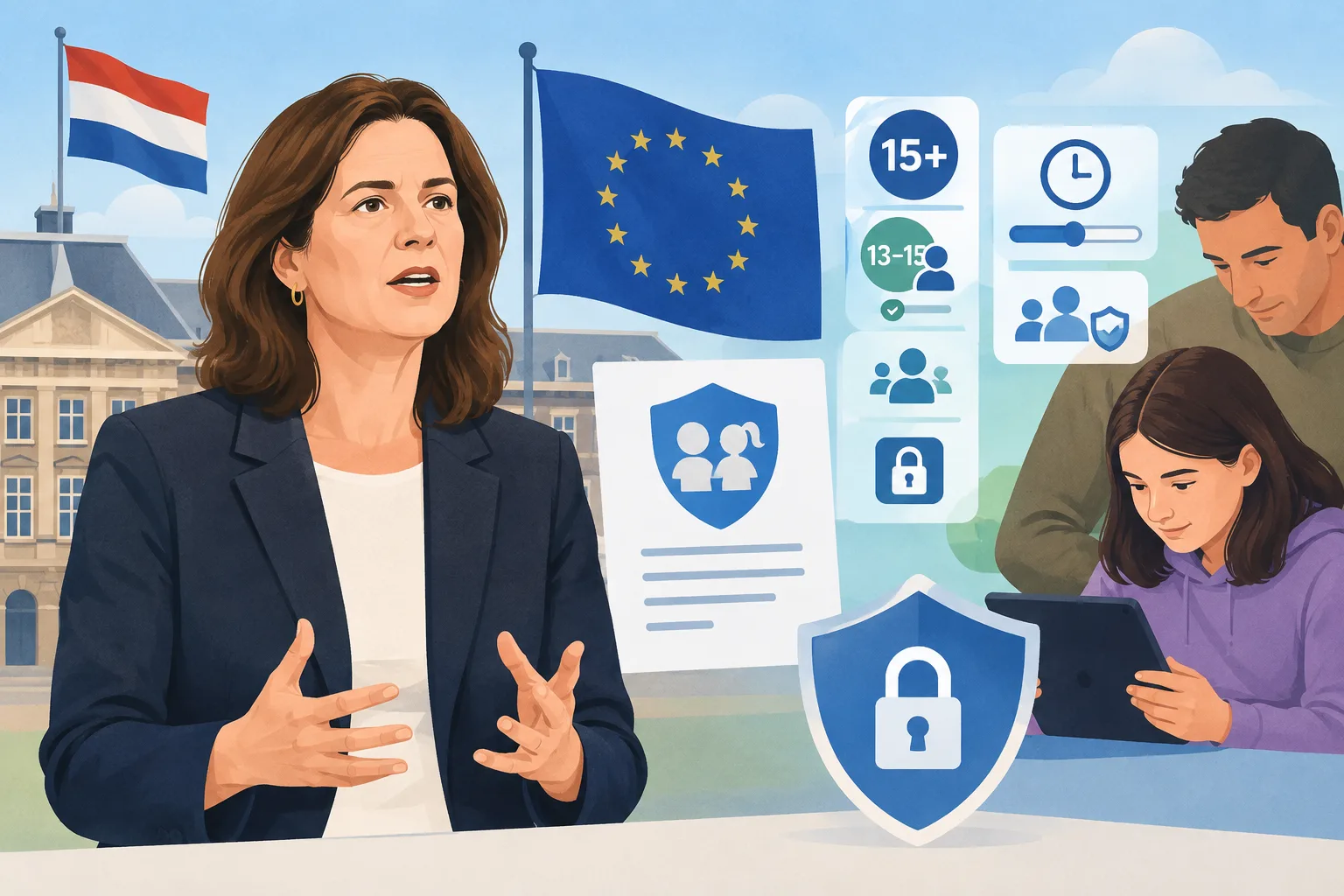
The proposal would set 15 as the minimum age for independently creating social-media and video-platform accounts. Children aged 13 to 15 could use limited “mini-accounts” with parental consent. The draft also requires platforms to offer parents tools to set screen-time limits and monitor their children’s online contacts.
The government says the minimum age could affect freedom of expression and access to information, and wants the Commission to reassess whether it remains necessary if platforms become sufficiently safe. It also warns that relying heavily on parental consent and supervision could disadvantage children whose parents have fewer resources to guide them online. Verifying parental responsibility could bring further privacy risks if services collect unnecessary personal data.
At the same time, the government backs the proposal’s “safety by design” approach, which would make companies responsible for building protections into services, including social media, games, app stores and AI chatbots. Very large online platforms would have to demonstrate compliance to the European Commission.
State Secretary for Digital Economy and Sovereignty Willemijn Aerdts said the Netherlands wanted to protect children online without unnecessarily limiting their rights or placing too much responsibility on parents. She said she would discuss the concerns with European counterparts.
The EU Kids Act remains a proposal. The Dutch government says it is positive about a common European approach, while seeking further examination of the effects of age limits and verification on children’s and adults’ rights and privacy.
How do we know?
1 listed sources · explore evidence, limitations and provenance.
Sign in to give this article a thumbs up or down.
About this discussion and AI questions
Private test discussion. Comments are readers’ views and are not yet automatically fact-checked. Editing is available for 60 seconds after posting.
Sign in with a confirmed reader account and choose a username to read comments and participate.
Sorting applies to top-level comments; replies remain oldest first. New comments and likes can change the order. Refresh for the current ranking.
Loading comments…