Bukele’s Haiti deployment helps retake sites as lasting security remains uncertain
Salvadoran troops have helped Haitian forces retake sites from gangs, but increased fighting has yet to establish whether the intervention will bring lasting safety to civilians.
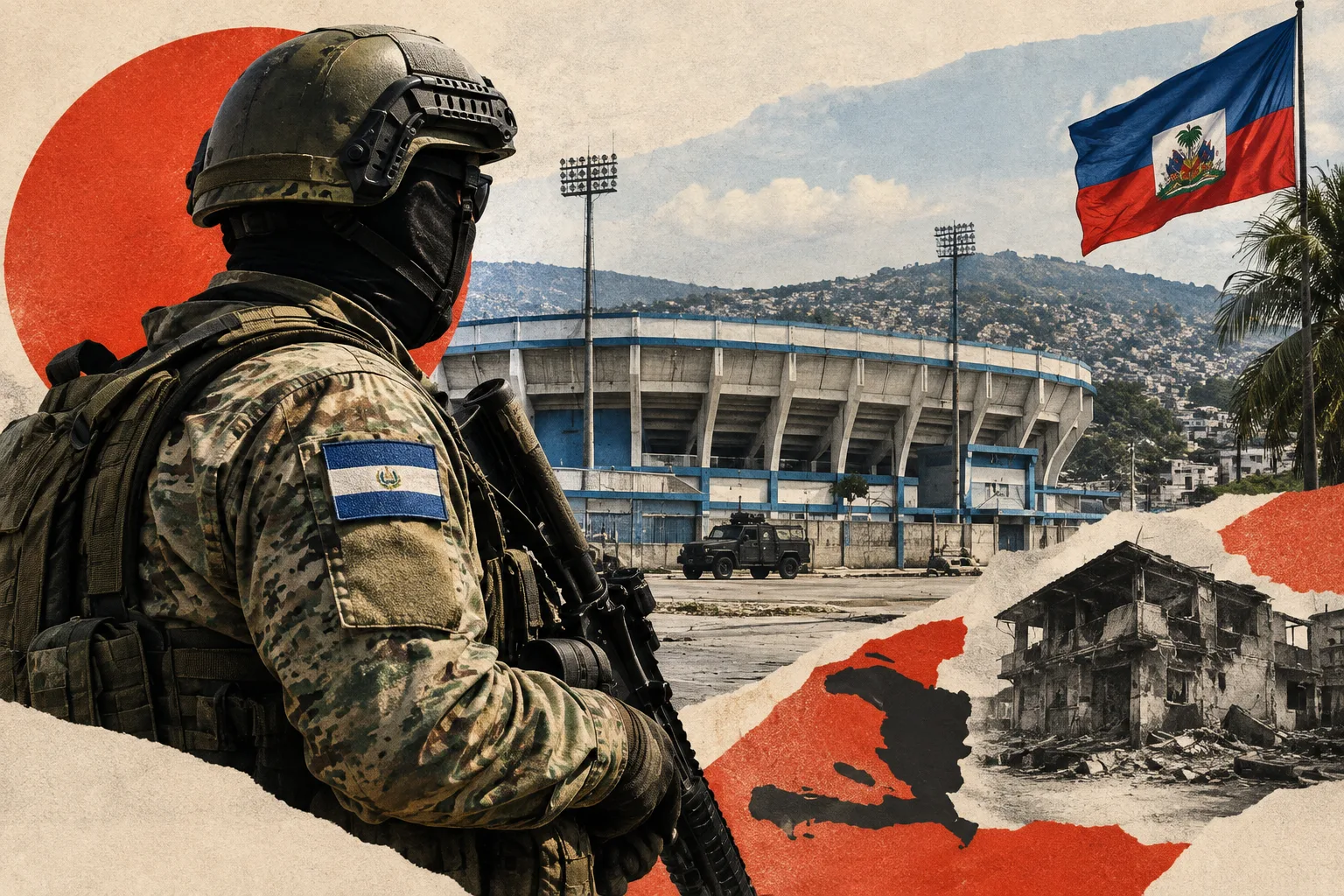
El Salvador expanded its deployment in Haiti after four Salvadoran aviation technicians serving with the UN-backed Gang Suppression Force went missing in a gang ambush on 18 October. The operation has since grown to support other forces fighting gangs.
Conflict monitor ACLED put the deployment, which began on 22 October, at about 2,500 personnel in an analysis published on 11 November. Most Salvadoran troops are operating outside the Gang Suppression Force, under an agreement with Haiti whose terms have not been made public.
Security forces have regained control of the Sylvio Cator football stadium in Port-au-Prince, where Salvadoran troops have established a base, the news agency EFE reported. Haitian police, the Haitian army, the Gang Suppression Force and a private security firm have also taken part in operations to varying degrees, EFE said.
In its 11 November analysis, ACLED reported that recorded clashes between security forces and gangs and drone strikes targeting gangs were up 45.8% over the preceding 21 days, compared with the 21 days before the deployment. Haitian police and the government task force were involved in most of the anti-gang operations recorded in that period, it said. The figures measure activity, not lasting territorial control or whether civilians are safer, and do not isolate the Salvadoran contribution.
President Nayib Bukele has shared footage of an attack on the home of Wilson Joseph, leader of the 400 Mawozo gang. ACLED says Haitian police, a government task force and Salvadoran personnel destroyed the house in Croix-des-Bouquets on 8 November.
The video followed a social media exchange between Bukele and Haitian entrepreneur and writer Sophia Fecu, who had posted a picture of the property and tagged him. Fecu told CNN that seeing the attack made her feel heard: “For the first time, I felt like someone had listened to me.”
But civilians remain at risk. ACLED reported that suspected 400 Mawozo members killed at least ten civilians in Plaine du Cul-de-Sac over the weekend before 16 November, in what it described as retaliation for suspected support for anti-gang operations. The UN has urged all security forces operating in Haiti to protect the population.
Coordination has also been disputed. Axios reported that David Howell, the senior US diplomat in Haiti, warned the Haitian prime minister that Salvadoran troops had nearly killed Gang Suppression Force personnel, according to his understanding. El Salvador rejected the account, saying its fire had not been directed at Chadian positions and that it had coordinated air operations.
Three Salvadoran soldiers have died after an explosion while they were handling explosive material at a camp in Haiti, according to El Salvador’s armed forces. EFE reported that one of the injured later died in hospital in the Dominican Republic and that another was out of danger.
How long the troops will remain is unresolved. El Salvador’s government has said they will leave once the four missing men are found, while Haitian authorities are seeking a longer-term commitment, according to ACLED. Its analyst Sandra Pellegrini says maintaining control of territory retaken from gangs is a central challenge.
Sign in to give this article a thumbs up or down.
From the discussion
Private test discussion. Comments are readers’ views and are not yet automatically fact-checked. Editing is available for 60 seconds after posting.
Sign in with a confirmed reader account and choose a username to read comments and participate.
Sorting applies to top-level comments; replies remain oldest first. New comments and likes can change the order. Refresh for the current ranking.
Loading comments…