News Made Clear · Loading…
Category
Regions
Continents
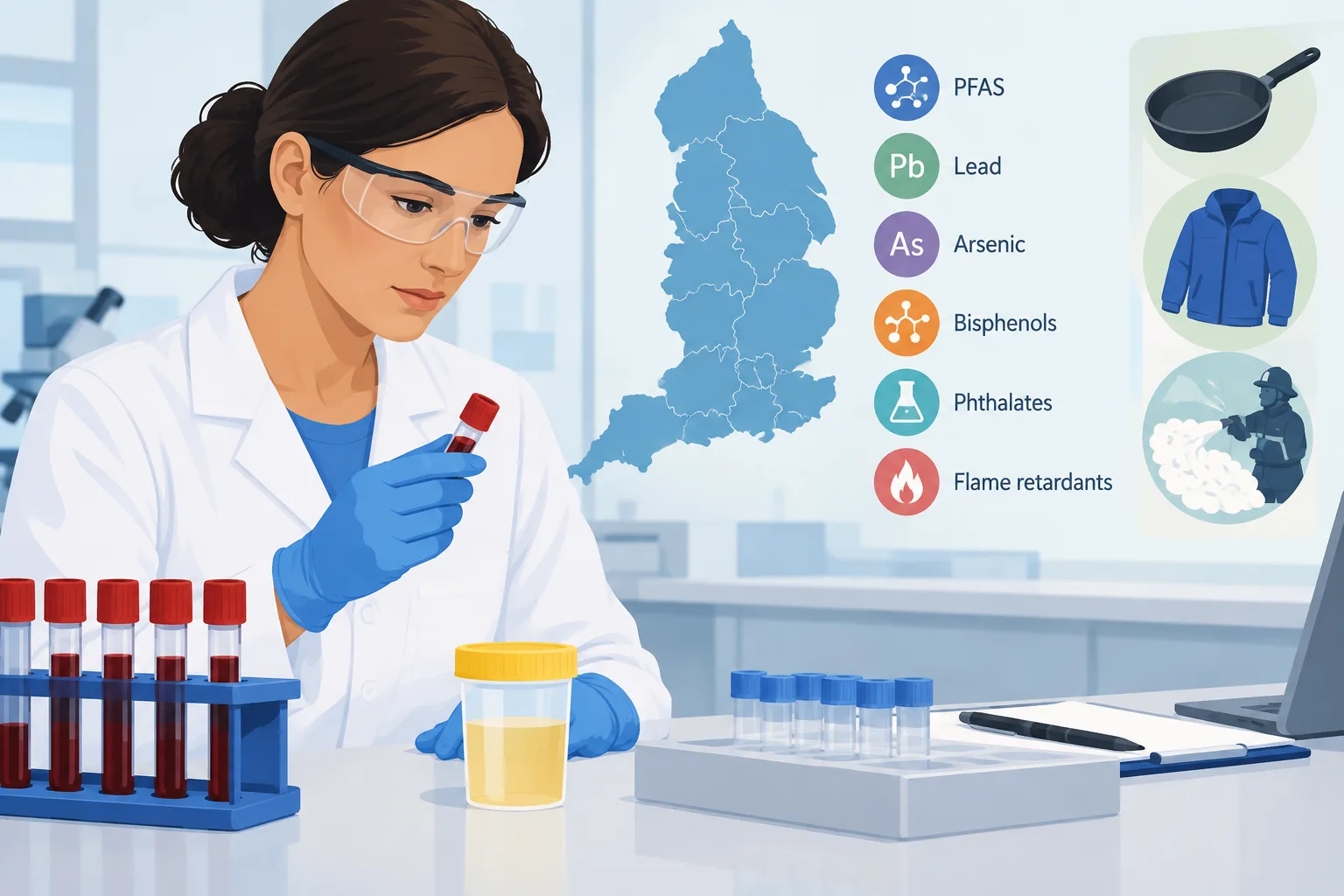
Study to measure ‘forever chemicals’ in people in England
Loading statistics…
Blood and urine samples from a health survey will be analysed to establish background exposure. Results for PFAS are expected after data on some other chemicals.
Review information is loading.
The UK Health Security Agency (UKHSA) will use blood and urine samples collected through the Health Survey for England to establish background levels of PFAS and other substances, the BBC reports. The findings could help inform public health advice and chemical regulation.
The survey covers England, rather than the whole UK. Alongside PFAS, the study will look at lead, arsenic, bisphenols, phthalates and flame retardants. UKHSA says it has access to a small number of population samples through the survey.
The government described a biomonitoring programme using samples from the survey in July, when it expected preliminary results later in 2026.
In a parliamentary answer on 26 October about UKHSA biomonitoring, the health department said laboratory analysis of metals, bisphenols and phthalates had been completed, with publication expected from early 2027. Data on PFAS and flame retardants would follow at a later stage.
PFAS are a large group of synthetic chemicals used in products including non-stick cookware, clothing and firefighting foam. They are known as forever chemicals because they break down slowly in the environment, although different PFAS remain in the body for different lengths of time.
UKHSA says the evidence on health effects is inconsistent, but exposure to two well-studied PFAS, PFOA and PFOS, has been linked to higher cholesterol and lower birth weights. The World Health Organization’s cancer agency classifies PFOA as carcinogenic to humans and PFOS as possibly carcinogenic.
Dr Edward Wynne-Evans of UKHSA told the BBC there were gaps in understanding what different exposure levels mean for an individual’s long-term health. The agency does not recommend routine individual PFAS blood testing: it says a result cannot predict future health problems or establish the cause of existing illness.
How do we know?
4 listed sources · explore evidence, limitations and provenance.
Sign in to give this article a thumbs up or down.
About this discussion and AI questions
Private test discussion. Comments are readers’ views and are not yet automatically fact-checked. Editing is available for 60 seconds after posting.
Sign in with a confirmed reader account and choose a username to read comments and participate.
Sorting applies to top-level comments; replies remain oldest first. New comments and likes can change the order. Refresh for the current ranking.
Loading comments…