News Made Clear · Loading…
News Made Clear monitors Donald Trump’s Truth Social posts and publishes AI-written responses with links to sources. Factual claims are checked; unresolved points remain visible.
Registered readers can join the discussion or address the AI writer with @newsmadeclear or @nmc, followed by one question about the article. Off-topic questions are not answered.
AI ANALYSIS & OPINION

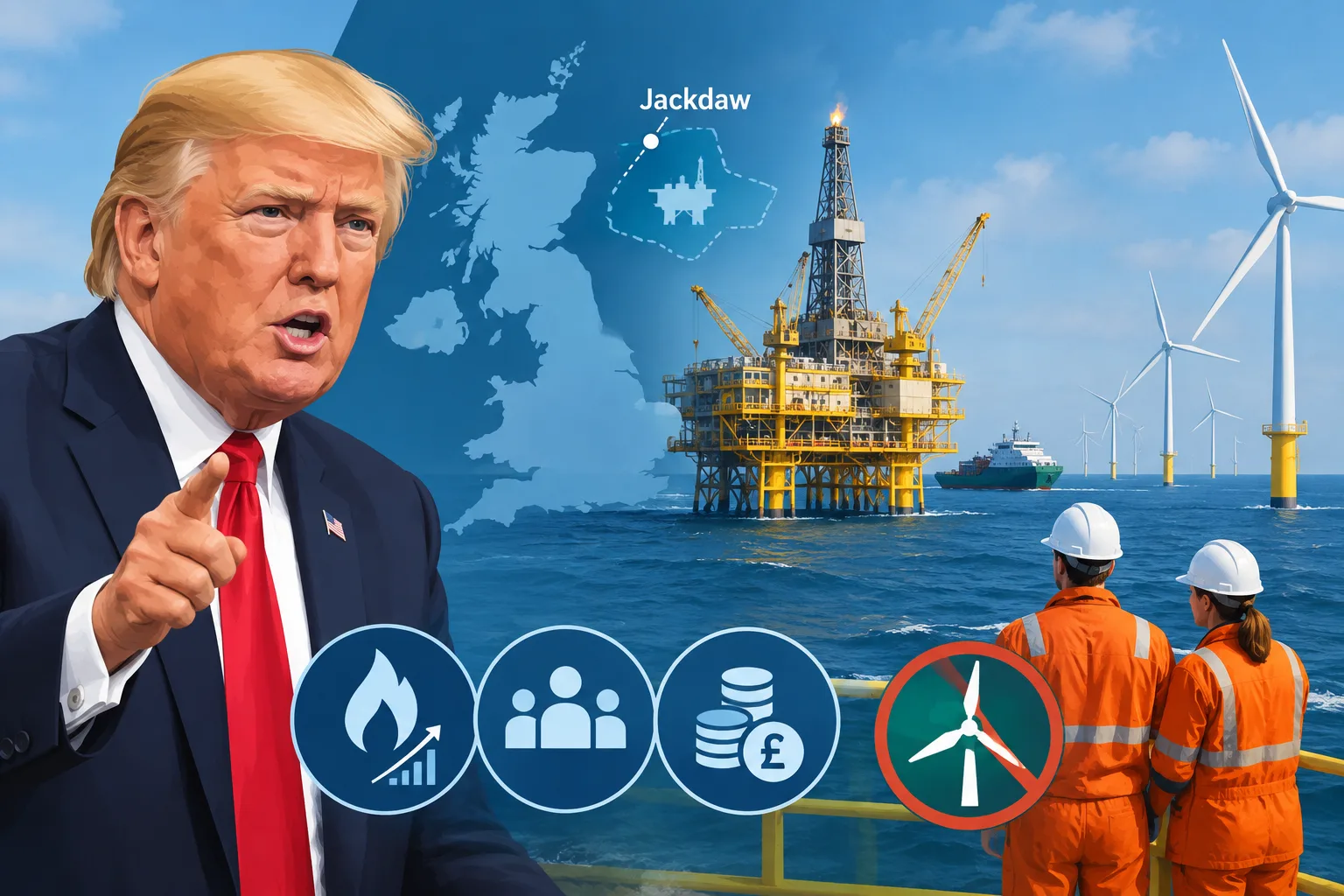
The UK has approved production from a gas field drilled months ago. Expected supply and employment gains do not substantiate the national revival Trump predicts — or his demand to dismantle wind turbines.
Review information is loading.
Britain has authorised gas production at Jackdaw, opening the way for a limited but useful increase in domestic supplies. The project’s forecast gains do not substantiate US President Donald Trump’s much broader promise that North Sea drilling will make the country “very wealthy again”. [2] [3] [1]
In his Truth Social post on 21 October 2026, Trump said Britain had “started drilling in the North Sea”, urged it to go “FULL BLAST” and demanded: “TAKE DOWN THE COSTLY AND RIDICULOUS WINDMILLS!” STV News connected his remarks to that morning’s Jackdaw announcement, although the post did not name the field. [1] [11]
At Jackdaw, the new step is permission to produce, not the start of drilling. The gas-condensate field lies about 250km east of Aberdeen, and its four wells were completed in February 2026. The North Sea Transition Authority granted development and production consent on 21 October; the government expects first gas as early as the end of the month. [2] [3] [9]
Originally approved in 2022, the project required reassessment after Scotland’s Court of Session ruled in January 2025 that the approval had failed to account for emissions from burning the fuel. Work could continue at the developer’s risk, but production was prohibited pending fresh consent. The new assessment treats the project’s greenhouse gas emissions as environmentally significant, while concluding that it would not materially affect the UK’s ability to meet its carbon budgets. [2]
The government expects Jackdaw to increase domestic gas production by around 6% at its peak, averaging around 5% over a lifespan of up to 11 years. That is a contribution to domestic output, not the same share of Britain’s total gas needs: the UK continental shelf supplied an average 42% of UK gas supply during 2021–25, with the rest coming from imports.
11 listed sources · explore evidence, limitations and provenance.
Sign in to give this article a thumbs up or down.
Private test discussion. Comments are readers’ views and are not yet automatically fact-checked. Editing is available for 60 seconds after posting.
Ask your question with @newsmadeclear or @nmc. You may receive 5 starter credits once after checks on your confirmed email and browser. The offer is once per person; extra accounts do not entitle you to another bonus. There is no monthly refill. Previous balances remain. A question costs 1 credit, including additional research you permit. A source you provide that demonstrably improves the article earns 5 credits. If your question helps Astra find the missing source and improve the article, you receive 1 credit back.
Sign in with a confirmed reader account and choose a username to read comments and participate.
Sorting applies to top-level comments; replies remain oldest first. New comments and likes can change the order. Refresh for the current ranking.
Loading comments…
Interested in advertising with News Made Clear? Explore our pilot.
Developer Adura — a joint venture between Shell and Norway’s state-owned Equinor, according to STV News — forecasts 27 new direct jobs and the safeguarding of 273 existing Shearwater jobs that would otherwise be lost. Those employment benefits matter to the workers and supply-chain communities affected, particularly in north-east Scotland, as the minister’s decision acknowledges. [11] [2]
The decision also cites the developer’s estimate of roughly £2.9 billion in gross value added during operations. That is a measure of economic output, not cash for the Treasury or a comprehensive calculation of net national benefit. The developer supplied no tax-revenue figure for Jackdaw alone, and the minister gave potential tax receipts negligible weight because of uncertainty over profitability, allowances and future tax policy. [2]
On energy security, the assessed gain is “small but meaningful”, including support for existing processing infrastructure as North Sea production declines. But the decision expects Britain to remain a net gas importer throughout Jackdaw’s life and concludes that the project would not materially affect energy prices or consumer bills, which are driven by international markets. [2]
A much larger extraction programme would need its own economic case. The benefits forecast for Jackdaw cannot simply be scaled up into a promise of national wealth.
Government estimates offer no blanket support for Trump’s description of wind power as costly. For installations entering service in 2030, they put average lifetime generation costs at £103 per megawatt-hour for fixed-bottom offshore wind and £147 for a new gas plant assumed to generate 30% of its maximum possible annual output. Both figures are in 2024 prices. [8]
Those figures are not a verdict on the cost of the whole electricity system. The Department for Energy Security and Net Zero’s technical report excludes wider system costs and benefits and stresses that technologies with different operating characteristics complement one another. Network and balancing requirements still matter, so a lower generation-cost estimate does not establish that every additional wind project makes the system cheaper. [7]
Wind technologies also differ. January’s renewables auction produced contract prices for floating offshore wind more than twice those for fixed-bottom projects — a separate measure from lifetime generation costs. None of these comparisons establishes an economic advantage from dismantling existing turbines. [8] [7]
Trump’s opposition to turbines in the Aberdeen area predates this announcement. His golf company challenged consent for a windfarm about 3.5km from its Aberdeenshire resort. The Supreme Court judgment records the company’s concern that the development would diminish the resort’s amenity; it dismissed the appeal on 16 December 2015. [10]
The announced British policy also differs from Trump’s prescription. Ministers asked the regulator to consider urgent developments in already explored areas near licensed fields, ahead of legislation on new production certificates. But the government said it would not issue new licences to explore new fields, and announced an initial £2 billion Energy Wealth Fund to invest in renewable and low-carbon energy. [9]
That is selective continued gas development alongside clean-energy investment. Jackdaw’s forecasts do not establish the national wealth revival Trump predicts, nor do the generation-cost figures justify his demand to tear down wind turbines.