CNN: Investigators identify router setting in US flight ground stop inquiry
A person familiar with the inquiry told CNN that an overlooked setting affected how a new router interacted with older equipment. Questions also remain over oversight of the maintenance work.
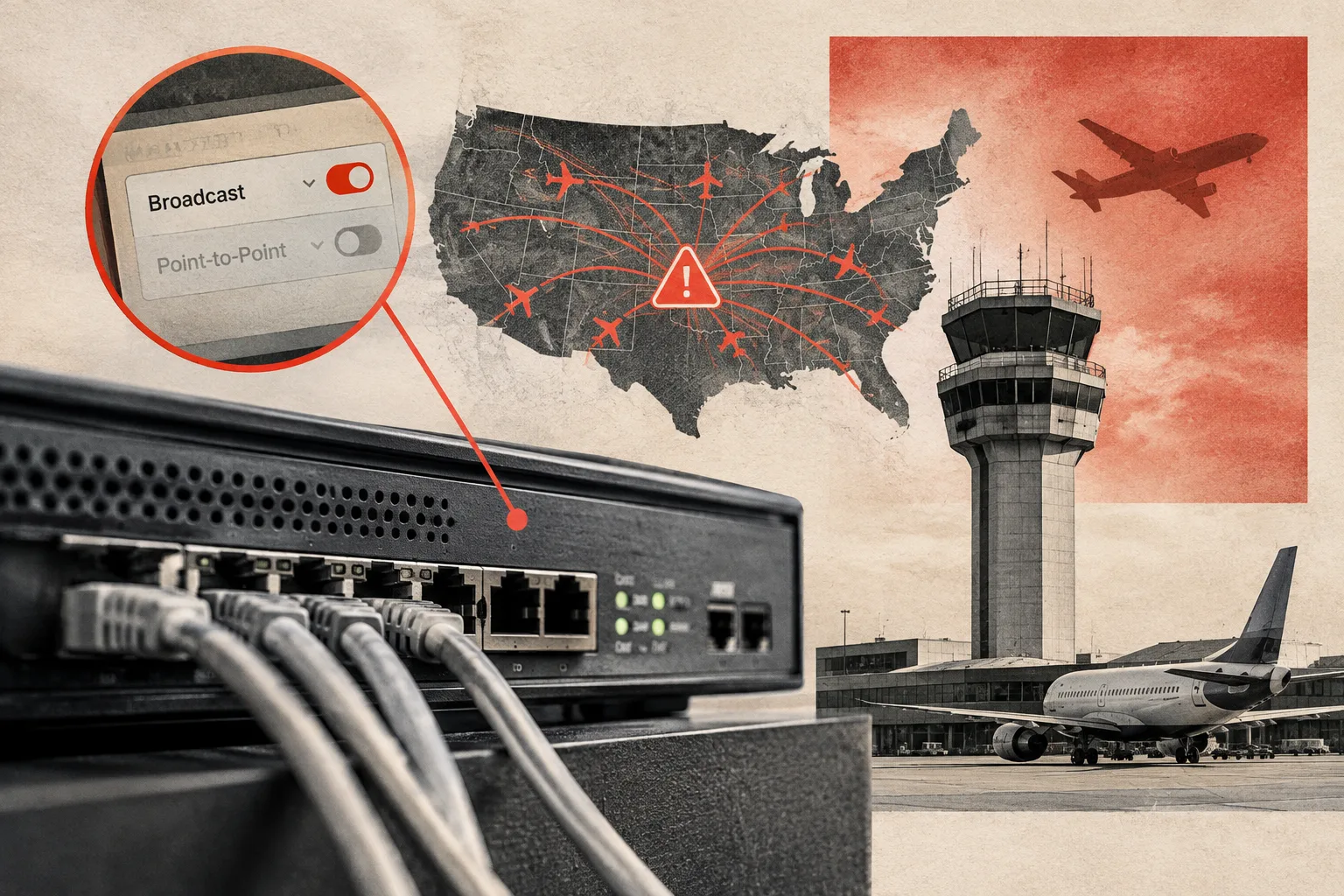
Investigators have recreated the technical failure behind the US nationwide flight ground stop and believe they have found its cause, CNN reported, citing a person familiar with the inquiry.
The person said an overlooked setting affected how a new router at an Arkansas radio site interacted with older routers in the Federal Aviation Administration’s network. CNN said investigators were preparing a report.
The FAA said it halted departures at about 3.30pm Eastern time on 13 November and that traffic resumed at 8.15pm after the system stabilised. It said older equipment became unstable when the network received about 1,000 connection attempts every four to five seconds, disrupting aircraft communications and radar feeds.
Operators cancelled approximately 12,462 flights that day, including 9,082 at major airlines, the FAA said. It cautioned that not all were directly caused by the ground stop.
In its initial account, the FAA identified two possible locations for the excess data: the radio site in El Dorado, Arkansas, where contractor L3Harris had installed a new router, and a radar site in Amarillo, Texas. It said the network stabilised after L3Harris blocked both locations.
On 15 November, Transport Secretary Sean Duffy said a router was being examined at an L3Harris laboratory in Florida with FAA staff present. He said investigators suspected the router or its installation, but remained open to other explanations.
Router maker HPE Juniper told local broadcaster KATV that the device had behaved as configured, using a broadcast function rather than a point-to-point connection. KATV said the company did not explicitly blame an installation error.
On 15 November, the FAA said it had disabled the same function on more than 60 other Juniper routers as a precaution and paused their installation.
How the maintenance was supervised is also disputed. The Professional Aviation Safety Specialists union said its technicians had not been involved in the upgrades and that FAA staff had historically assessed risk and co-ordinated such work.
The FAA told CNN it carries out continuous risk assessments and oversees L3Harris through service performance monitoring rather than on-site supervision. The agency said its personnel do not certify the contractor’s router installation work.
An FAA memo from March 2025, quoted by KATV, said certain maintenance would move from a request process to notifications and go ahead without FAA approval, while still being co-ordinated. The memo allowed requests to postpone work in extreme circumstances through an escalation process.
Whether that change applied to the El Dorado job, or contributed to the disruption, remains unresolved.
Sign in to give this article a thumbs up or down.
From the discussion
Private test discussion. Comments are readers’ views and are not yet automatically fact-checked. Editing is available for 60 seconds after posting.
Sign in with a confirmed reader account and choose a username to read comments and participate.
Sorting applies to top-level comments; replies remain oldest first. New comments and likes can change the order. Refresh for the current ranking.
Loading comments…