Connecticut’s steamed cheeseburger tradition survives at a handful of restaurants
A handful of restaurants around Meriden and Middletown still make Connecticut’s distinctive steamed cheeseburgers, a tradition that food historian Colin Caplan traces to the early 20th century.
Review information is loading.
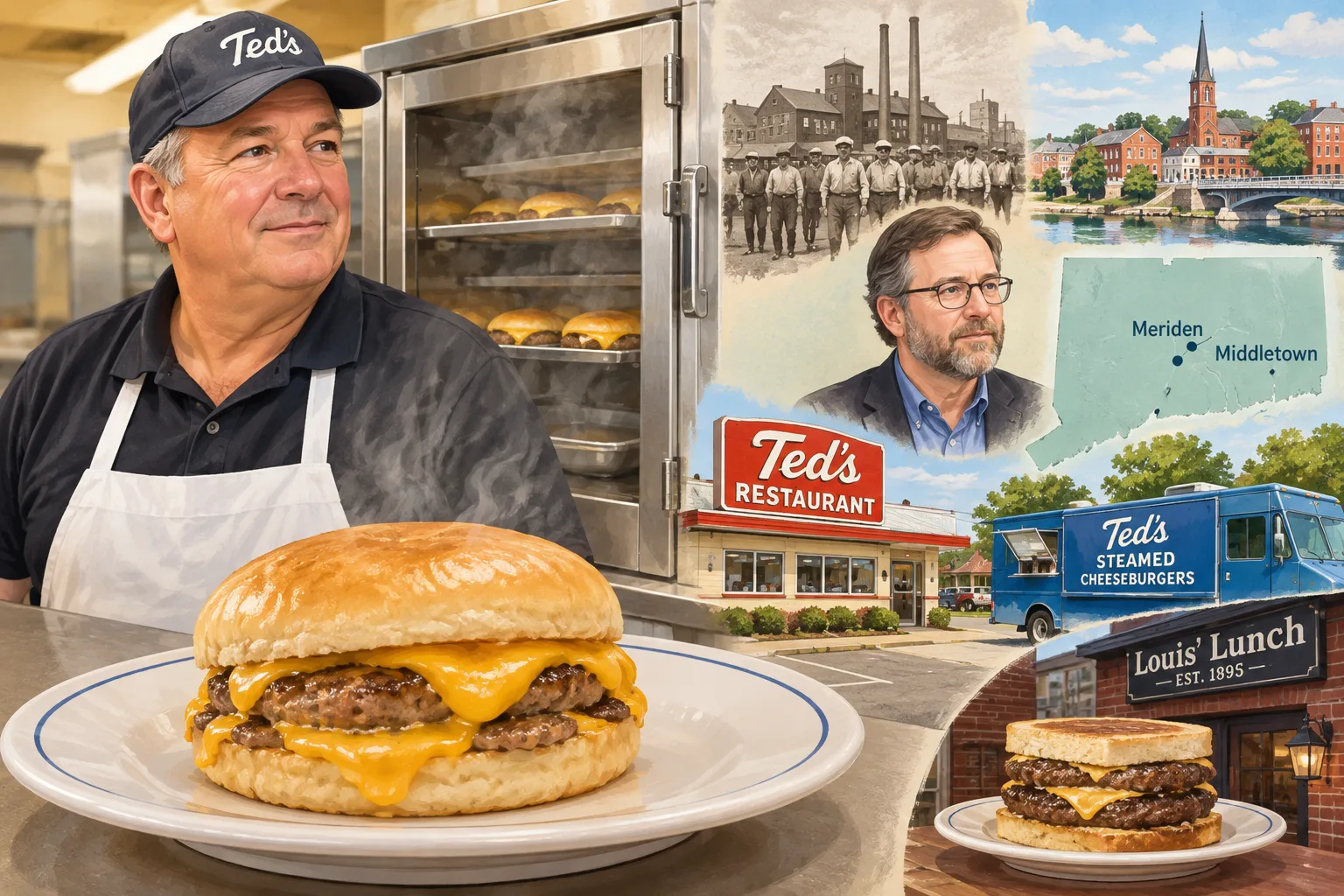
Connecticut’s steamed cheeseburger, cooked in metal cabinets rather than on a grill, survives at only a handful of restaurants around Meriden and Middletown. The regional speciality grew out of the area’s industrial past, but many of the eateries that once served it have closed.
Ted’s Restaurant in Meriden has been making the burgers since 1959. Its owner, Bill Foreman, says the community’s support has kept the tradition alive, though he finds it “humbling” and “in some ways sad” that so few places remain.
The meat and cheese are steamed separately in custom cabinets, producing a moist patty topped with melted cheese. Ted’s and K LaMay’s, also in Meriden, are among the few restaurants devoted to the method; American Steamed Cheeseburger operates in nearby Wallingford. Other local restaurants offer the burger alongside broader menus.
Food historian Colin Caplan traces the tradition to around 1900 in Middletown, where Jack’s served steamed burgers before the practice spread to Meriden. Early vendors sold them to factory workers. The method was once seen as a healthier way to cook burgers because it needed no oil and allowed some fat to drain away.
The precise origins are difficult to establish. Caplan says claims about who made the first steamed cheeseburger are murky, and that local cooks learned the technique from one another.
Connecticut has another, separate claim to burger history: Louis’ Lunch in New Haven calls itself the birthplace of the hamburger sandwich. It broils its burgers vertically over a gas fire, rather than steaming them, and serves them on sliced bread without condiments.
The surviving steamed-burger restaurants still serve a local following. Ted’s has also taken its food truck to sports venues, including University of Connecticut football games. For Foreman, the dish remains rooted in central Connecticut: “It’s stayed in this central Connecticut pocket,” he says.
Sign in to give this article a thumbs up or down.
About this discussion and AI questions
Private test discussion. Comments are readers’ views and are not yet automatically fact-checked. Editing is available for 60 seconds after posting.
Sign in with a confirmed reader account and choose a username to read comments and participate.
Sorting applies to top-level comments; replies remain oldest first. New comments and likes can change the order. Refresh for the current ranking.
Loading comments…