CTE blood marker shows promise in small study, but test is not ready for diagnosis
A small study found a blood marker associated with advanced CTE in former American football players, but researchers say it is not ready to diagnose the condition in living people.
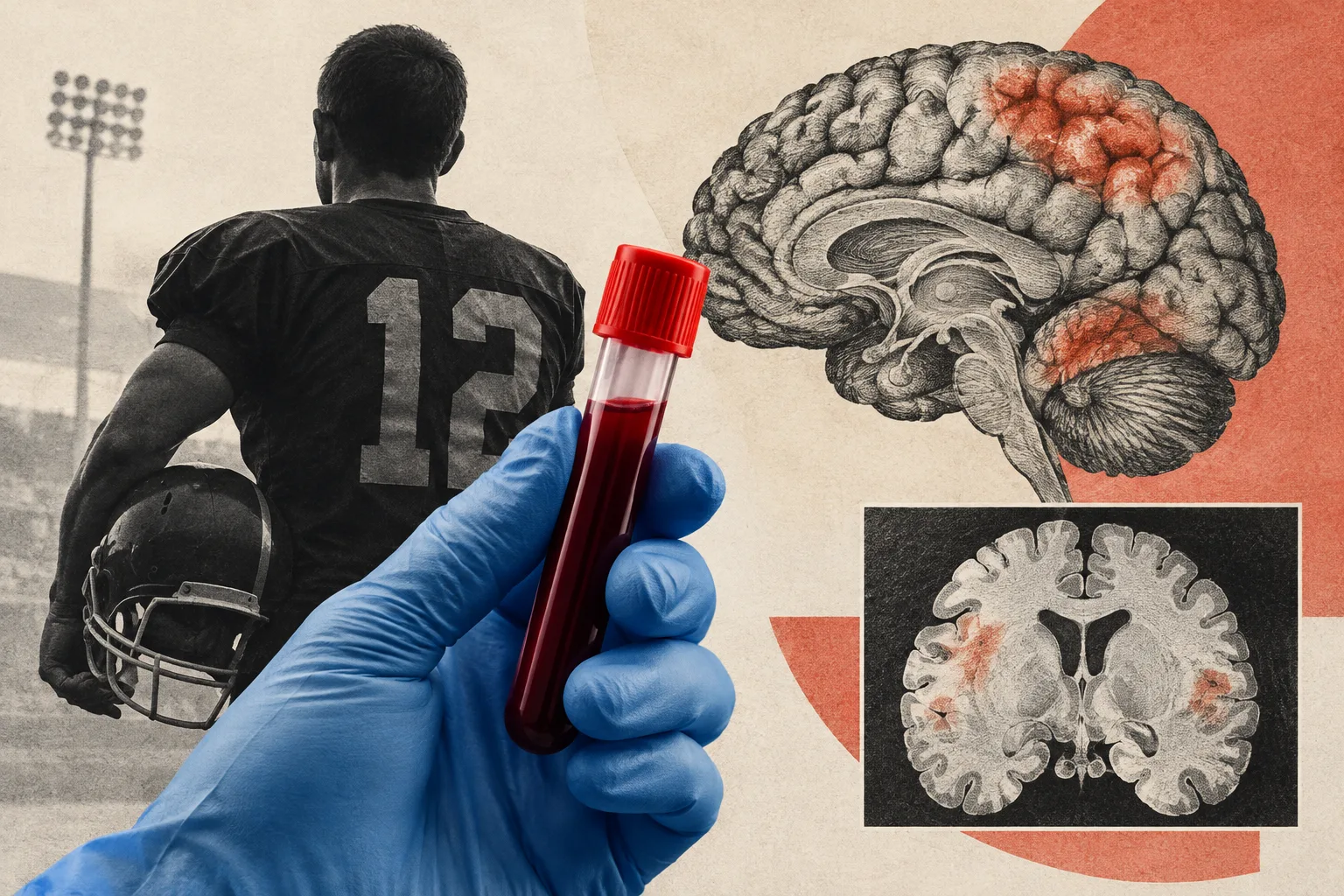
Researchers have found a blood marker that could one day help detect advanced chronic traumatic encephalopathy, or CTE, while a person is alive. The degenerative brain condition is associated with repeated head impacts and can currently be accurately diagnosed only through an examination after death.
The JAMA study examined blood taken during the lives of 21 men who had played American football and later donated their brains for research. Post-mortem examinations found advanced CTE in 16 of the 21 former players, early-stage CTE in two and no CTE in three. Levels of a blood marker called eMTBR-tau were higher in the advanced-CTE group than in those with early-stage or no CTE.
The comparison included just five people with early-stage or no CTE, and the study did not have age-matched controls. The researchers say larger studies are needed to determine how accurately and specifically the marker identifies CTE. Annalise Miner, the study’s first author, said the test is not approved by the US Food and Drug Administration, is not available to the public and should not be used to diagnose CTE before validation.
The marker is also associated with the build-up of tau protein in Alzheimer’s disease. A separate JAMA study of 728 participants investigated the marker in Alzheimer’s-related tau pathology. Distinguishing between conditions will matter when assessing a potential CTE test.
In the CTE study, marker levels were highest in the five participants who had both CTE and Alzheimer’s-related brain changes. The association with advanced CTE remained after those five cases were excluded.
Boston University said another group had also found elevated levels of a related marker in different people with CTE confirmed at autopsy, using a different method.
A reliable test could eventually give athletes information to consider when deciding whether to continue playing. Writing for MS NOW, Jason Page raised questions about who would see players’ results and what those results could mean for their careers.
Page cited figures of 91.7% to 93.5% for CTE among former players whose brains had been donated and suggested that many living players were highly likely, if not almost certain, to develop it. But figures from donated brains do not on their own establish that conclusion: donors are a selected group, and those figures do not account for players whose brains were not donated. That does not mean the wider risk is low.
Page argues that any future testing should be voluntary, with results discussed privately with an independent doctor and clearly explained to the player.
Sign in to give this article a thumbs up or down.
From the discussion
Private test discussion. Comments are readers’ views and are not yet automatically fact-checked. Editing is available for 60 seconds after posting.
Sign in with a confirmed reader account and choose a username to read comments and participate.
Sorting applies to top-level comments; replies remain oldest first. New comments and likes can change the order. Refresh for the current ranking.
Loading comments…