News Made Clear · Loading…
Category
Regions
Continents
AI models estimate cancer survival from facial photos, but remain experimental
Loading statistics…
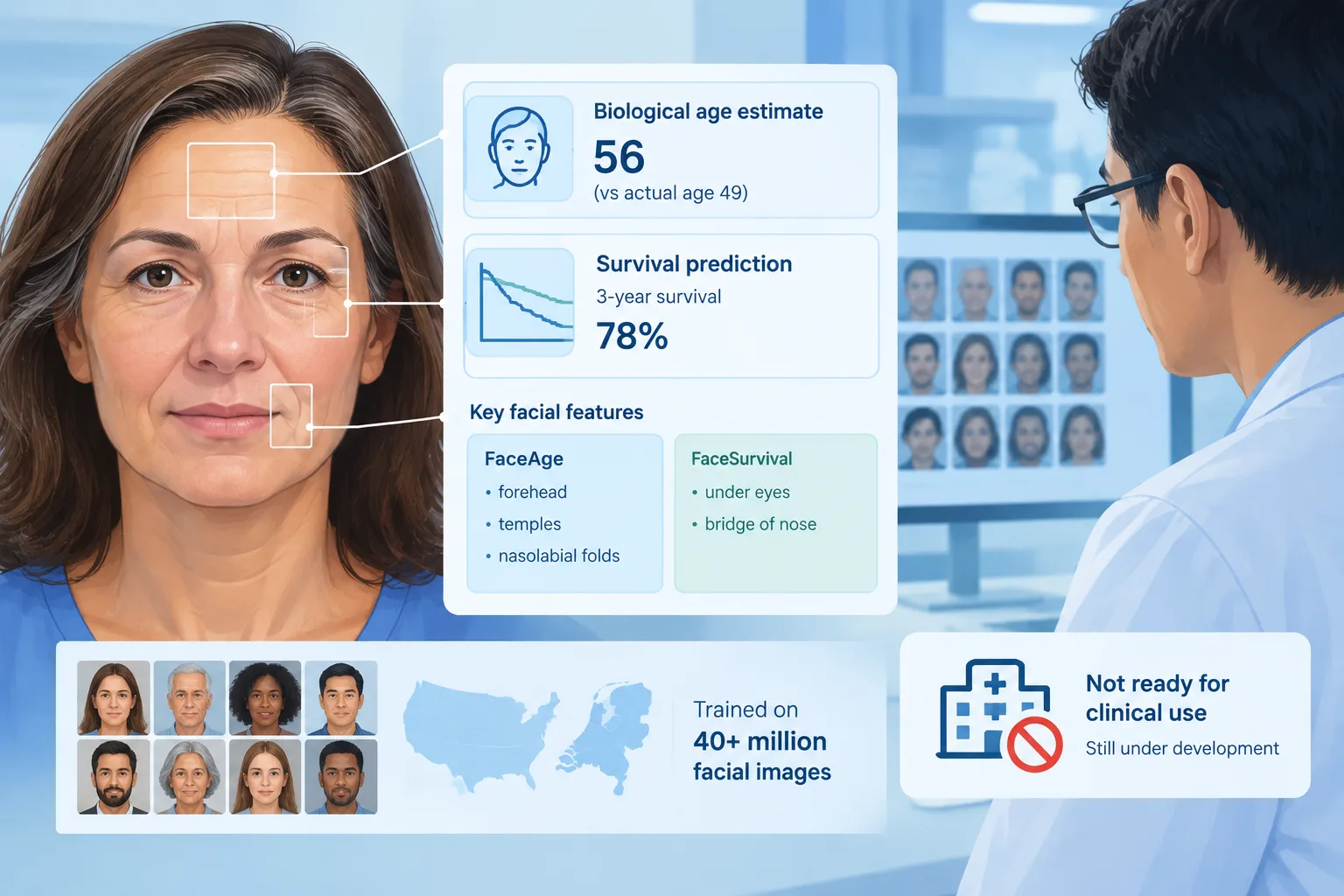
Researchers say AI models trained on more than 40 million facial images can estimate biological age and predict cancer survival from a face photograph. The tools remain experimental and are not ready for clinical use.
Review information is loading.
Researchers have developed artificial intelligence tools that estimate biological age and predict survival outcomes for cancer patients from a photograph of their face. But the system is still under development and is not ready for use in hospitals, the researchers say.
The model, developed by researchers at US healthcare group Mass General Brigham, was trained on more than 40 million facial images. It produced two tools: FAHR-FaceAge, which estimates how old someone appears compared with their actual age, and FAHR-FaceSurvival, which predicts cancer survival directly from a face photograph. [1] [2]
The models use different facial features. FaceAge focuses on areas including the forehead, temples and folds beside the nose and mouth; FaceSurvival places more weight on the area under the eyes and around the bridge of the nose, according to the researchers. Their estimates were only weakly correlated, and combining them improved the fit of a survival model in an external validation group, Mass General Brigham said. [1]
The BBC reports that the study included 35,000 photographs of cancer patients. It says the patients were from the US and the Netherlands, with a range of cancer types and ages. Among US patients treated with radiotherapy, those estimated to look at least five years older than their actual age had a 21% higher risk of dying during an average four-year follow-up than the rest of the group; those estimated to look at least five years younger had a 17% lower risk, The Guardian reports. [2] [3]
Those findings show an association between the model’s age estimates and survival in the groups studied. They do not establish that a face photograph can explain a person’s prognosis or replace the clinical checks doctors already use.
The study’s lead researcher, Raymond Mak, said the aim was to make facial-photo health assessments more consistent and scalable to support treatment decisions, “rather than replace physician judgment”. [1]
How do we know?
3 listed sources · explore evidence, limitations and provenance.
Sign in to give this article a thumbs up or down.
About this discussion and AI questions
Private test discussion. Comments are readers’ views and are not yet automatically fact-checked. Editing is available for 60 seconds after posting.
Sign in with a confirmed reader account and choose a username to read comments and participate.
Sorting applies to top-level comments; replies remain oldest first. New comments and likes can change the order. Refresh for the current ranking.
Loading comments…