Did four out of five new jobs go to non-British nationals? A look at UK payroll figures
Reform UK’s Zia Yusuf says four out of five new jobs went to foreign nationals. A correction in the Daily Mail brought the claim back into the spotlight. What do the UK payroll figures actually show?

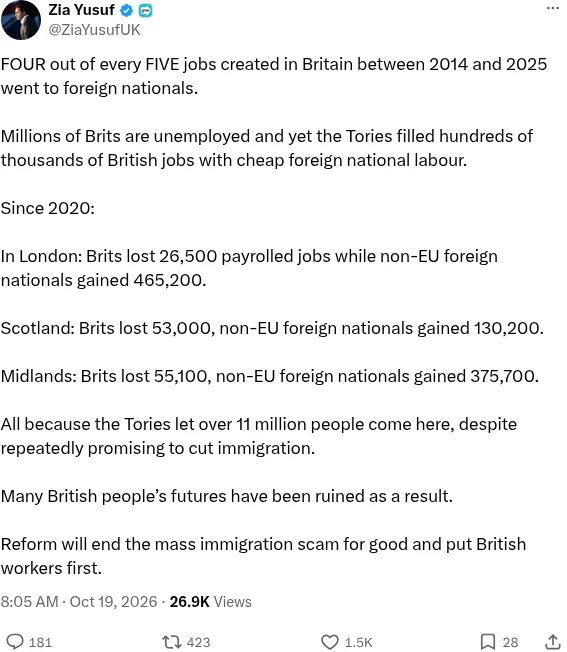
On 19 October 2026, Reform UK politician Zia Yusuf wrote on X that four out of five jobs created in the United Kingdom between 2014 and 2025 went to foreign nationals. [1]
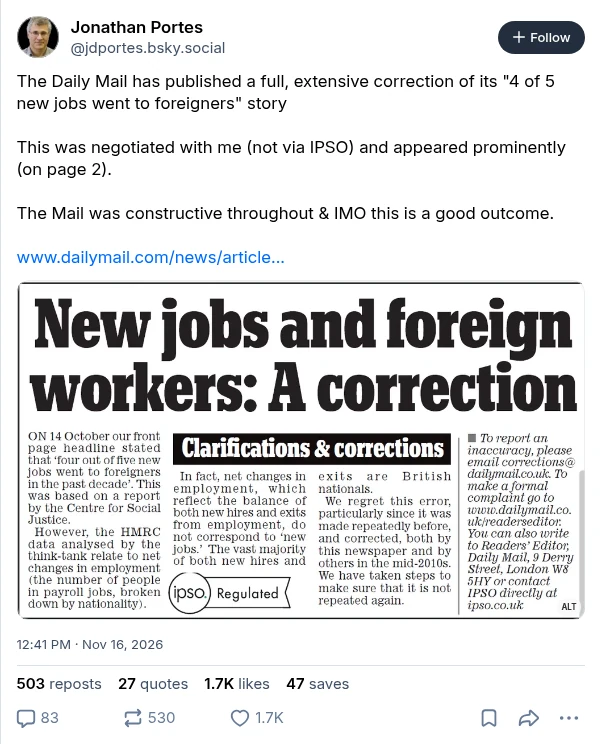
On 16 November, Jonathan Portes, professor of economics and public policy at King’s College London, shared on Bluesky a correction he had agreed with the Daily Mail. The correction said the figures show the net change after people were hired and others left. Portes was addressing the newspaper’s headline. Yusuf had previously cited the same figures on X. [2]
The two portraits above this article are an AI-generated editorial illustration by News Made Clear.
In a correction below the article, the Daily Mail said it had incorrectly described a net change in payroll jobs as ‘new jobs’ [5]. On 19 November, The London Economic reported on the correction [6].
The UK tax authority, HMRC, counts payroll jobs, not individual workers. Someone with two payroll jobs can therefore be counted twice. HMRC uses the nationality a person declares when registering for a UK National Insurance number as an adult. If someone later changes nationality, they are still counted under the nationality they originally declared [3].
We compared the figures for July 2014 and December 2025 in HMRC’s monthly table. By the end of the period, there were about 3.67 million more jobs on payrolls than at the start. The number of jobs in the group HMRC classifies as non-British rose by about 2.94 million. That is indeed about four-fifths of the net increase [4].
Suppose a shop hires ten people and eight leave in the same period. At the end, there are two more people on the payroll, even though ten were hired. Comparing the figures by nationality still only shows the net change. It does not tell you who was hired for a new role or who replaced someone who had left.
Yusuf is therefore wrong about what the UK payroll figures show. Four out of five is correct as a share of the net increase. But the figures cannot tell us who got four out of five newly created jobs. That is precisely the distinction Portes pointed out.
Sign in to give this article a thumbs up or down.
From the discussion
Private test discussion. Comments are readers’ views and are not yet automatically fact-checked. Editing is available for 60 seconds after posting.
Sign in with a confirmed reader account and choose a username to read comments and participate.
Sorting applies to top-level comments; replies remain oldest first. New comments and likes can change the order. Refresh for the current ranking.
Loading comments…