News Made Clear · Loading…
Category
Regions
Continents
Topics
Severe drought declared across parts of southern England
Loading statistics…
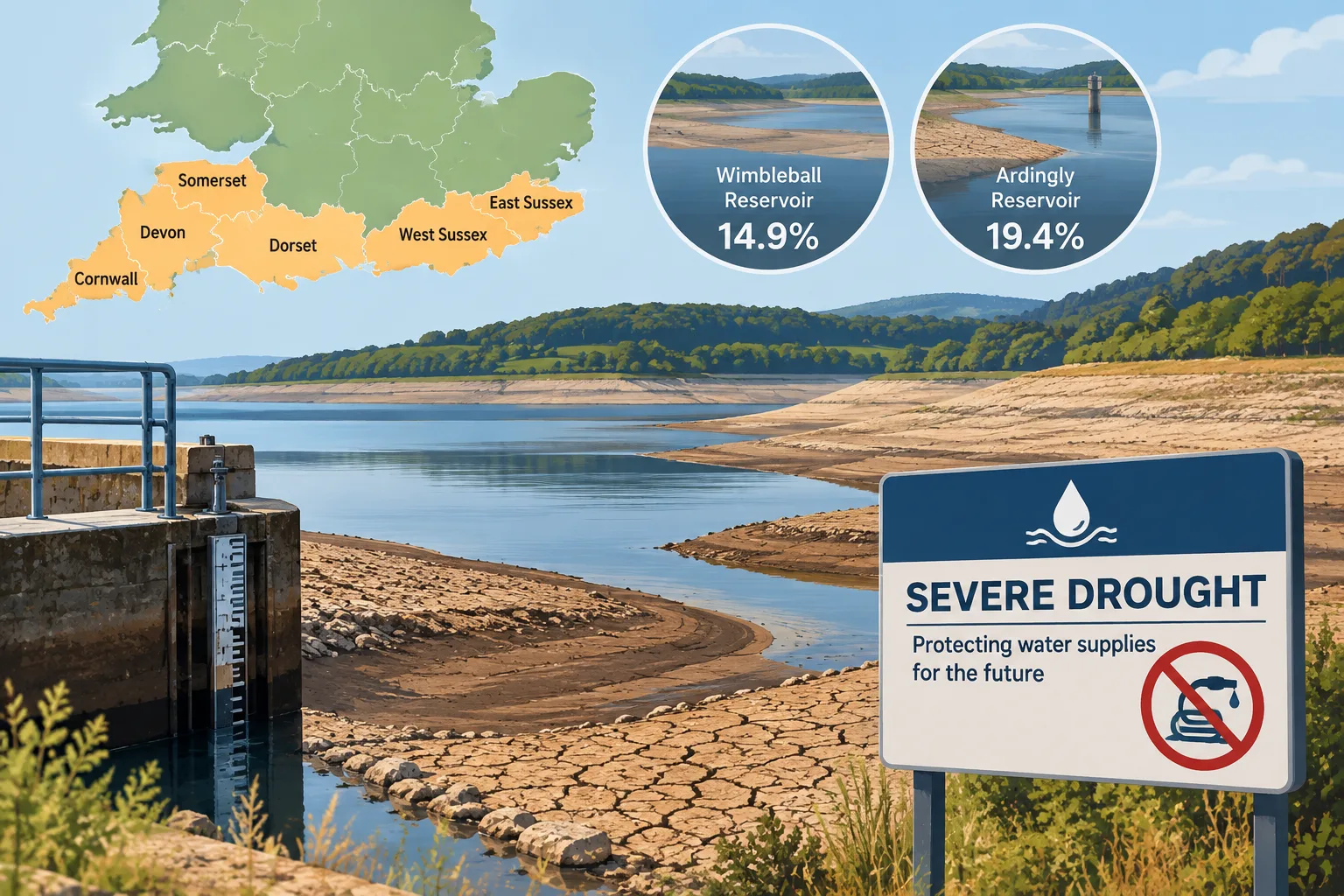
Parts of six southern English counties have been placed in the country’s highest drought category, with two major reservoirs below 20% capacity. The declaration triggers additional monitoring and conservation measures, but does not itself impose new restrictions.
A severe drought has been declared across parts of southern England, as months of low rainfall and high water demand leave several reservoirs at unusually low levels. The status signals a co-ordinated effort to protect supplies, but does not automatically bring new restrictions or mean a civil emergency.
The Environment Agency’s declaration covers parts of Cornwall, Devon, Dorset, Somerset, East Sussex and West Sussex. The decision followed a review by the National Drought Group, with particular concern over Ardingly Reservoir in West Sussex and Wimbleball Reservoir in Somerset. [1]
Wimbleball was at 14.9% capacity and Ardingly at 19.4%, according to the latest figures cited by the BBC. Other reservoirs were also low: Stithians in Cornwall stood at 21%, while Roadford in Devon was at 36.8%, Burrator at 33.6% and Colliford in Cornwall at 35%. The Environment Agency said reservoir storage was expected to be about 75% at this time of year. [1]
Severe drought is the highest drought status the agency can declare. It is used when drought is causing, or is likely to cause, serious harm and urgent action is needed. The government says customer water supplies will continue uninterrupted, while ministers have instructed water companies to monitor reservoir and river levels daily and increase water-quality checks. The agency will also step up checks on businesses taking water from natural sources. [1]
The agency has issued permits allowing South East Water to reduce the volume released from Ardingly into the River Ouse by three million litres a day, and South West Water to cut releases to the River Exe by nine million litres a day. [1]
Restrictions are already in place in some areas. A hosepipe ban has applied in Devon, Cornwall, the Isles of Scilly and parts of Dorset and Somerset since 8 August, with no definite end date. Wessex Water also introduced a ban in August, its first in 50 years, and says it will remain in force for the foreseeable future. [1]
Environment Agency chief executive Philip Duffy said recovery depended on rainfall and water use, and urged water companies to follow their drought plans and the public to use less water. The government said the South East and South West had experienced their driest April to September in more than a century.
How do we know?
1 listed sources · explore evidence, limitations and provenance.
Sign in to give this article a thumbs up or down.
About this discussion and AI questions
Private test discussion. Comments are readers’ views and are not yet automatically fact-checked. Editing is available for 60 seconds after posting.
Sign in with a confirmed reader account and choose a username to read comments and participate.
Sorting applies to top-level comments; replies remain oldest first. New comments and likes can change the order. Refresh for the current ranking.
Loading comments…