News Made Clear · Loading…
Category
Regions
Continents
Rapid infection test linked to antibiotic changes in children’s ICU study
Loading statistics…
A rapid genetic test was linked to antibiotic-treatment changes in a study at Great Ormond Street Hospital, but its impact on children’s recovery remains unproven.
Review information is loading.
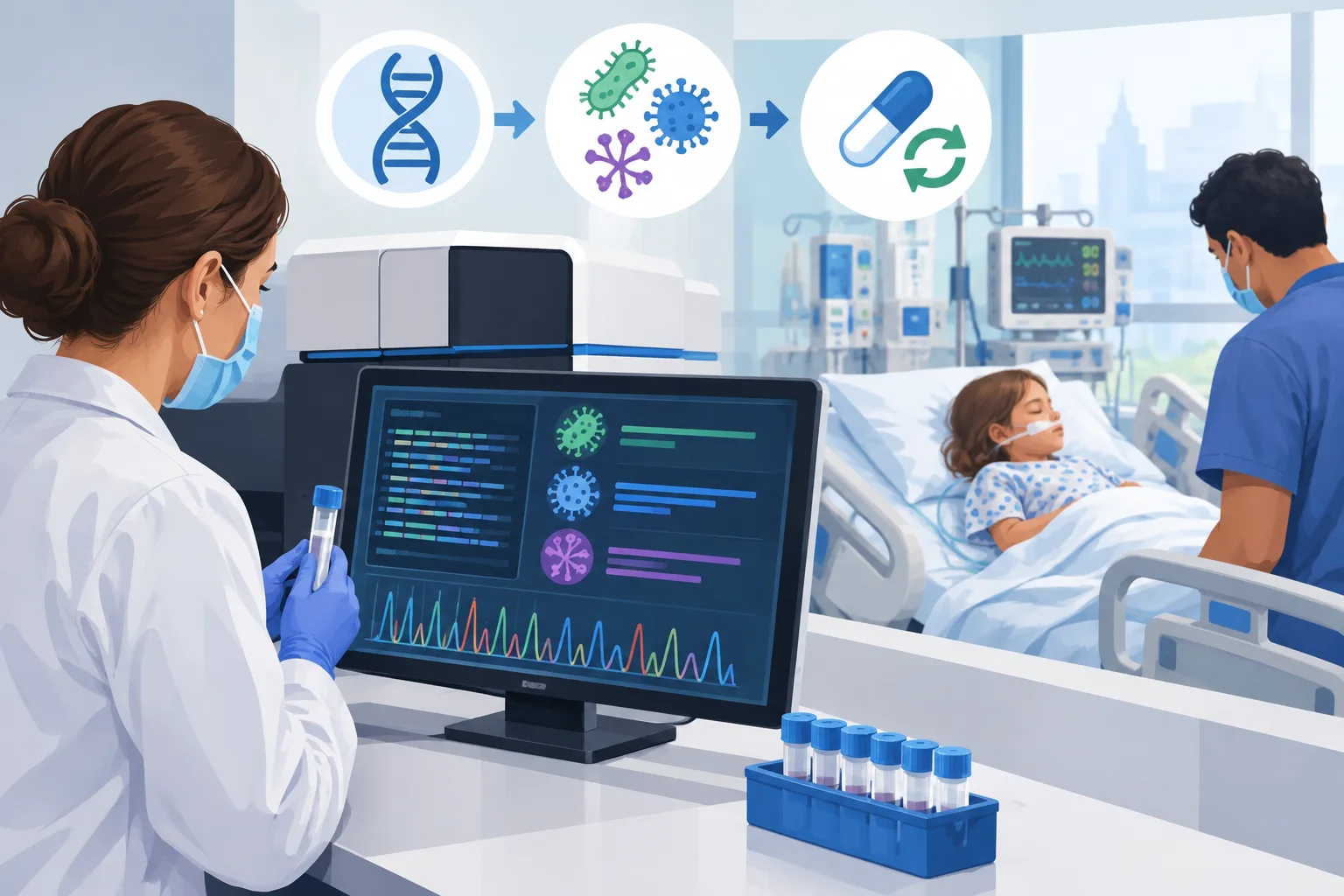
A rapid sequencing test identified additional respiratory pathogens and was linked to changes in antibiotic treatment in a study of children in intensive care at Great Ormond Street Hospital (GOSH). But the findings are from a preprint, and researchers say further studies are needed to establish whether the approach improves patient outcomes.
The test analyses genetic material in a respiratory sample to look for bacteria, viruses and fungi. In a study conducted at the London hospital between November 2024 and February 2025, researchers tested 177 samples from 122 children. They reported preliminary results on the same day and final results the next morning. [1]
The preprint reports that, after 16 hours of sequencing, the test detected 89% of bacterial infections, 87% of viral infections and all fungal infections identified by the study’s comparison methods. It also found 50 additional pathogens in 42 of 174 samples that passed quality checks; these findings were subsequently confirmed using targeted tests. [1]
Antimicrobial prescribing changed in 46 of the 174 samples, or 26.4%, according to the researchers. Changes included starting or stopping antibiotics. The team said it was difficult to determine exactly how much the test itself contributed to clinical decisions, and the study did not establish that it improved recovery or survival. The authors call for larger, multi-centre studies to assess patient outcomes and cost-effectiveness. [1]
The BBC reported that the study’s results had been published in The Lancet Microbe. However, the matching study record is on medRxiv, which identifies it as a preprint that has not been peer-reviewed. [1][2]
The BBC also reported the case of 10-year-old Willow Crowther, whose doctors used metagenomic testing to identify a drug-resistant bacterial infection. Her mother, Stacey Moore, said the test saved her daughter’s life. [2]
How do we know?
2 listed sources · explore evidence, limitations and provenance.
Sign in to give this article a thumbs up or down.
About this discussion and AI questions
Private test discussion. Comments are readers’ views and are not yet automatically fact-checked. Editing is available for 60 seconds after posting.
Sign in with a confirmed reader account and choose a username to read comments and participate.
Sorting applies to top-level comments; replies remain oldest first. New comments and likes can change the order. Refresh for the current ranking.
Loading comments…