ECB’s Lane presents evidence that central-bank communication moves markets
At Harvard, ECB chief economist Philip R. Lane presented research showing that speeches and other central-bank communications can move interest-rate markets. The evidence underlines the influence of communication between formal rate decisions, while its comparisons do not prove that communication alone caused market changes.
Review information is loading.
European Central Bank chief economist Philip R. Lane says the bank’s communications can move financial markets as much as, or more than, its formal policy announcements, presenting evidence on their effects in a speech at Harvard on 17 November.
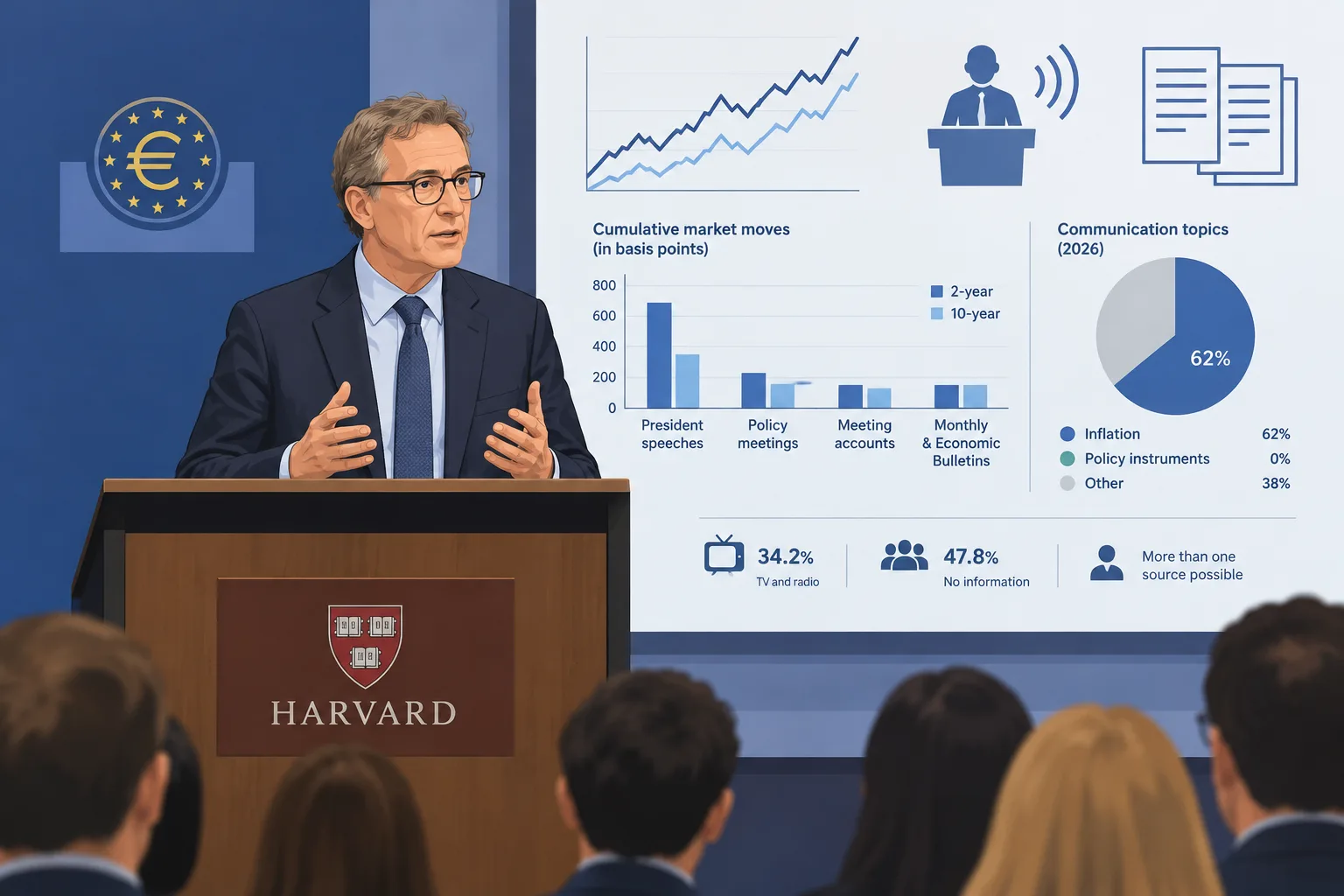
The speech reviews ECB research on how investors respond to different kinds of central-bank communication. Between January 2004 and October 2023, speeches by the ECB president were associated with the largest cumulative absolute movements in risk-free interest rates among the event types measured: 645 basis points at the two-year maturity and 350 at 10 years. The figures add up absolute changes across events; they do not represent a single rate move.
The comparable totals were 335 and 200 basis points around monetary-policy meetings, and 50 and 72 around publication of meeting accounts. The ECB study also includes monthly and Economic Bulletins, which were associated with totals of 220 and 130 basis points respectively.
Lane’s presentation argues that communication is part of how monetary policy is transmitted, not merely an explanation of decisions after they are made. It sets out the ECB’s approach of explaining the criteria behind decisions — including the inflation outlook, underlying inflation, monetary-policy transmission and risks — rather than signalling a fixed future path for interest rates.
Research presented in the speech suggests markets’ interest-rate expectations became more responsive to euro-area economic news after the ECB withdrew forward guidance. Lane’s figures show a stronger response under the later “reaction function” framework than during the forward-guidance period. The comparison spans different economic conditions, however, and does not by itself establish that the communication framework caused the change.
The speech also shows how the ECB has discussed different subjects over time. Inflation accounted for 62% of the topics in the communication outlets measured in 2026, while policy instruments accounted for none. The chart’s coverage is limited: it includes Governing Council press conferences, related releases and accounts, and speeches by the ECB president, but excludes the Monthly Bulletin and Economic Bulletin.
Reaching the public remains a challenge. In the ECB’s latest survey data cited by Lane, 47.8% of respondents said they had received no information about the bank in the previous two months. Television and radio were the most commonly cited channel, at 34.2%; respondents could name more than one source.
Lane also presented ECB staff analysis using large language models to assess the tone of the bank’s communications. The speech describes the approach as a way to analyse large volumes of text, alongside research estimating the effects of communication shocks on output and inflation. These are analytical tools and estimates, not a claim that every change in tone produces a predictable economic effect.
The speech continues Lane’s examination of how the ECB communicates: in a speech last week, he discussed how communication can shape market expectations between rate decisions. Neither speech announces a change in interest rates.
Sign in to give this article a thumbs up or down.
About this discussion and AI questions
Private test discussion. Comments are readers’ views and are not yet automatically fact-checked. Editing is available for 60 seconds after posting.
Sign in with a confirmed reader account and choose a username to read comments and participate.
Sorting applies to top-level comments; replies remain oldest first. New comments and likes can change the order. Refresh for the current ranking.
Loading comments…