ECB’s Philip Lane examines climate change’s effects on inflation, growth and lending
ECB Executive Board member Philip R. Lane’s Dublin speech examines how climate risks and the shift to a lower-carbon economy could influence inflation, growth and lending, while stressing that its figures include model-based scenarios.
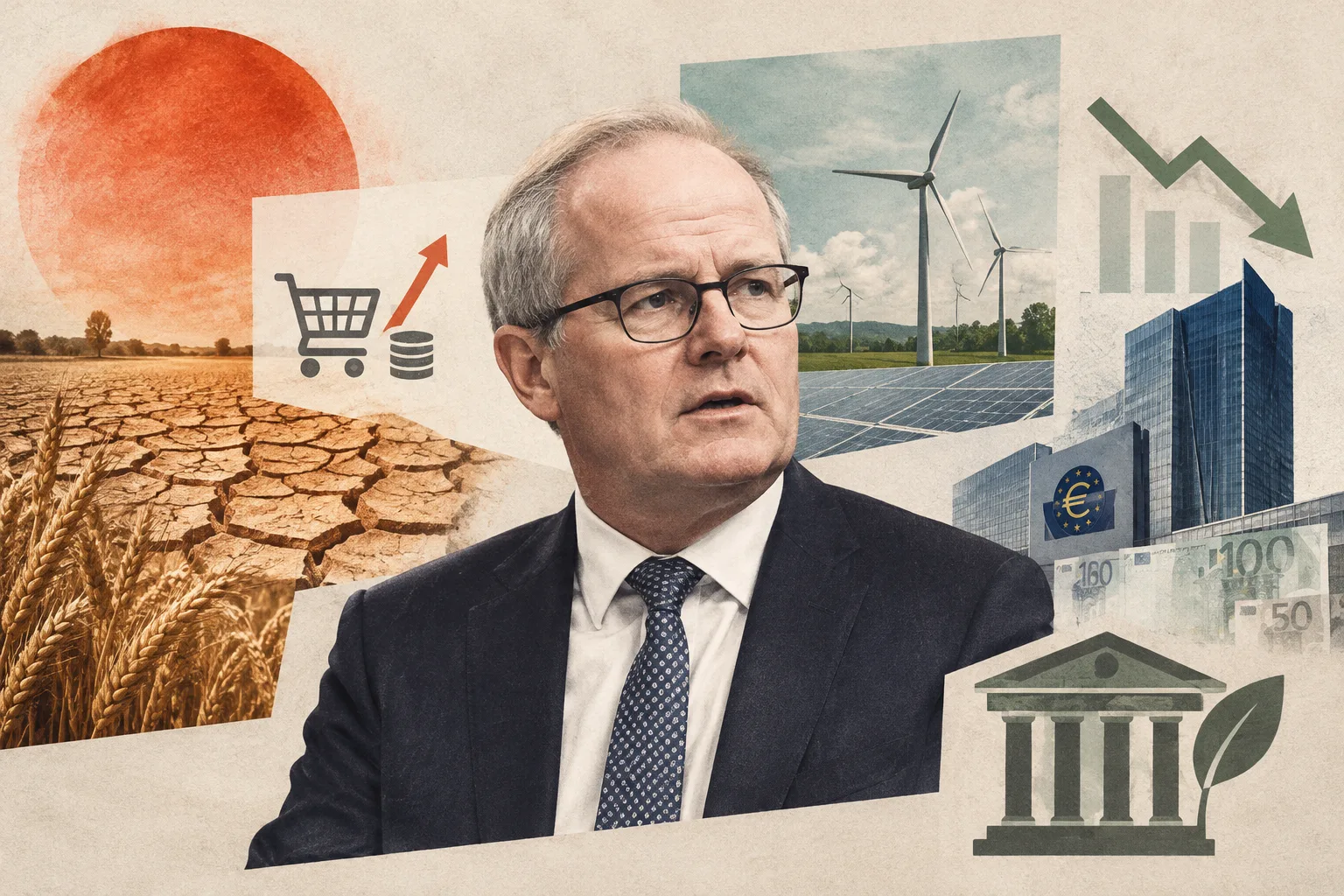
European Central Bank Executive Board member Philip R. Lane has set out how climate change and the transition to a lower-carbon economy could affect inflation, growth and bank lending, in a speech delivered in Dublin on 23 November.
The ECB presentation links physical risks, such as extreme heat and natural disasters, with the economic effects of climate policies and changes in energy markets. Its estimates are scenarios and model-based analyses, rather than predictions of what will happen in every case.
One analysis cited in the speech estimates that an extreme summer heatwave could add between 0.88 and 1.02 percentage points to food prices after 12 months in 2035, depending on the emissions scenario. By 2060, the estimated effect ranges from 1.07 to 1.84 percentage points. The exercise does not account for future changes in inflation dynamics, broader economic conditions or adaptation to climate change.
The presentation also shows how climate policies designed to meet the EU’s 2030 emissions target could affect the euro-area economy. In one model exercise, a carbon-tax-only route would reduce real GDP by 2.68% in 2030 relative to the stated baseline, while a policy mix would reduce it by 1.12%. The same scenarios raise headline inflation in 2030 by 0.098 and 0.047 percentage points respectively. The calculations assume economic agents know the future policy path and that the policy interest rate stays constant.
Lane’s material also points to possible benefits of the energy transition. It says lower reliance on fossil fuels could reduce inflation volatility and lessen the effect of energy-price shocks. Renewable electricity costs have fallen substantially in many of the countries shown, although the figures also show variation by technology and country.
For banks, the presentation reports that euro-area lenders expect climate-related factors to continue affecting credit conditions. In the survey figures, banks’ net assessment points to tighter standards for high-emitting firms, while green firms have faced net easing. Banks also expect physical risks and firms’ transition risks to contribute to tighter lending conditions over the next 12 months.
The speech was delivered to the Irish Department of Finance’s Climate Economy Group. Its data and scenario estimates underline the challenge for monetary policy: climate-related shocks can affect prices and economic activity, while the effects of climate measures depend on how the transition is carried out.
Sign in to give this article a thumbs up or down.
From the discussion
Private test discussion. Comments are readers’ views and are not yet automatically fact-checked. Editing is available for 60 seconds after posting.
Sign in with a confirmed reader account and choose a username to read comments and participate.
Sorting applies to top-level comments; replies remain oldest first. New comments and likes can change the order. Refresh for the current ranking.
Loading comments…