El Niño strengthens as forecasters predict a possible record peak
Forecasters expect the strengthening Pacific climate pattern to shift rainfall risks into 2027, but its predicted record peak and effects on individual events remain uncertain.
Review information is loading.
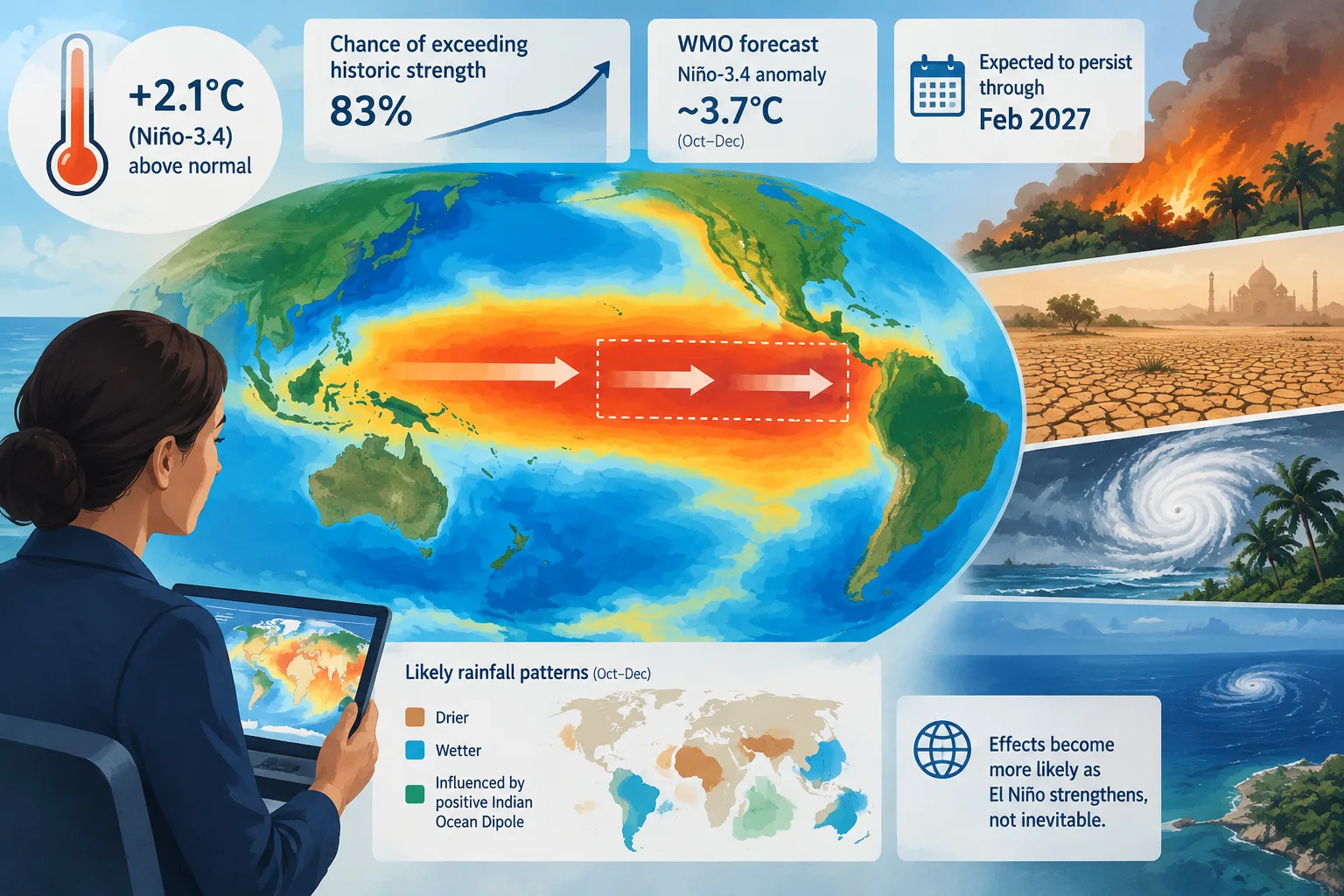
El Niño is strengthening in the tropical Pacific, increasing the likelihood of unusually wet or dry seasons in different parts of the world. In its 8 October assessment, the US National Oceanic and Atmospheric Administration (NOAA) reported that sea-surface temperatures in the Niño-3.4 region were 2.1°C above normal, alongside atmospheric changes consistent with a strengthening event. [3]
A record peak remains a forecast, not an observed seasonal result. NOAA put the chance of an El Niño exceeding its historic-strength threshold in October–December at 83%. Separately, the World Meteorological Organization (WMO) forecast a Niño-3.4 seasonal temperature anomaly of about 3.7°C for those months, above the previous record it cites of 2.6°C in November 2015–January 2016. The two assessments use different measures of the event’s strength. [2] [3]
The WMO expects El Niño to persist through February 2027. Its October–December outlook favours drier conditions over the Indian subcontinent and western Pacific, and wetter conditions across the central and eastern equatorial Pacific and parts of the Americas. It also identifies a positive Indian Ocean Dipole as another influence on rainfall. [2]
BBC Weather reports extensive wildfires in Indonesia and says India’s monsoon rainfall has been 13% below average, although it notes that India’s meteorological department would still class the nationwide figure as normal. It also describes an active eastern Pacific hurricane season and a quieter Atlantic one. [1] Those regional accounts show what is at stake, but they do not establish how much El Niño contributed to any individual fire, dry spell or storm. NOAA says effects associated with El Niño become more likely as it strengthens, not inevitable. [3]
Sign in to give this article a thumbs up or down.
From the discussion
Private test discussion. Comments are readers’ views and are not yet automatically fact-checked. Editing is available for 60 seconds after posting.
Sign in with a confirmed reader account and choose a username to read comments and participate.
Sorting applies to top-level comments; replies remain oldest first. New comments and likes can change the order. Refresh for the current ranking.
Loading comments…