England and Wales to get one stalking offence, but maximum sentence stays at 10 years
The government plans to replace the two stalking offences in England and Wales with one, but will not increase the 10-year maximum sentence and has yet to set an introduction date.
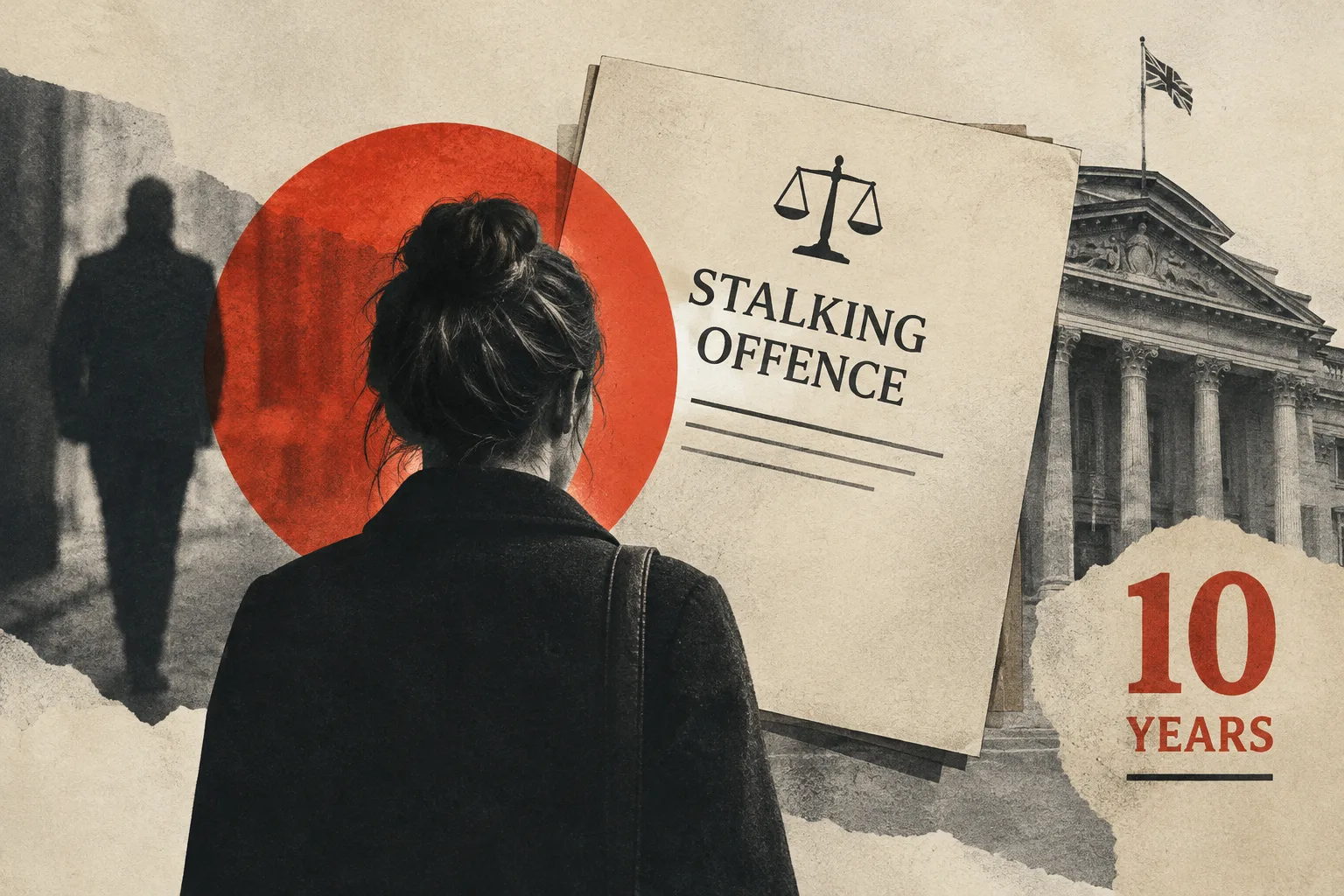
England and Wales are to get a single stalking offence, but the government has rejected a recommendation to increase the maximum sentence from 10 to 14 years. It has not set a date for bringing in the new offence, saying it will do so when parliamentary time allows.
The change is intended to simplify laws that currently require prosecutors to establish an underlying harassment offence, as well as additional factors such as fear or distress, for stalking to be recognised. A review led by Richard Wright KC concluded that confusion between stalking and harassment could contribute to failures to identify and prosecute the crime.
The government says the new offence will be triable in either a Crown Court or a magistrates’ court. Under the current system, only the more serious stalking charge — which requires proof that the victim feared violence on at least two occasions — can be tried in the Crown Court.
Ministers rejected Wright’s proposal to raise the maximum sentence to 14 years, pointing to an average sentence of 18.6 months for the more serious stalking offence in the year to March. Safeguarding minister Satvir Kaur said judges already had the power to impose a 10-year sentence and that the priority should be making sure they used it.
Some victims welcomed the move to one offence but said they were disappointed that the maximum sentence would not rise. Katherine, from Newcastle, said her former partner had been charged initially with the lesser offence of stalking without fear, despite her being terrified. She said he resumed his behaviour after serving a three-year-and-four-month prison sentence.
The review also recommended removing the need to prove that a victim experienced fear or serious disruption to their life. The government says it will explore that proposal but has not committed to including it in the new offence. Kaur said she was “sick and tired of it being the onus on the victim”.
Other recommendations have also not been adopted. The government said it needed to examine proposals for safeguards around applications to change protective orders, after Ashley, a stalking victim, said her restraining order had been amended without her being consulted. The government has also rejected a proposal to allow a new stalking prosecution after one further incident involving the same victim and a previously convicted stalker.
Separately, legislation taking effect on Thursday will allow courts to issue stalking protection orders whether a case ends in conviction or acquittal. The government says the new standalone offence will be introduced when parliamentary time allows; it has not announced a date.
Sign in to give this article a thumbs up or down.
From the discussion
Private test discussion. Comments are readers’ views and are not yet automatically fact-checked. Editing is available for 60 seconds after posting.
Sign in with a confirmed reader account and choose a username to read comments and participate.
Sorting applies to top-level comments; replies remain oldest first. New comments and likes can change the order. Refresh for the current ranking.
Loading comments…