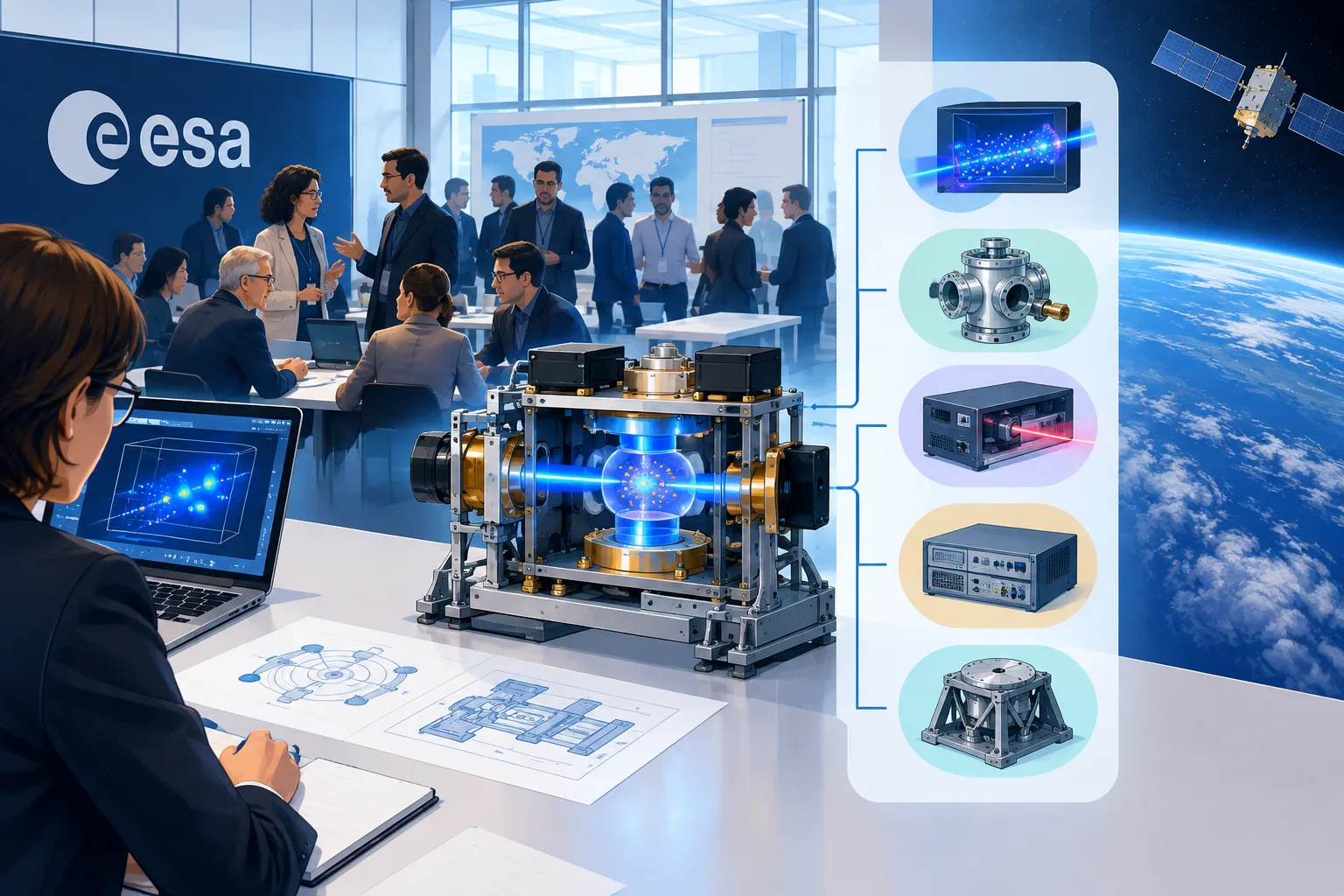
ESA outlines phased development of cold atom technologies for future space missions
The European Space Agency says five technology activities worth a potential combined €8 million could help develop a space-ready cold atom interferometer, following a workshop attended by more than 43 people from 12 countries.
Review information is loading.
The European Space Agency is planning phased development of five technologies needed for a future space-ready cold atom interferometer, after a workshop at its ESTEC centre brought together more than 43 participants from 12 countries.
The 10 November meeting in the Netherlands focused on how the technologies could support future space missions. ESA said more than 70 bilateral meetings took place among participants from over 33 organisations, including small and medium-sized businesses and research bodies.
The five activities, presented under ESA’s General Support Technology Programme, represent a combined €8 million in potential development. They cover an ultracold-atom beam, an atom source, a laser system, a control unit and an inertial reference platform. The aim is to mature these elements towards a complete instrument, while addressing challenges including size, power use and compatibility with the space environment.
ESA said the workshop indicated that a phased approach—funding smaller activities that can eventually form a complete test instrument—would work best for the complex technology. The agency said its Basic Activities Programmes, including the Technology Development Element, would start initial phases of some activities.
Cold atom interferometers use laser-manipulated atoms to measure acceleration, gravity gradients and rotation. ESA says possible space applications include monitoring changes in Earth’s gravity, studying planetary interiors, testing fundamental physics and navigation independent of satellite signals.
Sign in to give this article a thumbs up or down.
About this discussion and AI questions
Private test discussion. Comments are readers’ views and are not yet automatically fact-checked. Editing is available for 60 seconds after posting.
Sign in with a confirmed reader account and choose a username to read comments and participate.
Sorting applies to top-level comments; replies remain oldest first. New comments and likes can change the order. Refresh for the current ranking.
Loading comments…