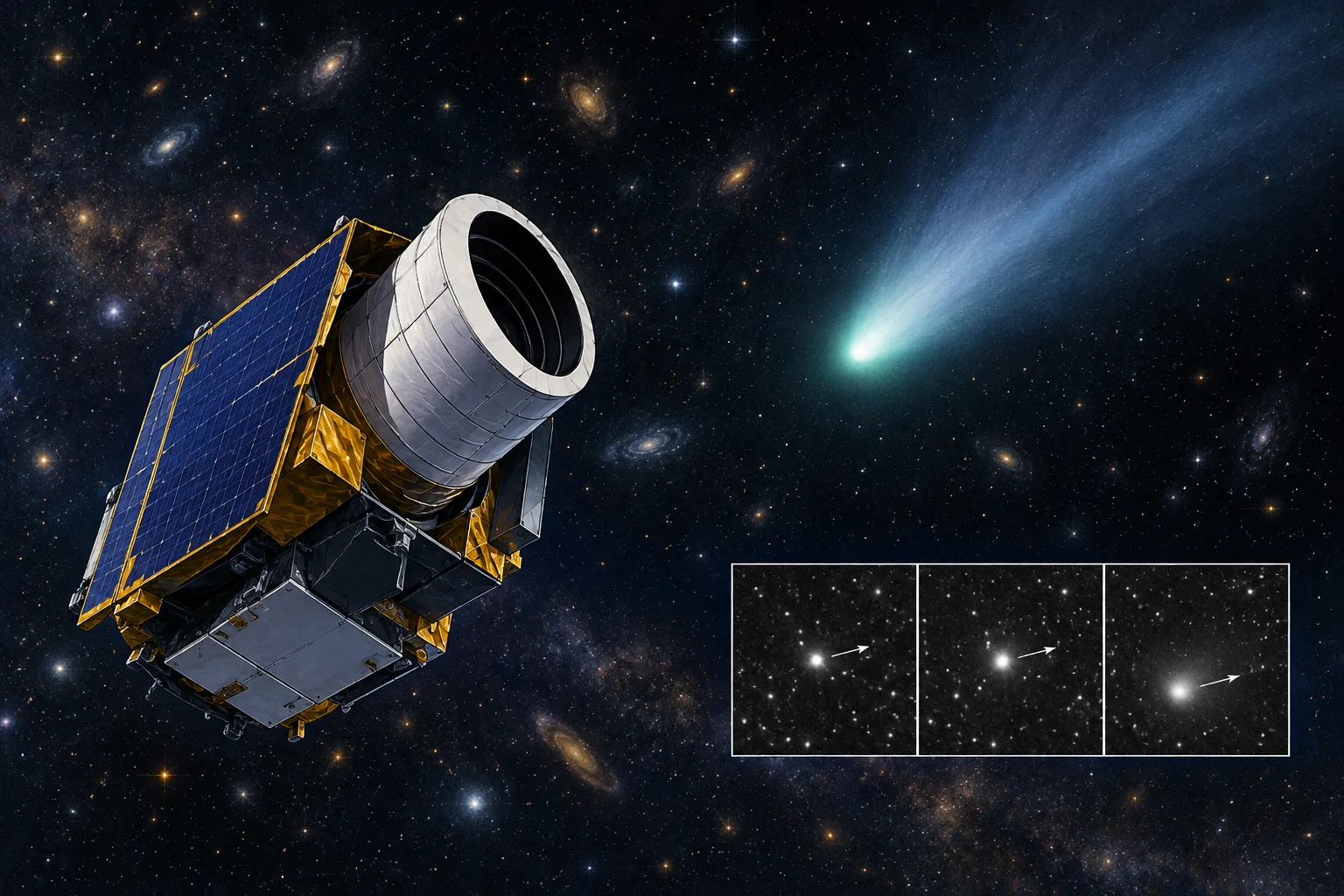
Euclid telescope discovers its first previously unknown comet
ESA’s Euclid telescope has discovered its first previously unknown comet, an unexpected find for a mission built to map distant galaxies. The comet was confirmed on 8 October and is now designated C/2026 S1 (Euclid).
Review information is loading.
The European Space Agency’s Euclid telescope has discovered its first previously unknown comet, after images captured it in September. The object, now named C/2026 S1 (Euclid), was confirmed by the International Astronomical Union’s Minor Planet Center on 8 October, ESA says. [1]
Euclid is designed to map distant galaxies, not track fast-moving objects in our Solar System. The comet was spotted in images taken between 16 and 24 September, when software developed by University of Helsinki PhD student Mikko Pöntinen flagged its movement across the telescope’s field of view. Further inspection revealed a fuzzy cloud around it, a sign of cometary activity, Pöntinen said. [1]
After checks found no match in catalogues of known comets and asteroids, the observations were sent to the Minor Planet Center. Ground-based astronomers then contributed follow-up observations before the centre confirmed the discovery. ESA says the comet is about 1.3 billion kilometres from Earth and is travelling on an orbit that takes thousands of years to complete. Its orbital period remains to be refined as more data is collected. [1]
The discovery was an unusual opportunity: Euclid generally avoids the plane of the Solar System, where dust can interfere with its deep-sky images, and its scanning strategy does not usually let operators revisit a patch of sky on demand. ESA says very few comets are expected to be found by the telescope. [1]
The comet is not a suitable target for ESA’s planned Comet Interceptor mission, project scientist Valeria Pettorino said. But she described the discovery and alert process as a test of how the Euclid and Comet Interceptor teams could coordinate in future. [1]
Sign in to give this article a thumbs up or down.
About this discussion and AI questions
Private test discussion. Comments are readers’ views and are not yet automatically fact-checked. Editing is available for 60 seconds after posting.
Sign in with a confirmed reader account and choose a username to read comments and participate.
Sorting applies to top-level comments; replies remain oldest first. New comments and likes can change the order. Refresh for the current ranking.
Loading comments…