News Made Clear · Loading…
Category
Regions
Continents
Dossiers
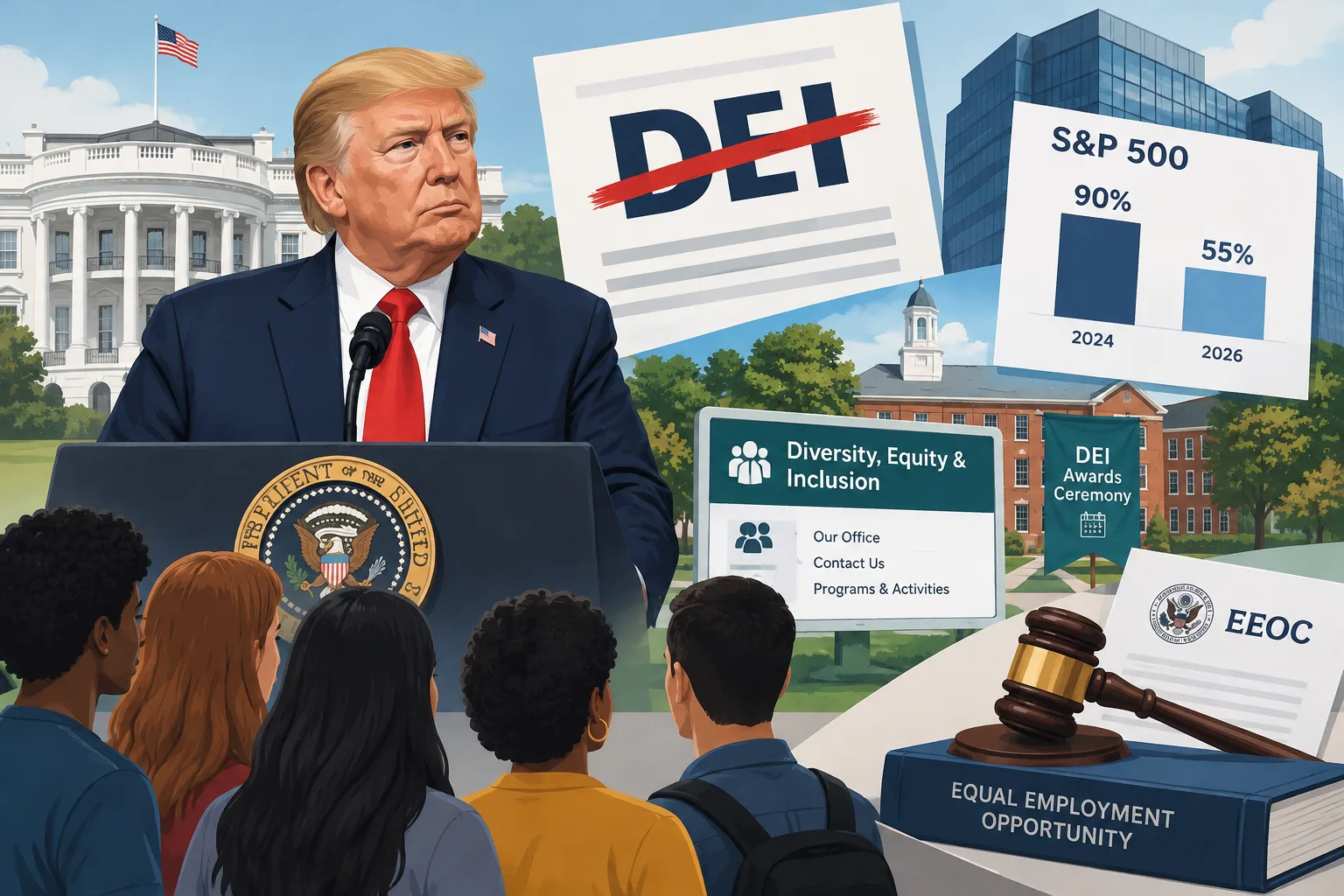
White House says ‘DEI is dead’, but its figures do not show programmes have disappeared
Loading statistics…
Trump’s administration has taken substantial action against DEI, but its new claim that ‘DEI is dead’ rests partly on figures about corporate wording rather than a measure of programmes ended.
Review information is loading.
The White House declared on 28 October that President Donald Trump had removed diversity, equity and inclusion (DEI) programmes from government, education and business. “DEI is dead,” its fact sheet said. The administration has taken concrete steps against DEI, but the examples it cites do not establish that programmes have disappeared across those sectors.
A January 2025 order instructed federal agency heads to end DEI offices and programmes within 60 days, to the extent permitted by law. In March 2026, Trump ordered agencies to add clauses to federal contracts and subcontracts prohibiting what the order defines as unequal treatment based on race or ethnicity. Those are significant policy measures; issuing an order, however, is not a count of programmes subsequently closed.
The distinction is especially clear in the fact sheet’s corporate figures. It says 90% of the 400 largest companies in the S&P 500 cut at least some DEI references after Trump’s election. The Financial Times research behind that figure covered only companies in that group that had filed eligible annual reports by March 2025. They had removed *at least some* references, not necessarily their diversity programmes.
A later analysis by lawyers at Orrick found diversity-related disclosures in 97% of S&P 500 annual reports in 2024, compared with 55% of reports filed by 417 companies in the first three months of 2026. Just 8% of those 2026 reports used “DEI” or similar language. That shows a sharp change in reporting, but it does not establish what each company did internally. The Financial Times also reported that some companies had scrapped programmes while others continued to defend them.
Nor had the DEI label vanished from education. Farmingdale State College in New York still listed a DEI office, contacts and activities on its website in October, and advertised a DEI awards ceremony for 28 October. One college cannot establish how widespread such activity remains, and the notice does not confirm that the ceremony took place. It does show why the White House’s blanket claim goes further than its examples support.
The legal question is separate. The US Equal Employment Opportunity Commission says DEI is a broad term, not one defined in the relevant federal employment law. An initiative may be unlawful if an employment decision is based, in whole or in part, on race, sex or another protected characteristic. The label alone does not determine whether a practice is discriminatory.
How do we know?
8 listed sources · explore evidence, limitations and provenance.
Sign in to give this article a thumbs up or down.
About this discussion and AI questions
Private test discussion. Comments are readers’ views and are not yet automatically fact-checked. Editing is available for 60 seconds after posting.
Sign in with a confirmed reader account and choose a username to read comments and participate.
Sorting applies to top-level comments; replies remain oldest first. New comments and likes can change the order. Refresh for the current ranking.
Loading comments…