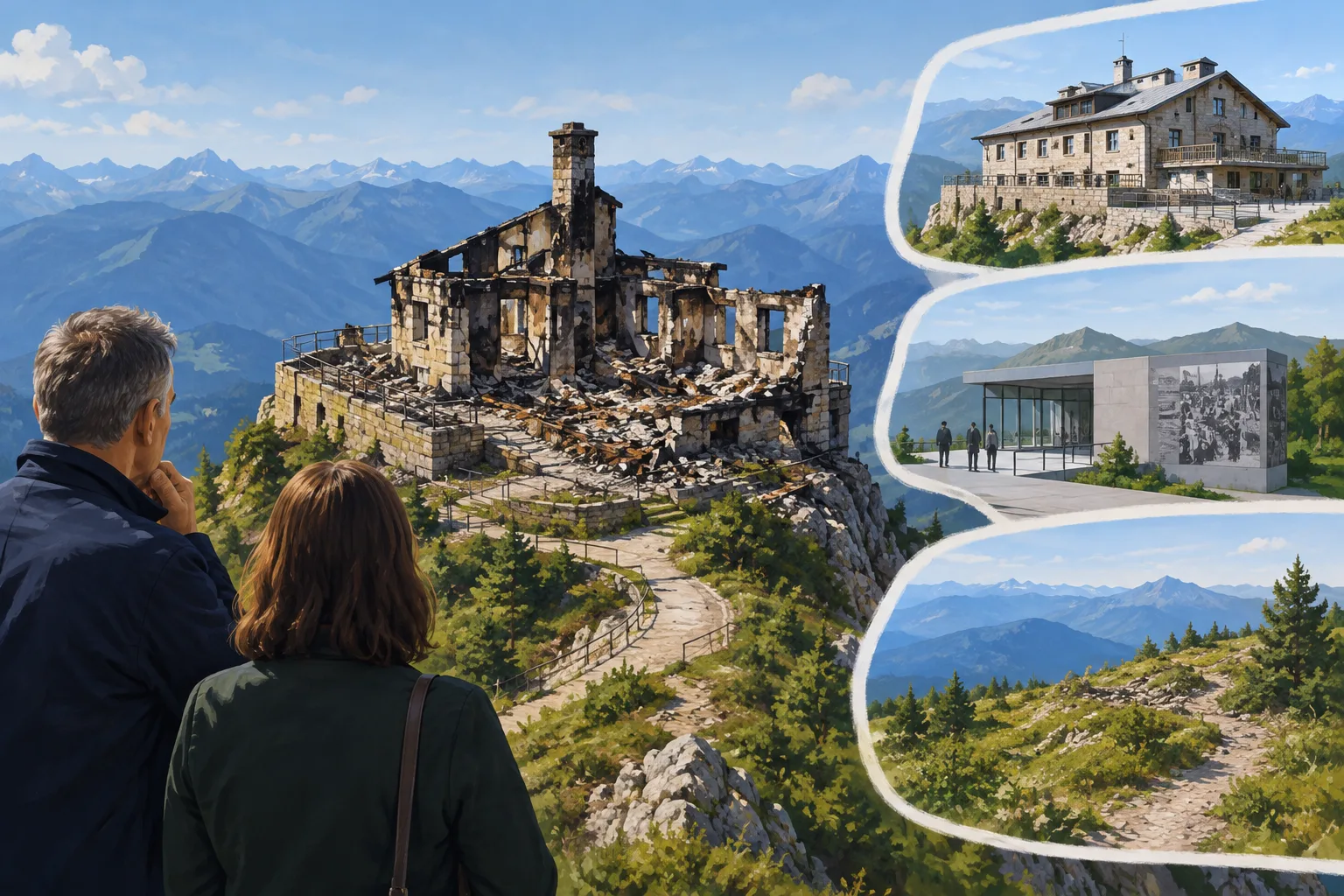
Fire-damaged Eagle’s Nest prompts debate over its future
A suspected arson fire has largely destroyed Bavaria’s Eagle’s Nest, prompting debate over whether to clear the ruins, rebuild or create a modern memorial to the Nazi-era site.
Review information is loading.
A fire that largely destroyed Bavaria’s Eagle’s Nest retreat has reopened a debate over how Germany should preserve sites tied to its Nazi past: clear the ruins, rebuild the building, or create a modern memorial that shows its history without recreating Nazi-era architecture.
The Kehlsteinhaus, known in English as the Eagle’s Nest, was built in 1938 and used by Adolf Hitler and other senior Nazis to receive guests. The state-owned site became a popular tourist destination, with tens of thousands of visitors each season, and included a restaurant. The fire broke out on 23 October. Police suspect arson; a 33-year-old man has been detained in a secure psychiatric hospital on suspicion of setting it. Authorities have not commented on a possible motive.
Bavarian officials have backed rebuilding. Interior Minister Joachim Herrmann said, “We can hardly leave a ruin standing there.” Arts Minister Markus Blume has also supported reconstruction, while saying it should not cost taxpayers anything.
But there is no agreement on what rebuilding should mean. Isabel Heinemann, a contemporary-history professor at Munich’s Ludwig Maximilian University, said a full reconstruction would put “highly ideological architecture” back in place. She favours documenting the fire damage and historical remains, then recreating parts in a modern design to make the site’s different layers visible.
Sven Keller, head of the nearby Obersalzberg Documentation Centre, also rejects a one-to-one reconstruction. He argues that leaving the building in ruins could attract neo-Nazi visitors hiking to the site. Demolishing Nazi-era buildings does not necessarily erase their place in extremists’ memories, he told the BBC, pointing to the former Berghof, Hitler’s nearby residence, which was demolished after the war.
Historian Richard J. Evans takes the opposite view: clear the rubble and return the mountain to nature. He described the Kehlsteinhaus as a “Nazi vanity project”. The building itself was largely destroyed, according to police, but the documentation centre survived. A museum addressing the Nazi-era history of Obersalzberg opened nearby in the 1990s, and a historical exhibition was later installed inside the retreat.
Bavaria’s authorities say they will seek a solution in consultation with historians. The decision will determine whether the site is rebuilt, left to nature or reshaped to confront its history without restoring its former appearance.
Sign in to give this article a thumbs up or down.
About this discussion and AI questions
Private test discussion. Comments are readers’ views and are not yet automatically fact-checked. Editing is available for 60 seconds after posting.
Sign in with a confirmed reader account and choose a username to read comments and participate.
Sorting applies to top-level comments; replies remain oldest first. New comments and likes can change the order. Refresh for the current ranking.
Loading comments…