Hera images show crater almost as wide as asteroid Dimorphos after NASA impact test
Images from the European Space Agency’s Hera mission show that NASA’s 2022 asteroid-impact test carved a crater almost as wide as Dimorphos. The spacecraft has also found hundreds of nearby boulders that could complicate plans for close-up exploration.
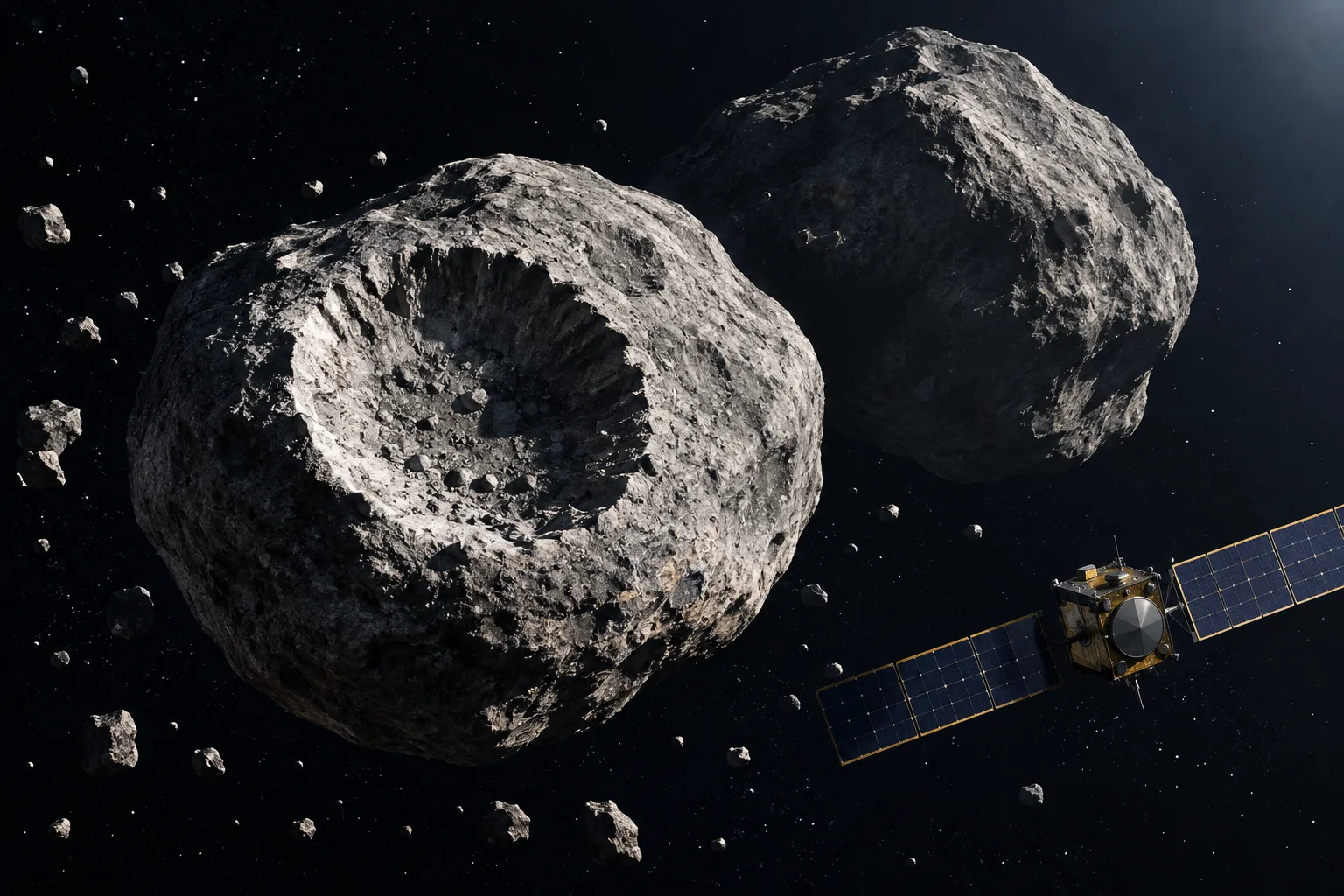
NASA’s 2022 asteroid-impact test left Dimorphos with a crater almost as large as the 151-metre-wide space rock, new images from the European Space Agency’s Hera mission show. The observations also reveal hundreds of boulders around the asteroid pair, a discovery that could complicate plans to send small spacecraft close to Dimorphos.
NASA’s DART spacecraft deliberately struck Dimorphos at 13,645 miles per hour to test whether an asteroid’s path could be changed. Earth-based telescopes found that the impact shortened the time it takes Dimorphos to orbit its larger companion, Didymos, by 33 minutes. Hera’s close-up observations are intended to show how the collision produced that change and how the asteroid itself responded.
The crater has flattened one of Dimorphos’ formerly rounded faces. The asteroid, which is 151 metres wide, is also tumbling chaotically, according to early observations. The European Space Agency said the boulder fields elsewhere on its surface show no evidence of major change.
Hera arrived at the binary asteroid system three weeks before the images were released and was about 30 kilometres away. Neither asteroid poses a danger to Earth, but Dimorphos is considered comparable in size to asteroids that could threaten the planet.
Boulders pose a challenge for close observations
Scientists have identified hundreds of boulders around Didymos and Dimorphos, including more than 100 roughly the size of a football to a washing machine. Their origin is unclear: they may be debris from the DART impact or have come from the larger asteroid, Didymos.
Two small satellites aboard Hera are expected to be released in January and are planned to approach and land on Dimorphos. The boulders could pose a collision risk, said Margherita Cardi, a space engineer overseeing one of the satellites. The team may have to account for them as it plans the manoeuvres.
Hera is scheduled to move to within about 13 kilometres of the asteroids in December to take sharper images and measure Dimorphos’ mass. That measurement will help scientists assess how effective the DART impact was and improve predictions of how other asteroids might respond to deflection attempts.
The images reveal the scale of the impact; the upcoming measurements are intended to establish how much it changed the asteroid’s motion and structure.
Sign in to give this article a thumbs up or down.
From the discussion
Private test discussion. Comments are readers’ views and are not yet automatically fact-checked. Editing is available for 60 seconds after posting.
Sign in with a confirmed reader account and choose a username to read comments and participate.
Sorting applies to top-level comments; replies remain oldest first. New comments and likes can change the order. Refresh for the current ranking.
Loading comments…