How a Sunderland school achieved strong GCSE results in a low-income community
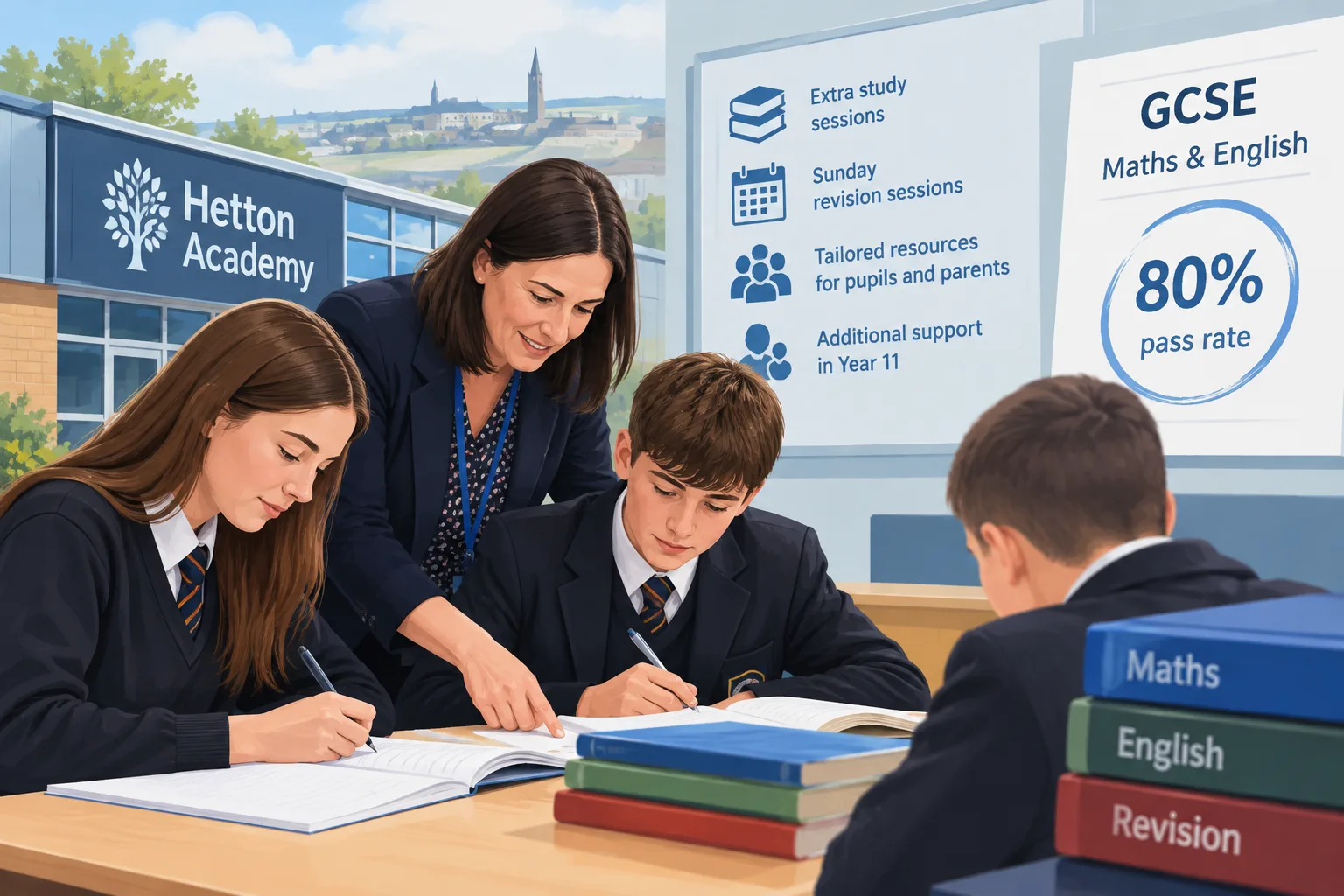
Hetton Academy, where nearly half of pupils receive free school meals, achieved an 80% pass rate in GCSE maths and English this summer. Its results stand out against broader gaps affecting poorer pupils, but education experts say the school’s success may not be easy to reproduce.
Review information is loading.
Hetton Academy, where almost half of pupils receive free school meals, recorded an 80% pass rate in GCSE maths and English this summer, highlighting how one school in a low-income community has achieved results well above the national average.
The school in Hetton-le-Hole, near Sunderland, is largely attended by white working-class pupils. Its results stand out in a national picture where pupils from poorer families are less likely to pass key exams, and where education leaders say progress has been difficult to shift.
Hetton’s principal, Vicky Pinkney, says the school does not accept that low family incomes should mean lower expectations. The school provides extra study sessions after lessons, revision sessions on Sundays and tailored resources for pupils and their parents. Teachers also question some Year 11 pupils in short morning sessions, with staff discussing who needs the extra support.
The approach has developed alongside a change in the school’s fortunes. It was rated “requires improvement” by Ofsted in 2021, before becoming an academy. In 2024, the watchdog described it as “rapidly improving”. Pinkney says it is now the “school of choice” for local families.
Hetton is among a relatively small group of high-performing non-selective schools in England. Of 339 such schools with an average pass rate of at least 80% in maths and English across the three years to 2025, most had fewer pupils from the lowest-income families and were less likely to be in deprived areas than schools overall.
That makes Hetton an exception, not evidence that the same results are easily replicable elsewhere. Education academic John Jerrim says the likelihood of children from the poorest families passing GCSEs has barely changed since 2010. Professor Lindsey Macmillan, who took part in a recent inquiry into white working-class pupils’ outcomes, says disengagement can grow during secondary school, while the inquiry found that families’ connection with school often weakens during the transition from primary education.
The inquiry’s next phase on white working-class pupils’ education will examine early years and teenagers aged 14 to 19. Its earlier work identified gaps in development, GCSE results and attendance among white British pupils receiving free school meals.
Macmillan also cautions against treating high grades as the only measure of a successful adult life. She has called for more entry-level apprenticeships and on-the-job learning for young people with lower academic grades.
Sign in to give this article a thumbs up or down.
About this discussion and AI questions
Private test discussion. Comments are readers’ views and are not yet automatically fact-checked. Editing is available for 60 seconds after posting.
Sign in with a confirmed reader account and choose a username to read comments and participate.
Sorting applies to top-level comments; replies remain oldest first. New comments and likes can change the order. Refresh for the current ranking.
Loading comments…