Inside Schuberth’s Formula 1 helmet factory in northern Italy
Schuberth makes about 250 bespoke Formula 1 helmets a year at its factory in northern Italy. Each must meet stringent impact and heat tests, while balancing protection, weight and a driver’s personal design.
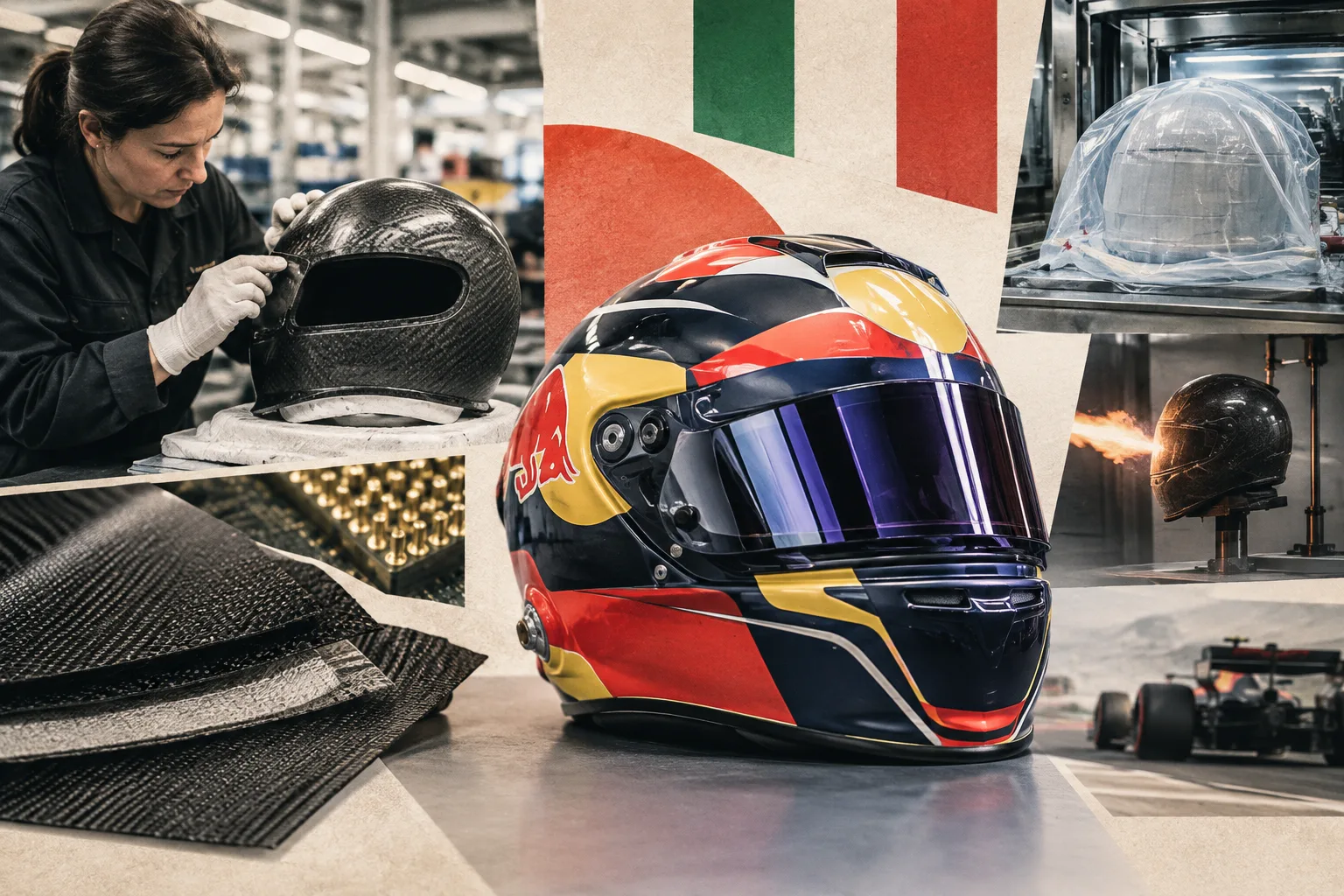
A Formula 1 helmet is assembled from hundreds of components, tested against extreme impacts and heat, and made to measure for its driver. At Schuberth’s factory in Schio, northern Italy, workers produce about 250 a year for drivers including Max Verstappen and Isack Hadjar, according to BBC Sport.
The German company’s small team includes engineers and trackside technicians who prepare helmets and visors at races. A carbon-fibre shell begins as layers of material, moulded by hand and baked in a vacuum bag. If a defect is found, the shell cannot be used, chief executive Alberto Dall’Oglio told the BBC.
The finished helmet weighs about 1.4kg, depending on its decoration and aerodynamic specification. It must be strong while remaining light, and includes a visor, ventilation, fire-resistant lining, communications equipment and a drinks tube. The BBC reports that current F1 helmets must withstand a 225g projectile fired at 155mph, a 790°C flame, and impact and crushing tests.
Personal paintwork can add weight. Dall’Oglio said the company works to remove 20 or 30 grams from its top-range helmets, while drivers may add 70 or 80 grams through decoration. The final design is the driver’s choice.
Schuberth works with the FIA on testing and future helmet regulations, Dall’Oglio said. The factory uses a water jet at 4,000 bars of pressure to cut the visor opening without applying mechanical force to the shell. The assembled helmet can comprise a couple of hundred pieces, he said.
The safety standards reflect a long evolution from leather caps and open-face helmets. Full-face designs appeared in the late 1960s, and the FIA introduced a new helmet standard in 2004. But helmets cannot prevent every injury: they are one part of a wider safety system that also includes survival cells, the HANS device and the halo.
The limits were starkly illustrated by Romain Grosjean’s 2020 Bahrain crash. His car split against the barriers and caught fire; he escaped after 28 seconds in the wreckage with burns to his hands and ankles. The BBC reports that his helmet, fire-resistant equipment and the halo helped save his life.
Schuberth is one of four leading F1 helmet manufacturers, alongside Arai, Bell and Stilo. Its current drivers include Verstappen, Sergio Perez, Nico Hulkenberg and Arvid Lindblad, as well as Isack Hadjar, the BBC reports.
Sign in to give this article a thumbs up or down.
From the discussion
Private test discussion. Comments are readers’ views and are not yet automatically fact-checked. Editing is available for 60 seconds after posting.
Sign in with a confirmed reader account and choose a username to read comments and participate.
Sorting applies to top-level comments; replies remain oldest first. New comments and likes can change the order. Refresh for the current ranking.
Loading comments…