Israel’s first-time voters split across parties as far right draws minority support
A poll finds a constituency for Israel’s far-right parties among first-time voters, but no single party dominates their preferences — and another survey gives the far right a lower figure.
Review information is loading.
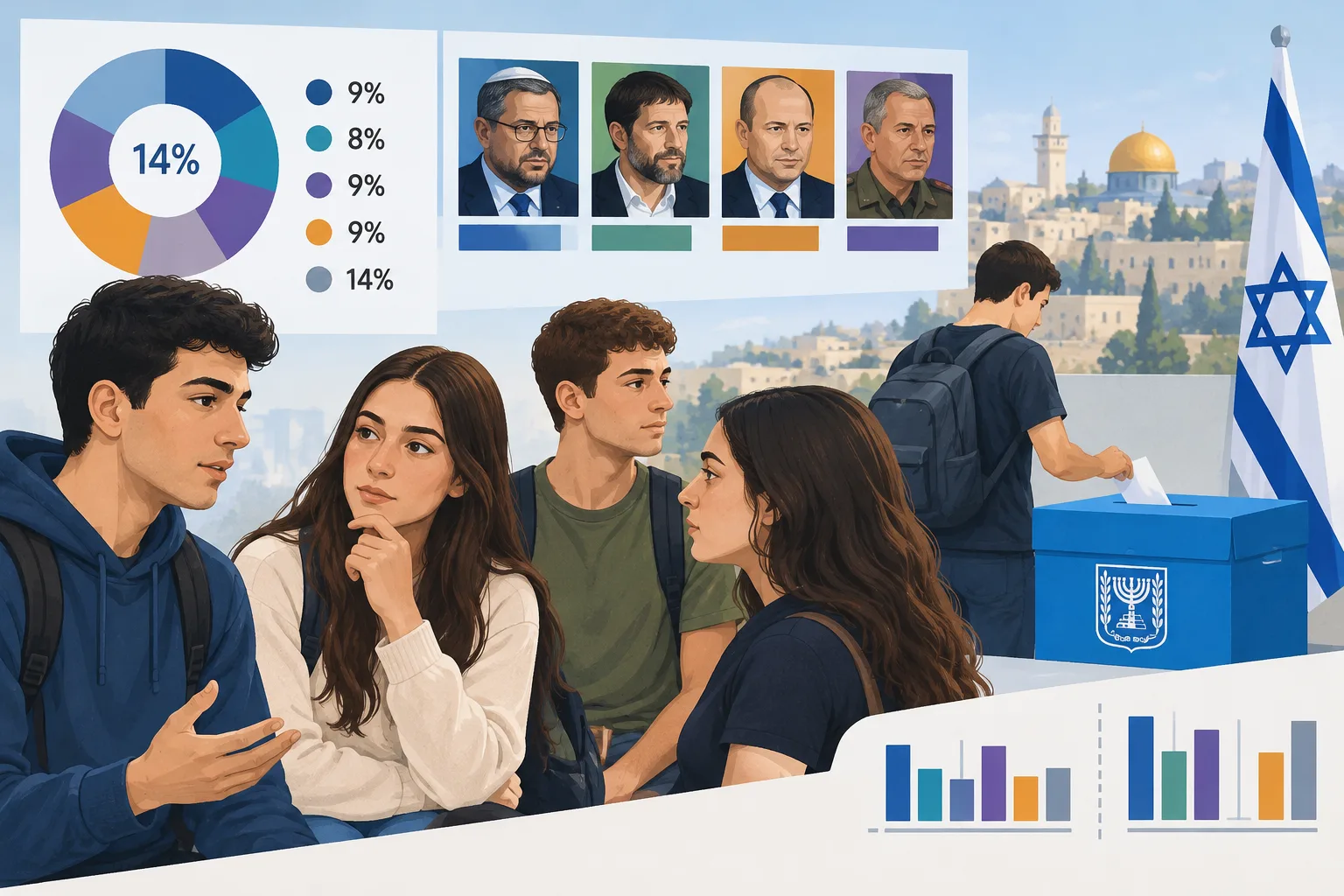
Israel votes on 27 October, with more than half a million people eligible to take part in a Knesset election for the first time. A poll conducted on 5–6 October puts support for two far-right parties at roughly 17% among first-time voters aged 18 to 22. It also shows how widely their preferences are spread: no party reached 10%. [1] [4]
The Dialog poll for ynet and Yedioth Ahronoth questioned 543 Jewish and Arab young people. It put Itamar Ben-Gvir’s Jewish Power on about 9% and Bezalel Smotrich’s Religious Zionism–Zehut on about 8%. Naftali Bennett’s Beyachad and Gadi Eisenkot’s Yashar each drew about 9%; 14% of respondents had not chosen a party. The combined far-right figure is based on rounded party percentages and measures voting intentions, not ballots cast. [1]
An earlier Channel 12 poll painted a different picture. Conducted on 15–22 September among 301 Jewish first-time voters of the same age, it put Jewish Power on 5% and Religious Zionism on 6%, or 11% together. It also found that 74% described their views as right-wing or centre-right. That description is not a measure of support for Ben-Gvir and Smotrich. The two polls were taken at different times and surveyed different populations, so their results do not establish a shift between September and October. [2]
The divisions are visible in young voters’ own accounts. Mordechai, 20, told the BBC that Ben-Gvir gave him “a sense of security”. Israeli outlet Ha-Makom interviewed eight young voters with varied preferences; of two soldiers it spoke to, one leant towards Bennett while the other said he would vote for the Democrats. Those interviews illustrate individual choices rather than how the electorate as a whole will vote. [3] [5]
The size of the new electorate makes those choices consequential. Ha-Makom, citing the Knesset’s research centre, reports that 618,839 eligible voters were under 18 at the previous election — about 8.4% of all eligible voters. In a separate May survey, the Israel Democracy Institute found that between 80% and 95% of respondents in each group studied thought they would vote or were certain they would. Their actual turnout and party choices will only become clear at the election. [5] [6]
Sign in to give this article a thumbs up or down.
From the discussion
Private test discussion. Comments are readers’ views and are not yet automatically fact-checked. Editing is available for 60 seconds after posting.
Sign in with a confirmed reader account and choose a username to read comments and participate.
Sorting applies to top-level comments; replies remain oldest first. New comments and likes can change the order. Refresh for the current ranking.
Loading comments…