Jim Jordan and John Thune face test of uniting Republicans in Congress
Newly installed Republican leaders Jim Jordan and John Thune face the task of holding their party together in the House and Senate, despite contrasting political styles and a history of tension between the chambers.
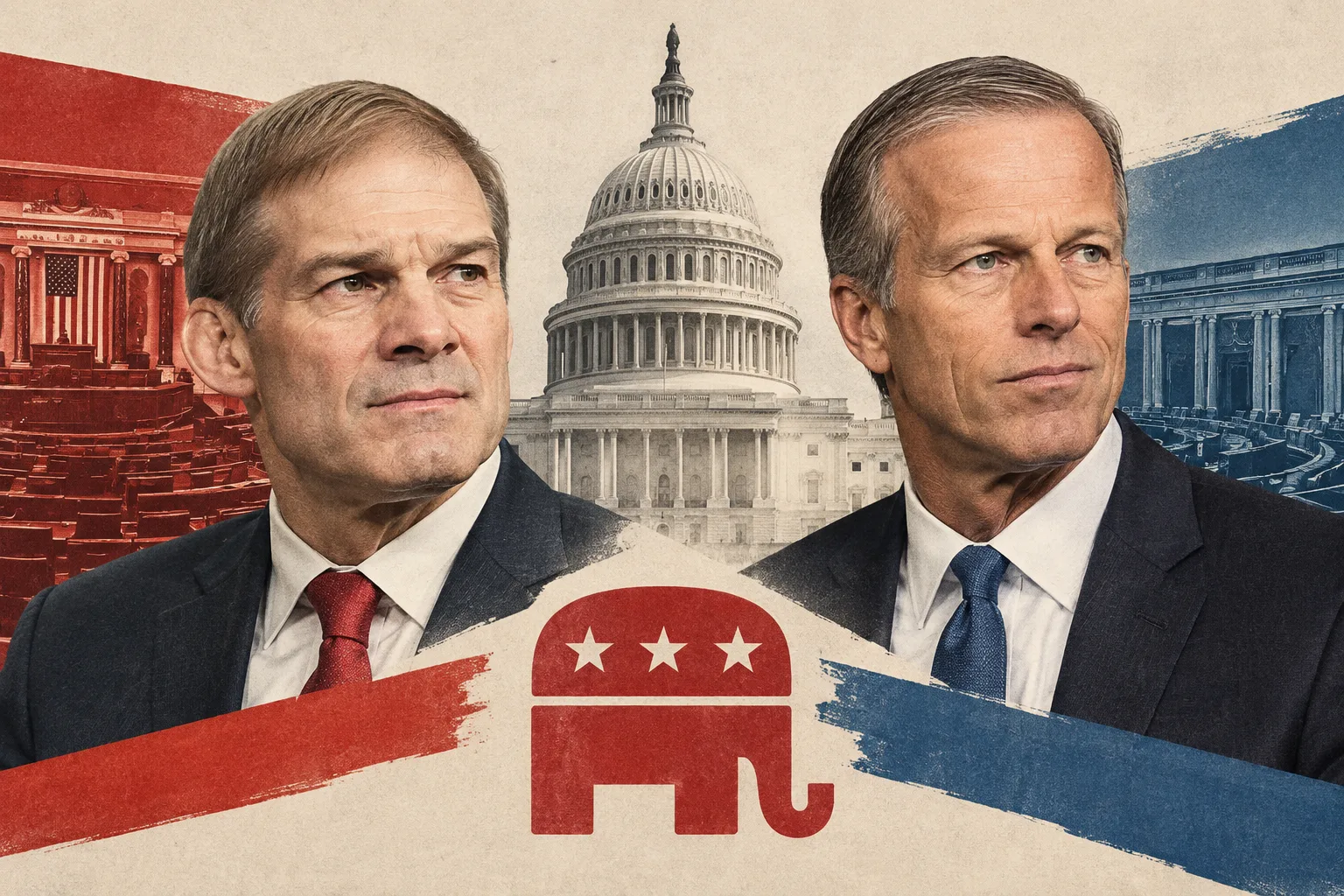
Jim Jordan and John Thune must lead House and Senate Republicans through two years in opposition despite barely knowing each other, after the party’s heavy election losses left Democrats with large majorities in both chambers.
The new Republican leaders met one to one for the first time after the losses earlier this month. Jordan said they talked about sport, knee problems and their families. Their immediate challenge is more consequential: keeping Republicans united as they try to shape their party’s message and regain power.
“We got to focus on who we are as Republicans, what our party is about, how we’re going to help families,” Jordan told POLITICO. “The House and Senate are different, but we’re Republicans.”
The two bring contrasting strengths. Republicans interviewed by POLITICO expect Jordan, a frequent television presence and popular figure among the party’s voters, to be its public fighter. Thune, whose standing with the MAGA base has weakened over the past year, is seen as a strong fundraiser and an effective negotiator behind closed doors. Thune called Jordan a “team player” who wants to “keep Republicans from fighting Republicans”.
But their chambers pose different tests. In the House, Democrats would need to lose scores of members before Republicans could help pass bills. In the Senate, just four Republicans joining Democrats could advance legislation, giving Thune a narrow margin to hold his party together. POLITICO reports that early Democratic bills are expected to be designed to divide Republicans.
Jordan may also face pressure from the House Freedom Caucus, the party’s ultraconservative bloc. Representative Eric Burlison, a possible future chair, said he hoped Jordan and Thune would be “blunt and honest with each other and fight”. He added that House leaders should fight for the House rather than defend the Senate.
The relationship between the chambers has been strained. House Republicans have criticised Thune over the Senate’s inability to overcome Democratic filibusters, while allies of Thune say outgoing Speaker Mike Johnson added friction by shifting blame to the Senate and, in their view, misrepresenting private conversations. Thune has generally avoided publicly advising Johnson or the House.
Jordan enters leadership in January after two unsuccessful attempts to win the speakership. He has led the House Oversight and Judiciary committees, which focus heavily on investigations and messaging. Thune, who became the Senate’s top Republican in 2025 after rising through its leadership ranks, has more experience in party leadership.
Some senators who have clashed with Thune have voiced confidence in Jordan. Rick Scott, who lost a challenge to Thune’s leadership in 2024, called Jordan “easy to work with” and a “positive influence”. Senator Kevin Cramer said Jordan respected his coming counterpart. “There’s mutual respect in the battle and an understandable competitiveness,” Cramer said, “but at the end of the day, we’re just people trying to get a job done.”
Sign in to give this article a thumbs up or down.
From the discussion
Private test discussion. Comments are readers’ views and are not yet automatically fact-checked. Editing is available for 60 seconds after posting.
Sign in with a confirmed reader account and choose a username to read comments and participate.
Sorting applies to top-level comments; replies remain oldest first. New comments and likes can change the order. Refresh for the current ranking.
Loading comments…