Leukaemia trial reports longer survival. Which figures in Topol’s post are correct?
According to trial sponsor SELLAS, median survival among the people with acute myeloid leukaemia (AML) in the study was 9.3 months longer with the galinpepimut-S vaccine than with the best available treatment. That difference between groups does not predict how much extra time an individual patient might gain.

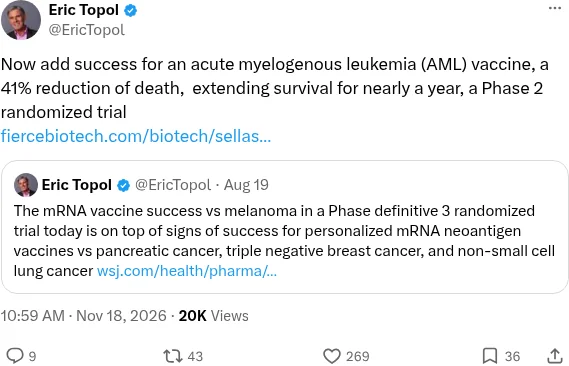
Physician and researcher Eric Topol wrote on X on 18 November 2026 that the vaccine extended survival in AML by nearly a year. He described REGAL as a randomised phase 2 study. Treatment was indeed assigned at random, but he got the trial phase wrong. [1]
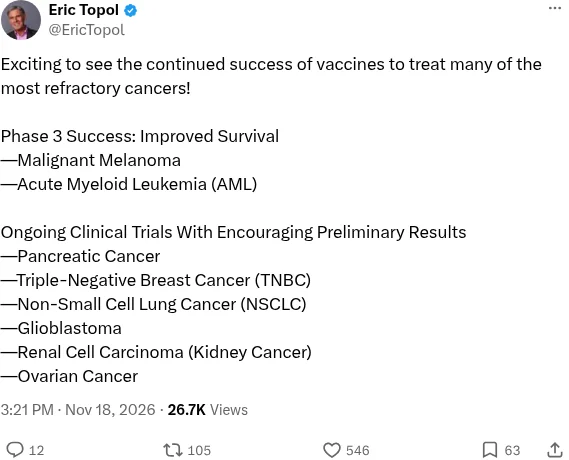
Later that day, Topol mentioned the longer survival in AML in a roundup of phase 3 results. In that post, he correctly identified the trial phase. [2]
The ClinicalTrials.gov registry lists REGAL as a phase 3 study. The researchers specified their primary outcome in advance. They measured how long participants lived from randomisation, regardless of the eventual cause of death. [3]
The study enrolled people whose leukaemia was in remission for the second or a subsequent time and for whom a donor stem cell transplant was not an option. They received either the vaccine or the treatment their doctor considered the best available option for them. [3][4]
Median survival is the point at which an estimated half of a group is still alive. According to SELLAS, it was 24.0 months in the vaccine group and 14.7 months in the comparison group, a difference of 9.3 months. That does not mean that every participant who received the vaccine lived that much longer. [4]
SELLAS also reported a 41% lower relative risk of death in the vaccine group. This measure compares the risk of dying at any given time among participants who are still alive at that point. The ratio between those risks, known as the hazard ratio, was 0.59. The 41% figure therefore does not tell us how many deaths occurred in each group. [4]
The survival figures come from an initial announcement by the sponsor. Fierce Biotech’s report was also based on that announcement. At the time of this fact-check, the trial registry did not yet contain results that would allow the figures to be independently recalculated. [3][4][5]
Sign in to give this article a thumbs up or down.
From the discussion
Private test discussion. Comments are readers’ views and are not yet automatically fact-checked. Editing is available for 60 seconds after posting.
Sign in with a confirmed reader account and choose a username to read comments and participate.
Sorting applies to top-level comments; replies remain oldest first. New comments and likes can change the order. Refresh for the current ranking.
Loading comments…