More Dutch municipalities sort waste after collection as separate PMD collection falls
Nearly 60% of Dutch municipalities used post-collection sorting of residual waste in 2025, up from about a quarter two years earlier. Separate collection of plastic, metal packaging and drinks cartons also declined, Statistics Netherlands says.
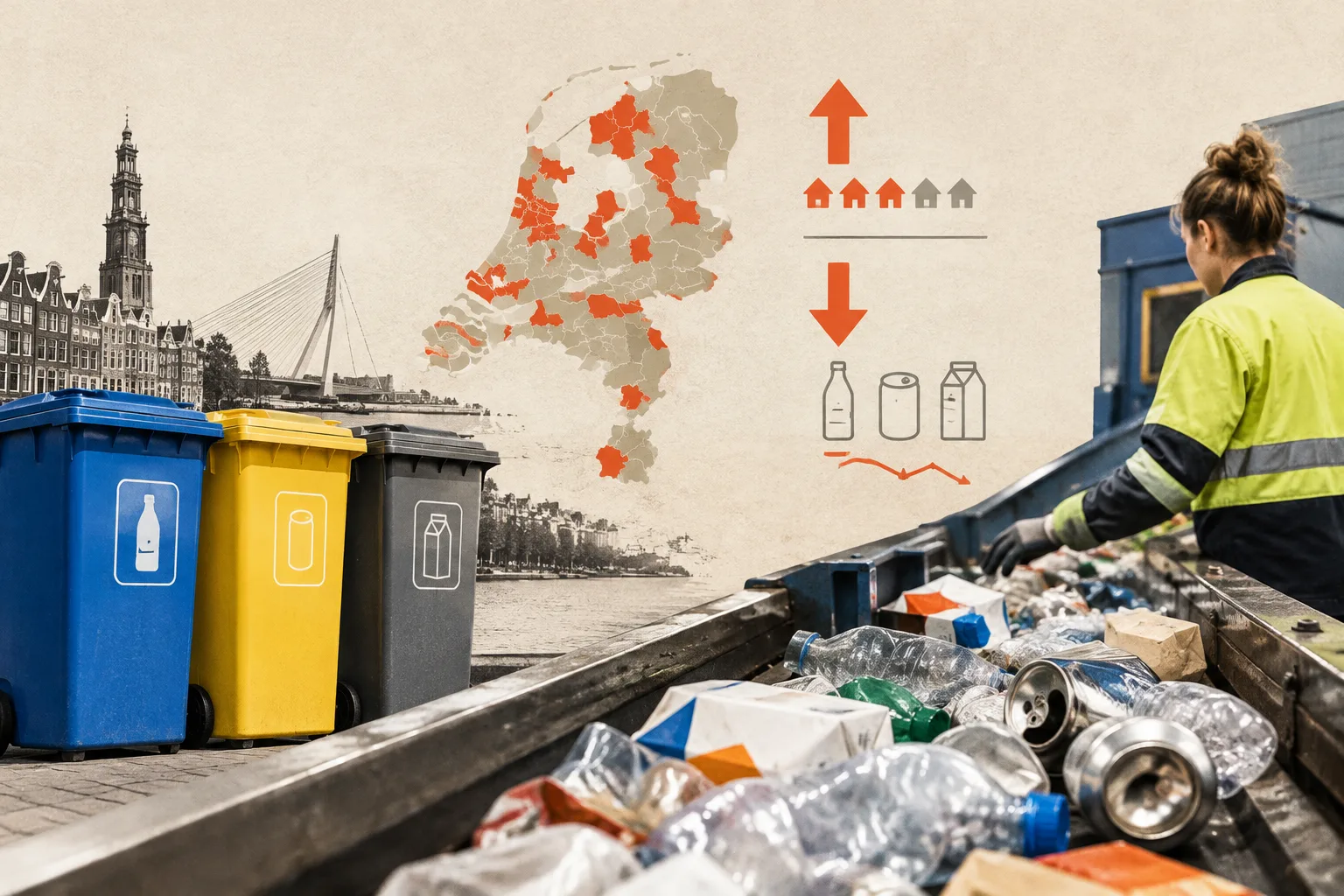
Dutch municipalities are increasingly sorting plastic, metal packaging and drinks cartons from residual waste after collection, while separate collection of those materials is declining, according to new figures from Statistics Netherlands (CBS).
In 2025, 195 municipalities used some form of post-collection sorting, up from about a quarter of municipalities in 2023 to nearly 60 per cent. The change can make waste collection easier for residents, CBS says, and is often used in larger cities where households may have little space for multiple bins.
The share of residual waste sent for sorting varies widely. Rotterdam had the highest proportion, at 73.5 per cent, followed by Vlaardingen at 71.3 per cent and The Hague at 69.7 per cent. In 12 municipalities, more than half of residual waste was sorted after collection. In some places the system operates only in selected neighbourhoods.
At the same time, the number of municipalities that do not collect plastic, metal packaging and drinks cartons (PMD) separately rose from 45 in 2023 to 53 in 2025. The amount of PMD collected nationwide fell by 3 per cent from 2023, to 367,000 tonnes, or an average of 20.3kg per resident.
CBS reported that households produced 8.02 million tonnes of waste in 2025, equivalent to 444kg per person. Residual waste averaged 176.1kg per person, slightly below the 178.6kg recorded in 2024 and the lowest level since the series began in 1993. It accounted for almost 40 per cent of household waste.
Post-collection sorting is one approach to recovering reusable materials; the alternative is for residents to separate waste at home. CBS says municipalities may choose sorting after collection for reasons including cost and concerns that residents do not always sort waste correctly. The figures show the collection methods changing, but do not establish how much material is ultimately recycled.
Sign in to give this article a thumbs up or down.
From the discussion
Private test discussion. Comments are readers’ views and are not yet automatically fact-checked. Editing is available for 60 seconds after posting.
Sign in with a confirmed reader account and choose a username to read comments and participate.
Sorting applies to top-level comments; replies remain oldest first. New comments and likes can change the order. Refresh for the current ranking.
Loading comments…